Training Funeral Directors in Cognitive-Sensitive Story Interviews
The Training Gap Most Funeral Homes Do Not Acknowledge
A metasynthesis of professionals reporting insufficient guidance for dementia grief documents a consistent finding across care settings: grief workers, including funeral professionals, feel unequipped to handle the specific shape of dementia loss. The grief is ambiguous. The storyteller is often gone before the death. The caregivers being interviewed are themselves grieving.
Standard funeral director training covers logistics, embalming, compliance, and general grief support. It does not cover how to interview a late-stage caregiver who has not had a two-way conversation with the decedent in three years. It does not cover how to sequence prompts for a spouse who is dissociating from anticipatory grief. It does not cover how to surface contradictions between caregiver accounts without destabilizing a family's fragile consensus. UK standards recommend 30 hours of grief training as a baseline for professionals handling complex bereavement — most US funeral directors have a fraction of that, and almost none specific to cognitive-stage work.
Credentials exist but are underutilized. The Certified Aftercare Specialist (CAS) credential fulfills NFDA Pursuit of Excellence criteria, and the Alzheimer's Association recognizes essentiALZ and CARES as evidence-based programs. State funeral director associations offer dementia-specific CE — the Ohio Funeral Directors Association's Dementia and Humanity seminar is one example. Adoption is low. Funeral homes serving memory-care populations need to treat cognitive-sensitive interviewing as a core operational skill, not optional CE.
The skill gap is not a mystery to the directors themselves. Survey any funeral director who has conducted dementia memorial intake and they will describe specific moments they handled poorly: a spouse who dissociated when asked about "happy memories," an adult child who burst into tears at what seemed like a routine question, a caregiver who disclosed a trauma during what was supposed to be a biographical interview. These directors know the existing training missed something. What they need is a structured curriculum that targets the specific moments — the fumble points — that generic grief counseling CE does not address.
Training as Tapestry Apprenticeship
StoryTapestry's cognitive-sensitive interview training is structured as a four-module apprenticeship that maps to the tapestry metaphor: gathering threads, recognizing weave patterns, handling knots, and finishing without over-smoothing. Each module runs 8-10 hours and combines didactic content with supervised practice on recorded sample interviews.
Module one — gathering threads — covers fragment-sensitive prompting. Trainees learn to match prompt style to informant type: family members get autobiographical prompts, professional caregivers get behavioral prompts, community members get episodic prompts. The module draws on the Cleveland Clinic's R.E.D.E. to Communicate model, which teaches relationship-centered communication applicable across clinical settings. Trainees practice opening questions that do not assume coherence ("tell me about a Tuesday with Margaret" rather than "what was Margaret like").
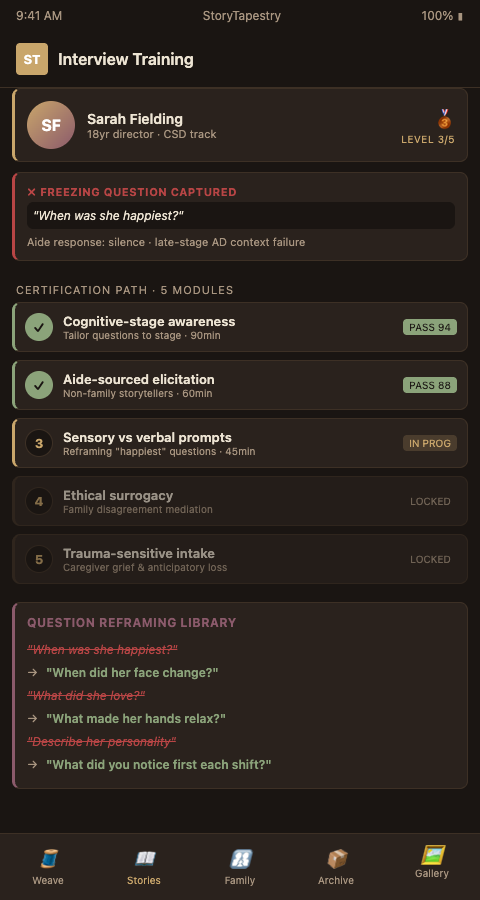
Module two — recognizing weave patterns — teaches trainees to identify where fragments converge into narrative arcs and where they resist convergence. Longitudinal sequenced learning for empathy development informs the pedagogy: trainees review their own recorded interviews weekly, annotate where they missed fragment-threading opportunities, and revise technique. Empathy, like threading, is trained through iteration, not lecture.
Module three — handling knots — is where cognitive-sensitive interviewing distinguishes itself from generic grief counseling. Knots are contradictions, trauma disclosures, caregiver collapse, and family conflict that surface during interviews. The module teaches de-escalation, referral criteria (when to pause the interview and refer to clinical grief support), and contradiction-documentation protocols. Trainees role-play scenarios drawn from real StoryTapestry case files (de-identified), including the moment when a caregiver discloses that the decedent hit her during a late-stage agitation episode. What do you do with that fragment? The answer is not simple.
Module four — finishing without over-smoothing — covers when to stop gathering, how to write up fragments without losing informant voice, and how to hand the raw material to the family for the reconciliation phase. This module partners with predictive story mapping tooling so trainees learn to document gaps as forward-looking work items rather than failures. The tapestry, they learn, is never "done" — it is handed off at a defensible waypoint.
Certification happens through demonstration. Trainees must complete 10 supervised real interviews, produce written fragment logs that pass quality review, and pass a scenario-based oral exam. This is closer to a clinical practicum than a continuing-education webinar, which is deliberate: the skills being trained are clinical in weight, and the evaluation method has to match.
Training builds on trust building families as the relational foundation. A director who cannot build trust cannot conduct cognitive-sensitive interviews, regardless of technique mastery. The training makes this explicit in module one and returns to it in module three. Directors serving international families encounter parallel skills where linguistic and cultural variation add further interview-sensitivity requirements.
Between modules, trainees complete supervised practicum interviews with real families who have consented to training use. This is the single largest pedagogical difference from typical bereavement CE. A trainee might interview a family whose loved one is six months into early-stage Alzheimer's, conduct three 45-minute sessions over six weeks, and produce a fragment log that a senior supervisor critiques alongside the recordings. The trainee then debriefs with the supervisor on specific moments: where the prompt misfired, where the silence was productive, where the family steered the conversation and whether the trainee followed appropriately. This kind of supervised skill acquisition is how clinical professions train and is demonstrably more effective than didactic learning for communication-heavy work.
Advanced Training Design Choices
Use real recorded interviews as training material, with consent. The single biggest upgrade from generic bereavement CE to cognitive-sensitive training is moving from hypothetical scenarios to actual recordings. Trainees who watch an interview where a director recovers from a fumbled prompt learn recovery technique in a way no textbook can teach. Building a case library requires consent infrastructure — families sign release forms specifically for training use, with de-identification — but the investment pays off across cohorts.
Pair trainees with grief-literate mentors, not just senior directors. Seniority in funeral work does not equal competence in dementia grief. A director with 25 years handling traditional services may have habits that hurt in memory-care interviews ("she was such a wonderful mother" prompts that flatten complexity). Pair trainees with mentors selected for demonstrated cognitive-sensitivity skill, even if those mentors are junior in tenure. This runs against funeral-home hierarchy norms but improves outcomes.
Require cross-specialty rotations. Have trainees shadow memory-care social workers, hospice chaplains, and MCI-clinic intake nurses for 8-12 hours each. The goal is not to make funeral directors into clinicians but to give them vocabulary and referential contexts their work will intersect with. A trainee who has watched a memory-care social worker conduct a family conference will conduct fragment interviews more capably.
Build reflective supervision into ongoing practice. Training does not end at certification. Monthly reflective-supervision sessions — small-group case review with a grief-literate facilitator — protect against skill decay and vicarious trauma. The same structure is used in clinical social work for a reason: emotionally heavy interviewing work erodes the worker without it. Funeral homes that skip this step lose trained staff to burnout within 24 months.
Align compensation with certification. Directors who complete the four-module apprenticeship, pass certification, and maintain reflective-supervision attendance deserve salary recognition. A home that treats cognitive-sensitive interviewing as "extra duties" without compensation signals that the skill is discretionary. Signal correctly, and trained directors stay.
Connect training outcomes to predictive story mapping program quality. Trained directors produce better pre-decline interviews, which produce richer tapestries, which produce better memorial outcomes on the measurement scorecard. Measuring this chain — training completion to memorial quality — builds the ROI case that justifies continued training investment and memory-care partnership pricing premiums.
Develop partner-facing training as a differentiator. Memory-care facility staff, hospice volunteers, and adult day program coordinators frequently interact with families approaching memorial work. Offering a condensed 4-hour cognitive-sensitive interviewing module to partner organizations does two things: it extends the funeral home's trained network, and it positions the home as a clinical-grade educator rather than a vendor. Facilities that send their staff to your training become referral partners in a qualitatively different way — they have watched you teach, they have seen the curriculum, they trust your clinical judgment. Training becomes business development without feeling like marketing. Firms that also serve transnational families should extend the curriculum with cross-cultural grief training modules, because the same pedagogical spine adapts well to linguistic and cultural variation across diaspora intake.
Record and analyze interview artifacts for training signal. Every completed interview a trained director conducts produces reviewable material. A quarterly review where senior trainers audit a random sample of recent interviews — checking prompt sequencing, fragment-threading opportunities, handling of disclosed difficulties — generates continuous calibration data. Directors who drift from the curriculum get targeted refreshers. The organization as a whole sees where curriculum revisions are needed based on what keeps going wrong in practice rather than what sounded good in theory.
Upgrade Your Interview Capability
Cognitive-sensitive interviewing is not a webinar away. StoryTapestry's four-module training program is available as cohort-based enrollment for funeral homes serving memory-care populations. Cohorts run quarterly with 12-director capacity. Request a curriculum brief and sample recorded-interview excerpt so you can see the pedagogy in action and decide whether this is the right fit for your team before committing to enrollment. The brief documents the full four-module sequence — cognitive-stage theory, prompt-library practice, contradictory-memory reconciliation, and partner-facing interview extensions — along with the peer-review structure, quarterly audit expectations, and certification assessment rubric. Cohort onboarding begins with a one-hour alignment call, followed by a 12-week curriculum delivered in weekly two-hour sessions with between-session fieldwork on active memory-care cases.
Firms that enroll two or more directors receive a supervision overlay where a senior StoryTapestry trainer reviews three of each director's recorded interviews and delivers individualized coaching notes. Enrollment closes eight weeks before each cohort start to allow time for pre-reading and partner outreach. Directors who complete certification receive a portfolio artifact, peer-network access, and eligibility for the partner-facing trainer track. Curriculum briefs ship within two business days of request, and the sample excerpt arrives under a brief clinical-use agreement.