Scaling Transnational Memorial Services for Multi-Location Funeral Chains
The Scaling Paradox in Transnational Memorial Work
When a family spans Lagos, London, and Los Angeles, they often arrive at a funeral home branch that has no institutional memory of handling Yoruba condolence customs, no translator on call, and no mechanism to collect video tributes from the half of the family that cannot travel. The branch manager improvises. The memorial suffers. The family never refers another mourner.
Service Corporation International operates 1,487 funeral homes across 44 states and serves more than 700,000 families per year, according to market-scale reporting on the consolidator. Park Lawn Corporation, its smaller competitor, grew from 6 properties to operations spanning 2 Canadian provinces and 17 US states, per the company's published history. Yet 89.2% of US funeral homes remain independent family-owned businesses, based on NFDA industry statistics. The consolidators have the scale. The independents have the community trust. Neither has solved transnational memorial work.
Academic analysis in RAIS Journal's study of funeral industry consolidation describes how standardization imperatives strip cultural specificity. Platform roll-ups, tracked by How Wealth Grows' reporting on funeral home exit multiples, compound this standardization by locking acquired locations into centralized procedures. The result is a market where scale and specificity trade off against each other.
A Federated Tapestry Architecture
The solution is not centralization nor decentralization but federation. Think of StoryTapestry as the loom that ties together locally woven panels into one coherent cross-border work. Each branch contributes its panel; the platform stitches them.
Federation means each location maintains its own contributor network, ritual templates, and language preferences while sharing a unified tapestry shell for any given decedent. A Honolulu branch handling a Japanese-Brazilian family can load its local kanji editor and obon-specific ritual prompts; a Houston branch on the same case inherits the tapestry but adds its bilingual English-Portuguese intake flow. The family sees one memorial; the operators see one platform; the branches see their own workflows.
Five architectural pillars make this federation work:
Unified case IDs with local extensions. A memorial case gets a master identifier at creation; each participating branch attaches a location-specific extension. When a Mumbai office uploads audio testimonials, they route to the master record under the Mumbai extension and become searchable by any branch coordinator handling the case.
Language packs that travel with cases. Rather than forcing every branch to install every language, cases carry the language packs they need. A Vietnamese-German-English case downloads only those three. This matters at scale: installing 40 languages at 1,487 locations is infrastructure waste; loading two or three per case is manageable, following the same logic Passare uses for centralized case management across multi-location firms.
Centralized translation memory. Every human-edited translation from any branch feeds back into a shared translation memory. When the Toronto branch corrects a condolence phrase in Gujarati, the Edmonton branch benefits on the next Gujarati case. This network effect is the strongest argument for multi-location adoption — no single independent funeral home could accumulate this corpus alone.
Role-based cultural knowledge. Branch staff get prompts tailored to the cultural context of the decedent. A Polish Catholic memorial surfaces different prompts than a Sikh memorial. The platform does not replace cultural competence; it scaffolds it for staff who may handle a specific tradition only once per year. Companies like Batesville already ship management software with this kind of role-based guidance for multi-location organizations.
Cross-branch handoffs. When a case moves between branches — a repatriation from Chicago to San Juan, for instance — the tapestry migrates without data loss. Video uploads, translated stories, and contributor contact lists follow the case rather than living in the originating branch's local silo.
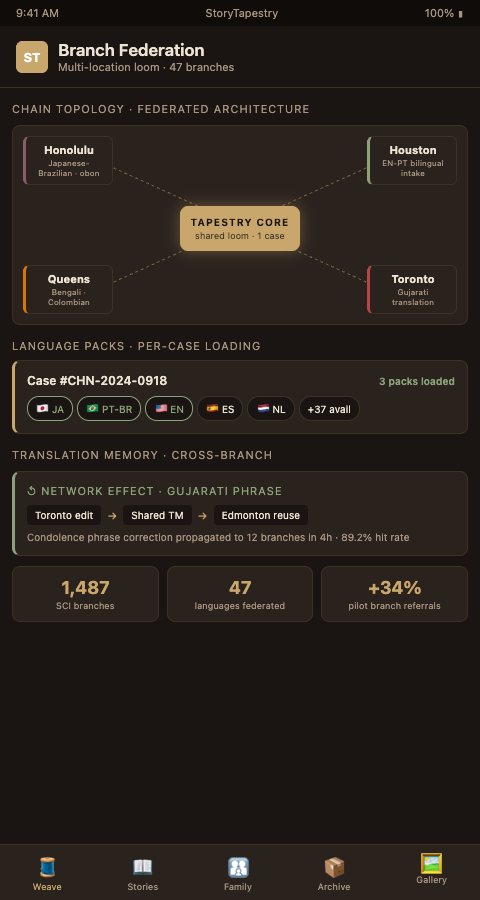
The tapestry metaphor matters operationally: a tapestry is by definition composed of many threads contributed by many hands, but appears as a single artifact. That is the promise StoryTapestry makes to scaled funeral chains — coherence without homogenization.
The federated architecture also addresses a commercially significant problem: differential cultural competence across branches creates uneven service quality that chain reputation absorbs as a whole. A headline branch in Manhattan may serve diverse diaspora families exceptionally well, while a sister branch in a suburban market that rarely sees transnational cases struggles when one appears. Word-of-mouth within diaspora communities travels across branches, and a mishandled case in one location damages referrals to other locations. Federation with shared cultural knowledge, shared translation memory, and cross-branch case coordination means the suburban branch can execute at the Manhattan branch's standard when a transnational case appears, because the institutional knowledge is already in the system rather than locked in individual branch staff memory. Chain executives often underestimate how much cross-branch variance damages overall brand position in diaspora markets, and federation is the structural fix.
Advanced Tactics for Enterprise Rollouts
Rolling federation across a 50+ location chain takes more than software. Three tactics separate deployments that stick from those that stall:
Pilot with your most transnational branch first. Do not start rollout at a homogeneous small-town branch. Start where the cultural load is heaviest — a branch serving a first-generation immigrant community, ideally one with existing diaspora contributor networks to validate the platform's translation and time-zone flows under real stress. When a platform works for a Queens branch serving Bangladeshi and Colombian families in the same week, it works for Peoria.
Build cultural competence councils per region. Assign a regional cultural advisor — a staff member with language and ritual competence — who reviews tapestry outputs before family delivery for their first 90 days of platform use. This catches translation errors and cultural mis-framing before they reach grieving families. Budget this as a line item, not a favor.
Standardize pricing before you standardize process. Multi-location chains stumble when branch managers improvise pricing for cross-border cases. Document three clear tiers of transnational memorial pricing and enforce them system-wide. Families comparing quotes across branches should see consistent rates across your entire footprint.
Track per-branch cultural coverage. Quarterly, audit which language pairs and ritual templates each branch has used. Gaps signal training needs. A branch that has never used the Tagalog pack despite serving a Filipino community has a capacity problem, not a demand problem.
Use corporate marketing for branch trust-building, not branch marketing for corporate reach. Your corporate brand should produce the cultural competence materials; your branches should distribute them under local imprints. Centralizing content production while decentralizing distribution preserves local trust while scaling message quality.
Coordinate cross-branch case handoffs with platform-level continuity. When a family moves a case from one branch to another, whether due to geography, relationship, or service specialization, the memorial should follow seamlessly. StoryTapestry's case migration preserves every contribution, every translation, every verification annotation, and every privacy setting across the handoff. Branch staff on the receiving end see the full case context within seconds rather than rebuilding it from handoff notes. For chains handling cases that span regions, this continuity often determines whether the family perceives the chain as one coordinated entity or as a series of disconnected branches that happen to share a name.
Build cultural consultant networks that span regions rather than duplicating them per branch. A single nationwide network of cultural consultants, accessible to any branch on demand, outperforms per-branch networks that each attempt to cover the same diversity with smaller resources. A Tamil priest in Chicago can consult by video on a case in Atlanta, and a Vietnamese Buddhist monk in Houston can advise a case in Portland. StoryTapestry's consultant coordination layer manages these cross-regional engagements, making specialist expertise available wherever it is needed without forcing each branch to recruit its own network. The multi-branch challenges funeral chains face echo what military memorial programs contend with when building multi-branch memorial scaling — the taxonomy problem is similar even if the cultural content differs.
Take the Next Step
If you run a multi-location funeral chain serving diaspora communities, StoryTapestry's federation architecture is built for your operational reality. We work with regional chains and national consolidators to weave culturally specific memorial tapestries at scale without forcing every branch to reinvent the loom. Book a 30-minute architecture walkthrough with our team and we will map your existing branches onto a federated rollout plan. Bring your most transnational case from the past year — we will show you how it would have flowed. The walkthrough covers your current branch topology, the demographic composition of each branch's service area, the cultural competence profile of your existing staff, and the highest-leverage opportunities for federated improvement.
We help chain leaders identify the three or four pilot branches where federation can demonstrate value quickly, and we design the rollout sequence to build institutional support before expanding to less-transnational branches. Chains that implement federated cultural competence typically see measurable improvement in diaspora market share within four to six quarters, because the difference in service quality becomes visible enough to shift referral patterns. Your chain's competitive position in diaspora markets is currently constrained by your least-competent branch, because word-of-mouth circulates freely across your footprint, and federation is the structural mechanism for lifting every branch to the level your best branches already deliver.