Pricing Transnational Memorial Packages for Global Families
Why Generic Funeral Pricing Fails Transnational Families
A family in Toronto asks a funeral home for a memorial package for their father, who had family in Pakistan, the UK, and Australia. The quoted price reflects a standard Toronto service. Six weeks into the case, invoices arrive for translation services, consular document processing, and cross-border video production. The family feels blindsided. They paid the original quote in full and refuse the surcharges. Relationship damaged, branch reputation damaged, margin destroyed.
The FTC Funeral Rule requires itemized General Price Lists — a foundational consumer protection. Federal Register updates to the Funeral Industry Practices Rule document that most providers still fail to publish prices online, which compounds the transparency problem for diaspora families comparing options across borders. FTC compliance guidance gives operational detail on service packages, but none of it anticipates the transnational cost layer.
That transnational cost layer is real and substantial. Repatriation alone runs $5,000 to $20,000+ according to Memorial Industries' analysis of funeral shipping costs. Travel.State.gov guidance on death abroad details consular fees families face. Grand View Research's analysis of the global funeral and cremation market documents package tier dynamics across international contexts. And World Bank data on remittances — remittances to low- and middle-income countries reached $685 billion — shows diaspora families routinely budget for cross-border financial transfers, though memorial costs are rarely planned for in advance.
A Three-Tier Transnational Memorial Pricing Model
The tapestry metaphor helps pricing clarity too: a tapestry's visible cost reflects the materials, but the invisible cost is the weaver's time and the specialty threads sourced from afar. StoryTapestry recommends a three-tier pricing model that names these invisible costs directly, making them comparable and budget-ready for diaspora families.
Tier 1: Base Tapestry (US$2,500-$4,500). Everything a single-country memorial provides: intake, obituary, local ritual coordination, and a shared tapestry page with text contributions from invited family. Supports up to two languages at Tier 2 translation quality (asynchronous, machine + light human review). Includes 90 days of active coordination and permanent platform hosting. This tier works for immediate diaspora cases where most contribution will come from one country.
Tier 2: Global Tapestry (US$6,500-$11,000). Adds multilingual support for up to four languages at Tier 2-3 translation quality (includes human translator hours for high-value contributions). Adds video contribution ingestion, geolocation enrichment, and a virtual gathering module with Tier 3 human-interpreter fallback for one gathering up to 90 minutes. Includes 120 days of active coordination and a dedicated coordinator-success manager. This is the tier most stretched-family cases fall into.
Tier 3: Heritage Tapestry (US$14,000-$25,000+). The premium tier for memorials spanning six or more countries or requiring repatriation coordination. Adds unlimited language packs, dedicated cultural advisors for each major cultural context in the family, consular documentation support, and up to three virtual gatherings with full human interpretation. Includes 180 days of active coordination and oral history archiving for future generations. Aligns with the complexity level documented in transnational service scaling cases.
Add-ons beyond tiers. Repatriation coordination (time-and-materials, typically $2,500-$8,000). Additional virtual gathering with interpreter ($800-$1,400). Custom ritual documentation with a cultural advisor ($400-$900 per ritual). Extended oral history interviews ($180-$260 per hour). These add-ons are transparent line items, not surprises.
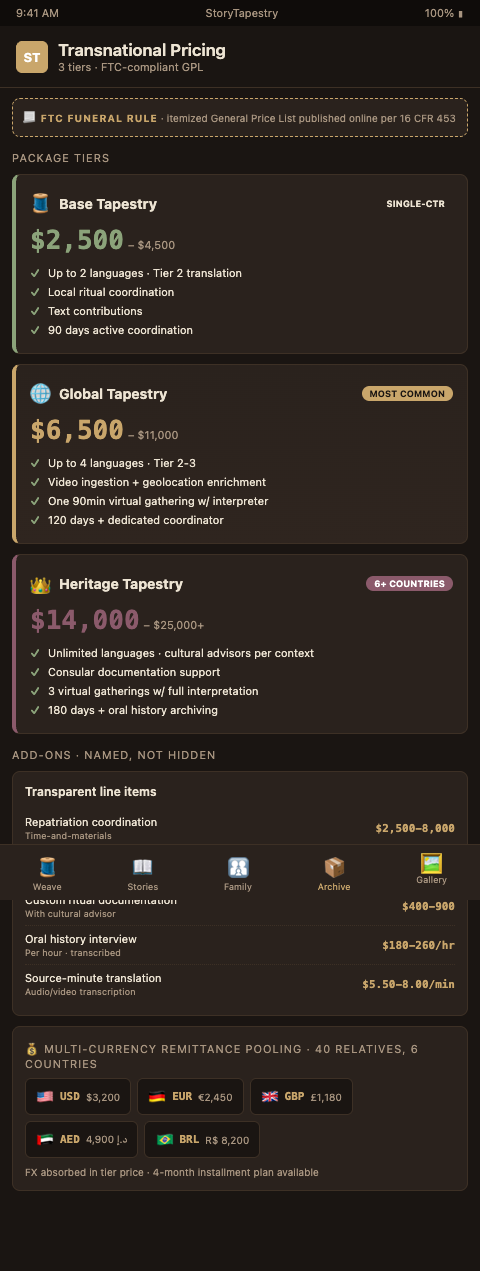
The tapestry framing helps families understand the pricing: more threads, more languages, and more weavers add cost, and the cost is named before the weave begins. This mirrors package transparency in cultural association partnerships where pricing structures must be clear to partner organizations too. The same package-economics logic drives veteran memorial revenue structures, though the add-on set differs.
The tiered pricing model also addresses a financial reality that generic funeral packages miss: diaspora families often pool contributions from multiple households to fund the memorial, and the pooled structure affects how pricing should be presented. A Nigerian family funding a matriarch's memorial may collect contributions from 20 to 40 relatives across six countries, each contributing $50 to $500 depending on their means. A pricing structure that demands a single upfront payment from one household does not match this reality; a pricing structure that accepts incoming transfers from multiple households and credits them toward the total fits diaspora economics far better. StoryTapestry's billing infrastructure supports multi-party contribution collection, running conversion to the funeral home's home currency automatically and applying all incoming transfers to the case balance.
Families report that this pooling support is itself a differentiator: it respects the cultural norm of collective responsibility rather than forcing individual financial burden onto one relative.
Advanced Tactics for Transnational Memorial Pricing
Six pricing tactics separate sustainable transnational memorial programs from those that lose margin on every case:
Publish the tiered price list online. FTC Funeral Rule compliance is a floor, not a ceiling. Publish Tier 1, 2, and 3 ranges prominently. Diaspora families comparison-shop before they contact you; absence of online pricing costs referrals. The 2022 Federal Register finding that most providers lack online pricing is an opportunity for those who publish first.
Invoice translation by source minutes, not output words. Word-count billing penalizes concise translators. Source-minute billing aligns your incentives with translator incentives and family expectations. Typical pricing: $2.80 to $4.50 per source minute for text, $5.50 to $8.00 per source minute for audio or video transcription.
Offer payment plans longer than single-country packages. Diaspora families often pool contributions from multiple households. A four- or six-month payment plan with small processing fee respects the pooled-funding reality. Single-pay upfront is the default in North American funeral practice but fits diaspora economics poorly.
Quote in multiple currencies for contributor contributions. If family members in the UK, UAE, and Brazil are contributing, let each pay in their local currency. Absorb the FX spread into the package price rather than billing spreads as line items. This reduces friction and shows cultural awareness.
Build a contingency line into Tier 2 and 3. Transnational cases produce surprises — a document delay, a last-minute interpreter, a shipping complication. Build 8-12% contingency into Tier 2 and 3 packages and refund unused contingency to the family within 30 days of case close. This demonstrates integrity and prevents nickel-and-dime invoicing that damages trust.
Bundle platform fees with coordination, not as SaaS. Diaspora families should see one memorial invoice, not a memorial invoice plus a platform subscription. StoryTapestry's licensing to partner funeral homes is structured to support this — platform costs are embedded in the tier rather than itemized to families. Families pay for a service, not for software they did not choose.
Discount Tier 2/3 for partner-referred cases. If a cultural association referred the family, discount 10-15% and include the discount as a visible line item. This rewards partner organizations and makes the referral relationship transparent to the family.
Offer explicit financial hardship accommodations for refugee and recently arrived families. Some diaspora families carry legitimate financial constraints that standard pricing does not address. A Syrian refugee family that arrived in the past two years, an Afghan evacuee family still establishing themselves, or a Venezuelan family navigating TPS uncertainty may need memorial services but lack the disposable resources typical pricing assumes. A published hardship accommodation policy, with clear eligibility criteria and transparent reduced pricing, signals cultural awareness and builds long-term community goodwill. Funeral homes that discount thoughtfully during a family's most difficult period earn lifetime loyalty that no marketing can replicate.
Plan for extended payment windows tied to insurance or remittance timing. Some diaspora families receive funds from life insurance, estate settlement, or organized community fundraising that takes months to process. A three- or six-month payment window with no-interest installments respects these timelines and prevents cases where families avoid full service because they cannot pay upfront. StoryTapestry's billing infrastructure supports installment plans natively, including partial contributions from multiple relatives over time rather than single-household upfront payment.
Take the Next Step
StoryTapestry works with diaspora funeral services to implement transparent transnational memorial pricing that protects margin while earning family trust. If your current pricing is either too generic (losing margin on every transnational case) or too confusing (losing referrals to competitors with cleaner pricing), we will run a pricing audit on your last 12 months of cross-border cases and propose a tiered structure fitted to your market. The audit takes two weeks and costs less than the margin you recover on three transnational cases. Book a pricing consultation with our partnerships team to begin. The audit reviews your last 12 months of transnational cases, calculates actual delivered costs versus quoted prices, identifies margin leakage patterns, and proposes tier structures fitted to your specific caseload. We also cover payment plan design, multi-currency acceptance, partner-referral discount logic, and hardship accommodation policies.
Funeral homes that implement transparent tiered pricing typically see two outcomes within the first two quarters: recovery of margin that was previously leaking through unquoted add-ons, and increased referrals from diaspora families who appreciate pricing clarity. The families who compare your quotes against competitors will recognize the tier structure as more professional than generic funeral pricing, and the cultural communities you serve will notice that your pricing respects their economic reality rather than assuming single-household Western defaults. Your pricing is a cultural signal as much as a financial one, and getting it right is part of how your funeral home earns its position in diaspora communities.