Building Partnerships with Cultural Associations for Memorial Referrals
Why Most Funeral Home Partnerships With Cultural Associations Fail
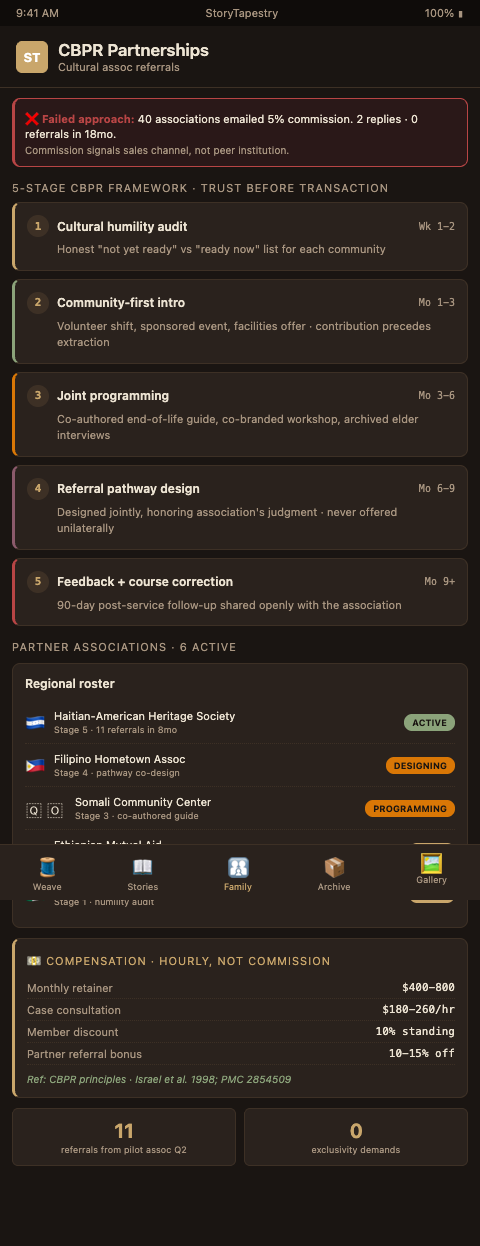
A funeral chain sends a marketing email blast to the directors of 40 cultural associations in its metro area offering a 5% referral commission. Two replies. Zero referrals over the next 18 months. The chain concludes cultural associations are ineffective partners. The cultural associations conclude the chain sees them as a sales channel. Both are right about the observed behavior; both are wrong about the underlying potential.
PMC research on hospices' perspectives on minority access found hospices with genuine church partnerships saw measurable increases in minority patient participation, where transactional outreach produced nothing. Hospice News reporting on cultural training and community outreach documents the same pattern: church and minority community partnerships drive referrals when they are relationships, not contracts. NPHI research on diversity initiatives at hospices emphasizes ambassador programs and cultural liaisons as the core mechanisms for referral trust. The National Coalition for Hospice's caring-with-respect guidance provides national-level grounding.
The underlying framework is community-based participatory research, a rigorous methodology for equitable community engagement. Wikipedia's overview of CBPR lays out the approach. PMC research on CBPR principles emphasizes community identity, strengths, and equitable partnership as non-negotiables. A PMC conceptual model of CBPR validates the partnership design principles empirically.
A Partnership Framework That Builds Trust Before Referrals
The tapestry metaphor applies directly to partnerships: cultural associations hold the cultural threads a diaspora memorial needs, and partnerships succeed when both parties weave together rather than one party buying threads from the other. StoryTapestry supports funeral service partners in building relationships with cultural associations through a five-stage framework that front-loads trust-building.
Stage 1: Cultural humility audit. Before approaching any cultural association, the funeral service audits its own capacity to serve that community. Do staff speak the language? Do facilities accommodate the community's ritual requirements? Is pricing transparent? An association sending referrals to a funeral home that cannot serve them damages the association's reputation more than the funeral home's. This audit produces an honest "not yet ready" list alongside the "ready now" list.
Stage 2: Community-first introduction. The first touchpoint with an association is not a referral ask. It is an offer to contribute: a volunteer shift at the association's cultural festival, a sponsored community education event on diaspora engagement metrics specific to the community, or a facilities offer for a community meeting. Contribution precedes extraction.
Stage 3: Joint programming. After 3-6 months of contribution, the partnership moves to co-created programming. A workshop on end-of-life planning designed jointly with association leadership. A written guide to navigating bereavement across borders, co-authored and co-branded. A series of recorded interviews with community elders about traditional practices, archived for the association's future use. The joint programming produces artifacts the association uses independently.
Stage 4: Referral pathway design. Only after joint programming does referral discussion begin. The pathway is designed jointly, not offered. What does a referral look like from the association's perspective? How is the family's privacy protected? What happens if the family prefers a different provider? The pathway honors the association's judgment, not the funeral service's quotas. This is structurally similar to referral pipeline building in memory care contexts — the trust-before-transaction logic transfers.
Stage 5: Feedback and course correction. Every referred family is followed up with the association 90 days post-service. What did we get right? What did we miss? This feedback is shared openly with the association and often results in curriculum changes to the training described in this niche's polyvocal diaspora memorials work.
The tapestry reveals itself over months, not meetings. A funeral service that expects referrals in quarter one has misread the framework; one that invests through quarter four sees stable, deep referral relationships by year two. This is why commission-only outreach fails: the incentive horizon is misaligned with the trust-building timeline. StoryTapestry provides the platform to make joint programming outputs tangible — co-authored guides, archived interviews, community education events — giving partners something to point to.
The partnership framework also recognizes a subtle but crucial distinction: cultural associations are not service providers to be contracted but community institutions to be collaborated with. A funeral home that treats a Filipino hometown association as a referral channel for a flat commission signals a transactional relationship that the association's leadership will recognize and resist. A funeral home that treats the same association as a peer institution, with shared interests in community well-being and long-term cultural preservation, signals a partnership relationship that invites reciprocity. This framing difference is often invisible to funeral directors who come from commercial backgrounds but deeply legible to association leaders who have navigated dozens of extractive outreach attempts. The relationships that last are built on the peer-institution frame; the ones that collapse within a year were built on the service-provider frame, even when both started with similar specific agreements.
Advanced Tactics for Cultural Association Partnerships
Six tactics separate partnerships that produce durable referral pipelines from those that stall after a pilot quarter:
Compensate, do not commission. Pay association staff hourly rates for cultural advisor hours they provide. Commission-on-referral creates conflicts of interest and feels extractive; hourly compensation for expertise feels like a professional relationship. A typical retainer: $400-$800 monthly for 5-10 advisory hours, plus $180-$260 per hour for case-specific consultation.
Co-brand community education. Jointly authored end-of-life planning workshops draw association members in a way the funeral service cannot do alone. The branding says both names; the content reflects both perspectives. Run these quarterly, not annually, to maintain visibility.
Hire from the community. The single strongest signal of partnership seriousness is hiring staff from the community. A funeral service serving a Somali community that has no Somali-speaking staff has a capacity gap and a credibility gap. Association partners notice and advise other associations.
Share attendance data from community events. When you host a joint event, share attendance data and feedback with the association. This treats the association as a program partner, not an audience source. Associations that see the data reciprocate with more engaged audiences next time.
Offer association members a dignity discount. A standing 10% discount for members of partner associations, visible in published materials, communicates respect for the community and makes the partnership tangible for members. The discount sits inside the pricing structure; it is not a promotion.
Attend the funerals you would not otherwise attend. Cultural association leaders notice which funeral services show up at community funerals even when they are not the serving provider. This is small-scale relational capital that compounds across the year. Rotate staff attendance so this is a team practice, not a founder's quirk.
Invest in long-tail community infrastructure rather than one-off events. A single-event sponsorship of a community festival produces short-term visibility but fades quickly from memory. A multi-year commitment to a community scholarship fund, a sustained contribution to a community health program, or ongoing sponsorship of a cultural heritage preservation effort produces durable positioning that compounds over time. Association leaders remember which funeral homes stayed with them through multiple years of programming and which showed up once for a photo opportunity. The funeral home with sustained community infrastructure investment becomes the default referral destination within that community.
Coordinate with other partner associations rather than demanding exclusivity. Some funeral homes make the mistake of asking associations for exclusive referral relationships, as if community institutions could or should funnel all members to one provider. This request misunderstands how community organizations function. Associations serve their members' interests, which means recommending the provider that fits each specific family's needs, which varies. A funeral home that accepts non-exclusive partnership and competes on genuine service quality wins over time against homes that demand exclusivity and then cannot deliver universally superior service.
Take the Next Step
StoryTapestry helps funeral services build cultural association partnerships through a structured program that respects the community-based participatory research framework. We connect you with a regional cultural partnership coach — typically a staff member from a peer funeral service with demonstrated success in one community context — for six months of monthly coaching. The program costs less than hiring a single marketing coordinator and produces referral pipelines that outlast any marketing campaign. Schedule an intake call with our partnerships team to evaluate fit. During the intake we map your current community touchpoints, assess your cultural humility audit readiness, identify two or three priority communities for initial partnership investment, and design a 12-month engagement plan with specific contribution, programming, and referral-pathway milestones.
The coaching model pairs you with someone who has navigated the exact community partnership you are entering, so the learning is direct peer experience rather than abstract advice. Funeral homes that complete the six-month program consistently report that their diaspora referral patterns shift in ways marketing campaigns never produced, because community trust operates on fundamentally different mechanisms than paid awareness. Your next decade of diaspora market position will be determined largely by the partnerships you build with cultural associations now, and the cost of building them properly is far lower than the cost of rebuilding relationships that fail because they were built transactionally. Contact our partnerships team to begin the conversation.