Revenue Opportunities in Veteran Memorial Service Partnerships
The Underpriced Veteran Memorial Service Line
A funeral home in a Southeast city serves roughly 520 families annually. Of those, 180 are veterans—a 35% veteran share typical in VA-dense regions. The home charges a flat $275 "military honors coordination" fee across all 180 cases, generating $49,500 in line-item revenue. The veteran memorial production work—comrade outreach, unit roster research, deployment mapping, photo archive integration—falls into unpriced coordinator hours absorbed into general overhead. When the owner looked at veteran service economics last year, he found his veteran memorials were running 40% below total-service margin despite requiring 65% more coordinator labor than civilian memorials.
This pricing pattern is common across the industry. IBISWorld's US funeral home market size report pegs the 2026 market at $23.9B, with veterans representing a substantial share of end-of-life services. NFDA industry statistics document average pricing benchmarks that rarely reflect veteran-specific service complexity. The VA burial allowance structure and 38 CFR burial benefits regulations create a revenue flow through VA reimbursements that many funeral homes don't fully capture.
The structural issue is that veteran memorial production is more labor-intensive than civilian memorial production, yet most funeral homes price it as lower-effort because the VSO partnerships and VA reimbursements feel like they should reduce, not increase, the service's complexity. The inverse is true. PMC research on veterans and hospice documents that veteran end-of-life services carry additional layers (service-connected disability context, unit connection maintenance, VA benefit coordination) that drive real coordinator labor.
Without a structured revenue architecture, funeral homes either price veteran services at break-even to stay competitive or avoid the complexity by delivering minimal-viable memorial products that leave families underserved. Neither outcome is sustainable.
The StoryTapestry Revenue Architecture for Veteran Memorials
StoryTapestry enables funeral homes to package veteran memorial production as a differentiated service tier with clear scope, differentiated pricing, and partner revenue flows. The architecture weaves three revenue streams into one coherent service line.
Tier One: Packaged Veteran Memorial Tapestry. Rather than flat-rate honors coordination, funeral homes offer a Veteran Memorial Tapestry package priced at $1,200-$2,400 depending on complexity (career length, branch count, contributor pool size). The package includes structured intake, comrade outreach workflow, deployment mapping, photo/video integration, collaborative memorial canvas, and post-service engagement reporting. Families understand they're buying a memorial production service, not just a coordination fee. The package pricing aligns with the veteran program scaling framework where production cost scales with service complexity.
Tier Two: VSO and VA Benefit Coordination. The American Legion burial benefits resource and VFW authorized provider partnership structure establish the VSO partnership infrastructure funeral homes can activate. VA burial allowance per 38 CFR provides direct reimbursement for specific services. Funeral homes with structured VA benefit coordination processes capture 80-95% of eligible reimbursement; homes without structure capture 40-60%. The gap is pure missed revenue. StoryTapestry's coordinator workflow includes a VA benefit eligibility checklist and coordination timer that ensures the full reimbursement envelope is captured on each case.
Tier Three: Partnership Referral Revenue. Structured partnerships with transition program partnerships, VSOs, and veteran-focused legal/financial services create referral revenue flows. A funeral home becomes the local-market hub for veteran end-of-life services, with partner revenue from attorneys handling VA claims, financial advisors managing survivor benefits, and veteran service organizations coordinating honors. Typical partnership referral revenue runs 3-8% of total veteran service line, compounding the package and benefit coordination streams.
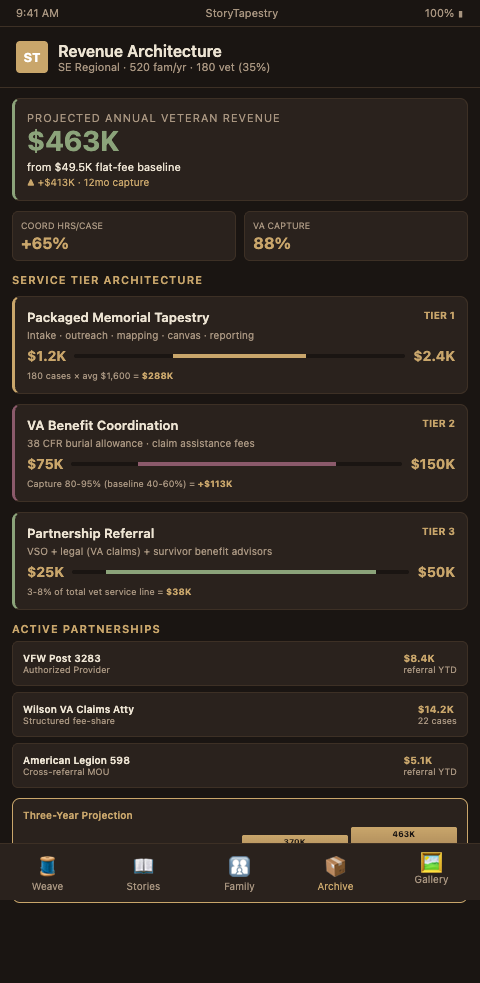
Portfolio economics across the caseload. For the 520-family Southeast funeral home with 180 veteran cases, the revenue impact of structured architecture typically breaks down: average package revenue of $1,600 times 180 cases equals $288,000 (versus $49,500 at the flat-fee pattern). VA benefit coordination capture improvement of $75,000-$150,000. Partnership referral revenue of $25,000-$50,000. The veteran service line moves from break-even to meaningful margin contributor within 12 months of deployment.
Mirroring adjacent memorial revenue patterns. The memorial partnership revenue framework in bereavement programs provides a cross-domain template. Both share the structural insight that specialized memorial services deserve differentiated pricing reflecting their labor and outcome profiles.
Service differentiation in competitive markets. In metros with multiple funeral homes competing for veteran families, a structured veteran memorial service line becomes a competitive differentiator. Families comparing funeral homes can see a clear service-level difference between a firm offering a packaged Veteran Memorial Tapestry and a competitor offering generic honors coordination. Word of mouth through VSO networks amplifies the differentiation across the local veteran community.
Advanced Revenue Tactics for Veteran Memorial Programs
Pre-need veteran memorial packages unlock forward revenue. Veterans who pre-plan their memorial services can purchase the Veteran Memorial Tapestry package years before need arises. Pre-need payment schedules with StoryTapestry-integrated memorial planning tools create a recurring revenue layer that smooths funeral home cash flow and locks in future at-need production work. Pre-need conversion rates for packaged veteran memorials run 2-3x higher than generic pre-need packages because veterans specifically value the comrade-connection dimension the package makes explicit.
Anniversary service upsells extend revenue across the memorial lifecycle. At six months and one year post-service, families often want anniversary events that activate the memorial tapestry for family and comrade re-engagement. Packaged anniversary services ($400-$800) with coordinator-led virtual gatherings, tapestry updates, and comrade re-activation workflows create follow-on revenue from the same family relationship.
Regional network pricing supports multi-location funeral home groups. A six-location regional group can centralize veteran memorial production at one location while all six sell the packaged service. Economies of scale on coordinator specialization and VA benefit expertise drive per-case margin up 20-30% versus each location running its own veteran production independently.
Partnership revenue formalization requires clear economic structure. Informal VSO and legal partner relationships rarely produce documented revenue because nobody tracks referral flow. StoryTapestry's partnership CRM captures referral events (origination, conversion, revenue) so partners can verify referral value and funeral homes can report partnership revenue accurately. This formalization unlocks larger partnership commitments from partners who previously hesitated without revenue visibility.
Insurance and benefit claim handling as a margin stream. Many funeral homes refer families to outside firms for VA claim assistance and SGLI processing. Bringing these services in-house (either directly or through structured fee-sharing partnerships) captures revenue that currently leaves the funeral home. The typical veteran family processes $15,000-$35,000 in benefits and claims; capturing even a small percentage in fee revenue meaningfully compounds the memorial service line.
Data-driven pricing optimization matures the revenue architecture over time. With instrumented memorial production data (coordinator hours per case, contributor pool size, complexity indicators), the funeral home can refine package pricing tiers to match actual service cost. Twelve months of data supports moving from three tiers to five tiers or adjusting tier boundaries to capture margin on complex cases that currently under-price.
Structure Your Veteran Memorial Service Line
Veteran Memorial Programs operating without packaged pricing, VA coordination capture, and partnership revenue structure are leaving 30-60% of potential service-line revenue on the table. StoryTapestry's revenue architecture modules integrate with your existing case management and case-close workflows to convert labor-intensive veteran memorials from margin drag to margin driver. Request a revenue architecture consultation with a StoryTapestry partnership specialist to model the caseload economics for your funeral home. Your 180 annual veteran cases can anchor a differentiated service line rather than absorb unpriced coordinator hours. The consultation runs 60 minutes and covers your current packaged-pricing tiers, the VA coordination capture workflow including allowance claim assistance fees, the partnership revenue structure with VSO posts and regional unit associations, the case-close margin analysis, and a three-year revenue projection against your current caseload economics.
Pilot engagements include revenue-architecture onboarding for your office manager and lead coordinator, a supervised first-package rollout across five current-caseload memorials with a named partnership specialist on the calls, and a 90-day margin audit against the pre-pilot baseline. Most funeral homes complete the revenue-architecture configuration within eight weeks of the consultation and see measurable margin improvements across active cases by month four. Bring your owner or general manager, office manager, and lead memorial coordinator — the consultation produces a board-ready revenue model the three of them can present to ownership within two weeks.