Building Relationships with Military Transition Programs for Memorial Leads
The Transition Program Blind Spot for Memorial Pre-Need
A 28-year Army master sergeant completes his final out-processing at Fort Cavazos and leaves the gate for the last time in his career. Over the previous 18 months, he attended a DoD Transition Assistance Program workshop, met with a VA benefits counselor, took a SkillBridge industry fellowship with a logistics firm, and discussed retirement savings with an Army retirement services officer. At no point during his transition did anyone mention memorial pre-planning, veteran-specific end-of-life services, or the importance of documenting his 28-year service history while he was still the living source of that record. He retires, moves back to his hometown, and dies 11 years later. His widow scrambles to reconstruct his career without his input.
This gap is structural. GAO reports on servicemembers transitioning to civilian life document that 200,000+ servicemembers transition annually through DoD's Transition Assistance Program. Congressional analysis of TAP and DOL's evaluation of TAP both assess the program's scope, which covers financial planning, VA benefits education, and employment services but not memorial pre-planning.
Adjacent transition-support programs including DoD's SkillBridge (180-day pre-separation industry fellowships), Army's Soldier for Life retirement services, and MyArmyBenefits Army TAP resources expand the transition touchpoint beyond the core TAP workshop but still do not cover memorial planning. The consequence for funeral homes is that 200,000 newly-separated veterans annually enter the civilian world with zero relationship to memorial pre-need services. When they eventually need those services—in some cases decades later, in some cases much sooner—the relationship must be built at a moment of crisis rather than readiness.
Veterans are particularly well-suited to memorial pre-planning. They understand documentation discipline, they have structured service records to reference, and they often have specific wishes about military honors, unit affiliations, and comrade participation. Yet the transition window—the moment when this cohort is most actively engaged with their service record—passes without memorial pre-planning touchpoints.
Building the Transition-Program-to-Memorial Pipeline
StoryTapestry's transition-program partnership framework gives funeral homes a structured channel for weaving memorial pre-planning into the transition experience in ways that serve the transitioning servicemember rather than intrude on their transition workflow. The metaphor matters: transition is a servicemember weaving their civilian chapter for the first time, and memorial pre-planning helps them leave a tapestry template their family and comrades can complete later.
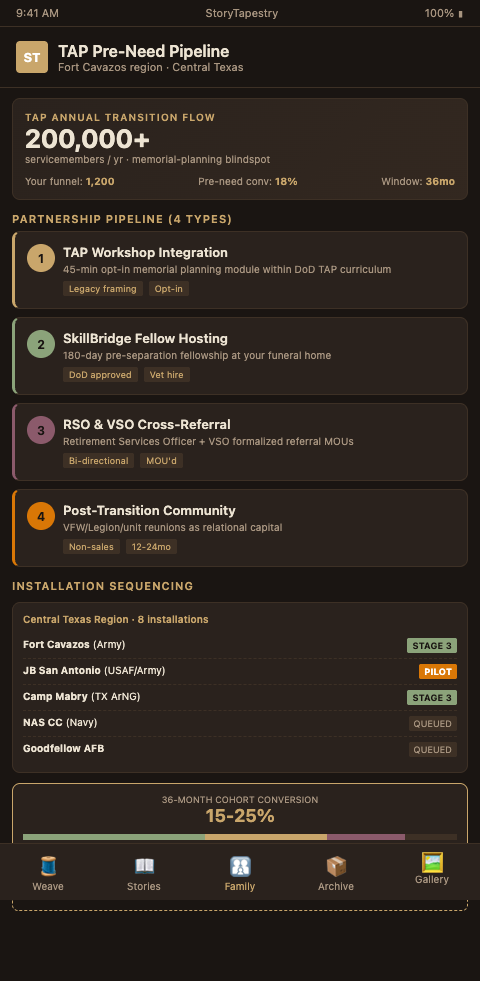
Partnership Type One: Installation-level workshop integration. TAP workshop curricula include legal and financial modules. Adding a 45-minute memorial planning module (optional, opt-in) gives transitioning servicemembers a brief introduction to veteran-specific memorial considerations: the value of documenting unit affiliations while contacts are fresh, VA burial benefit eligibility, military funeral honors protocols, and comrade contribution patterns. The Soldier for Life Army retirement services framework demonstrates that lifelong relationship-building with retiring soldiers is already an Army priority; memorial planning fits naturally within this relationship.
Partnership Type Two: SkillBridge fellow hosting. Funeral homes can host SkillBridge fellows for 180-day industry fellowships in memorial operations, coordinator roles, or partnership development. The fellow gets industry experience and potential post-separation employment; the funeral home gets a veteran team member who brings military cultural fluency and transition-program network access to the memorial production workflow. DoD's SkillBridge program streamlines the employer-side participation. Funeral homes hosting SkillBridge fellows often report that the fellow becomes the company's primary liaison to the local transition-program network.
Partnership Type Three: VSO and retirement officer cross-referral. Most installations have a network of transition-adjacent services: retirement services officers, VA benefits advisors, VSO representatives. Formalizing cross-referral relationships—where the retirement officer mentions memorial pre-planning during retirement briefings, and the funeral home refers transitioning veterans back to retirement officers for benefit questions—creates mutual referral flow. The pattern parallels OB unit referral coordination in adjacent memorial domains where professional cross-referral unlocks pre-need leads at life transition points.
Partnership Type Four: Post-transition veteran service event participation. Transition-adjacent events (VFW post ceremonies, American Legion meetings, unit reunion gatherings) provide ongoing touchpoints for the post-TAP veteran community. Funeral home coordinators attending these events as community members (not as sales representatives) build the relational capital that converts into pre-need conversations over months and years.
The memorial tapestry as pre-planning artifact. StoryTapestry's pre-need module lets transitioning servicemembers begin weaving their career tapestry while they still have access to unit contacts, recent photos, and the memory of specific deployment episodes. This is not a funeral plan—it's a living service-record document that captures the career while it's documentable. The tapestry sits in the pre-need account, updated periodically by the veteran, and activates as a complete memorial canvas if and when need arises. Families inherit a partially-woven tapestry rather than a blank canvas, which substantially improves comrade memorial effectiveness at the later at-need moment.
Revenue integration. The transition-program partnership pipeline feeds the memorial revenue opportunities structure. Pre-need packaged Veteran Memorial Tapestry conversions from transition-program leads typically run 15-25% within 36 months of TAP contact—higher than cold-market pre-need conversion because the transitioning servicemember has already engaged with the concept at a moment of life reflection.
Advanced Transition Partnership Tactics
Active-duty unit engagement during pre-retirement window. The 12-18 months before a servicemember retires often include unit-level events (changes of command, retirement ceremonies, final deployments) that funeral homes can support in memorial-adjacent ways: photography services for retirement ceremonies, commemorative tapestry starter kits gifted through unit associations, unit reunion coordination support. These touchpoints establish brand association before the veteran even hits formal TAP.
Spouse and family transition engagement. Military spouses often drive memorial pre-planning decisions long before the veteran engages. Transition programs include family-track modules at many installations. Partnerships that reach the spouse community—military spouse networking events, family readiness group meetings, spouse clubs at officer and NCO levels—create leads that route back to veteran pre-planning through the household.
Regional transition network mapping. Installations cluster regionally—Fort Cavazos, Fort Hood (historical name), Camp Mabry, plus various reserve and guard installations in central Texas. A funeral home group serving the region benefits from mapping all transition-program touchpoints across the region and building a sequenced partnership plan across 8-15 installations. Regional scale unlocks full-time transition partnership staff roles that single-location funeral homes cannot justify.
Digital outreach to recently-separated veterans. Post-TAP veterans enter the civilian world with active VA.gov accounts, VSO memberships, and alumni unit associations. Structured digital outreach through veteran-permissioned channels (not LinkedIn spam) reaches this cohort after they've settled into civilian life and are more receptive to long-term planning conversations. The outreach respects opt-in preferences and focuses on educational content about memorial pre-planning rather than direct service pitches.
Measuring transition pipeline performance. The transition-program partnership pipeline has long conversion cycles—24-48 months from initial TAP touchpoint to pre-need package purchase is typical. Funeral homes measuring this pipeline need cohort tracking from initial contact through conversion. StoryTapestry's partnership CRM captures TAP contact origination, interim touchpoints, and conversion events so the funeral home can attribute pre-need revenue to specific partnership channels and refine the outreach model over time.
Legacy and heritage framing. Transition-age servicemembers (age 38-55 for typical 20-year retirement) respond differently to memorial planning framed as "legacy documentation" versus "end-of-life planning." The framing matters. Legacy framing positions memorial pre-planning as a gift to future family and comrades; end-of-life framing positions it as mortality planning. The former outperforms the latter by substantial margins in transition-program contexts.
Build Your Transition Program Partnership Pipeline
Veteran Memorial Programs ignoring the 200,000-annual transition pipeline are ceding a high-intent pre-need lead channel to whichever competitor builds it first. StoryTapestry's transition partnership framework plus pre-need tapestry module equips your funeral home to weave memorial pre-planning into TAP, SkillBridge, and retirement services touchpoints without disrupting the transition servicemember's primary workflow. Schedule a transition partnership strategy session with StoryTapestry to map the installations in your region and sequence outreach. The Army master sergeant retiring at Fort Cavazos next month could leave his transition with a memorial tapestry already underway. The strategy session runs 60 minutes and covers the installation-map exercise for your region, the TAP workshop integration protocol, the SkillBridge fellow hosting pathway with DoD SkillBridge application support, the retirement services officer cross-referral framework, and a review of comparable regional outcomes from funeral homes already running the partnership model.
Pilot engagements include partnership onboarding for your two lead coordinators, a supervised outreach sequence on three installations in your region with a named partnership specialist on every call, and a 12-month cohort-tracking CRM configuration that attributes pre-need revenue to specific partnership channels. Most funeral homes complete initial installation outreach within eight weeks of the strategy session and see their first pre-need conversions from TAP contacts by month 18. Bring your owner or general manager, lead coordinator, and your veteran-community liaison or outreach coordinator — the session produces an installation sequencing plan the three of them can execute starting with the nearest retirement services office.