Scaling Veteran Memorial Programs Across Multi-Branch Service Histories
The Fractured Branch Problem in Veteran Memorials
A retired master sergeant passes away after 26 years of service spanning the Coast Guard (1985-1994), Navy Reserve (1994-2005), and Army active duty (2005-2011). His obituary in the local paper mentions only the Army—the final branch. His memorial service features the Army flag, an Army honor guard, and Army chaplaincy. Shipmates from his Coast Guard cutter and sailors from his reserve unit learn about his death three months later, when a Facebook post surfaces in a veterans group. They never get to contribute.
This scenario is not a hypothetical edge case. According to the US Census analysis of post-9/11 veterans, the modern veteran population increasingly reflects branch mobility, component transfers, and blended active-reserve careers. The VA VetPop2023 data story projects that multi-branch service histories will grow more common as force structure shifts favor Total Force integration. Pew Research documents how the veteran demographic has diversified across service eras, compounding the branch-braiding challenge.
Families attempting to plan a multi-branch memorial run into friction at every step: which branch banner frames the service, which VSO to invite, which unit contacts to prioritize, which deployment chapters deserve the most visual weight. Single-branch assumptions baked into funeral home software, obituary templates, and memorial program formats leave veteran memorial programs unable to represent the full arc of service. The result is incomplete tributes, alienated comrades from orphaned branches, and grieving families who sense the memorial did not capture the whole person.
Weaving Multi-Branch Tapestries With StoryTapestry
The Joint Chiefs of Staff command structure recognizes that modern military operations cross service lines constantly—yet memorial frameworks lag a generation behind. StoryTapestry treats each branch chapter as a distinct color thread in a single continuous tapestry, rather than forcing program coordinators to choose one service as the dominant story. The metaphor matters: a tapestry accommodates a Coast Guard seafoam green alongside Navy deep blue and Army olive drab without any thread canceling another.
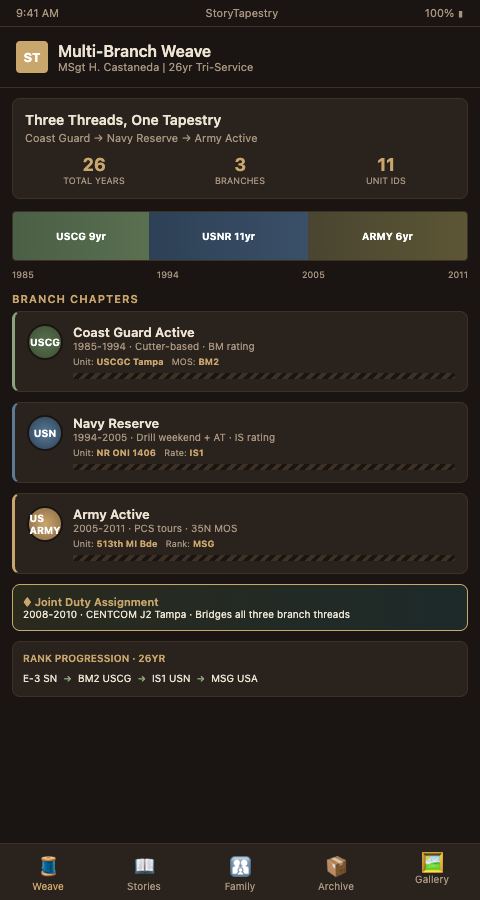
Implementation starts with branch-aware intake. When the program coordinator creates a new memorial in StoryTapestry, the system prompts for every branch/component the veteran served in, with date ranges and unit identifiers. Each entry creates a distinct chapter card on the memorial canvas. Families can weight chapters visually—a 22-year Navy career gets more real estate than a two-year Reserve stint—without erasing shorter service periods. The Special Operations Memorial Foundation offers a real-world precedent: a joint memorial honoring operators from every branch, each branch insignia displayed alongside the others.
Comrade invitation lists scale accordingly. Traditional memorial software asks for "unit buddies" as one input field. StoryTapestry's multi-branch architecture supports parallel contribution streams: Coast Guard shipmates invited through cutter-specific channels, Army battle buddies invited through deployment rosters, Reserve weekend drill peers invited through unit Facebook pages. Each invitation is branch-coded so contributors see context relevant to their shared chapter.
The VA's Veterans Legacy Memorial demonstrates that federal infrastructure can host cross-branch tributes at scale—every veteran interred in a national cemetery has a digital memorial page regardless of branch. StoryTapestry extends this principle to the private funeral home sector, where most multi-branch memorials are actually produced. Program coordinators at funeral homes managing 300-500 veteran services annually need scalable templates, not one-off custom builds. The branch-aware tapestry structure becomes the default, with families opting into specific branch emphasis rather than being forced to omit.
Visual integration on the finished memorial matters. Rather than three separate flag icons stacked vertically, the tapestry weaves branch insignia into a timeline ribbon. A veteran's 1985-1994 Coast Guard service flows chronologically into the 1994-2005 Navy Reserve period, which flows into 2005-2011 Army active duty. The viewer experiences one life, not three resumes. Scaling this pattern across a funeral home's annual veteran caseload requires the same infrastructure pattern you see in bereavement program scaling: modular chapter templates, role-based contributor workflows, and branch-agnostic data models. The unit reunion networks that drive comrade participation work better when the memorial canvas already accommodates their specific branch context.
Branch-specific terminology follows each chapter. The Coast Guard chapter uses "cutter" and "rating" vocabulary; the Navy Reserve chapter uses "drill weekend" and "annual training"; the Army active-duty chapter uses "PCS" and "field problem." Contributors from each branch find their own idiom already embedded in the chapter prompts, which produces more authentic testimony than a generic memorial form could generate. StoryTapestry's branch-aware templates also handle rank translation across components—a Navy Chief Petty Officer (CPO, E-7) sits at a different cultural position than an Army Sergeant First Class (SFC, E-7) despite the same pay grade, and the memorial text respects these distinctions rather than flattening them into abstract pay-grade terminology.
Advanced Multi-Branch Memorial Tactics
Beyond the basic branch-chapter structure, scaling requires handling the harder cases. Inter-service transfers with reserve/active swaps create timeline ambiguities—did a veteran "serve" during their IRR years when they held no drill obligation? The defensible approach is to display all periods with component-specific visual treatment: active duty in full saturation, active reserve in a medium tone, IRR in a lighter shade. Viewers understand the service depth without families having to litigate what counts.
Joint-duty assignments deserve their own chapter category. A Navy captain who spent three years at Central Command working alongside Air Force, Army, and Marine officers has a joint chapter that shouldn't get force-fit into "Navy" exclusively. StoryTapestry supports a joint-duty chapter type that visually bridges multiple branch threads, signaling cross-service collaboration.
Geographic scaling matters for regional funeral home chains. A funeral home group serving bases near Fort Hood, Pensacola, and Norfolk will see different branch concentrations in its memorial caseload. Branch-aware templates let each location customize default invitation lists (VFW posts, fleet reserve associations, Marine Corps League detachments) without rebuilding the underlying memorial infrastructure. This is how you turn veteran memorial revenue into a repeatable service line rather than a custom project on every death.
Service-era context adds interpretive depth. A Vietnam-era Marine and a post-9/11 Marine share a branch but served in wildly different units, deployment patterns, and cultural moments. Tapestry chapter templates pull era-appropriate visual references—BDU camouflage patterns, unit patches in circulation during a given window, deployment locations active in that era—so the memorial feels authentic to the veteran's specific service period rather than a generic branch pastiche.
Finally, multi-branch memorials benefit from structured fact-checking. When 14 contributors from three branches weigh in on a 30-year career, inconsistencies surface: did he deploy to Kuwait in 1991 or 1992? Was the callsign "Wraith" from his Navy squadron or his Army Reserve unit? StoryTapestry supports a contributor reconciliation workflow where the program coordinator can flag conflicts and route them to the appropriate branch-specific contributors for resolution.
Handle commissioning transitions carefully when veterans crossed from enlisted to officer ranks within a single branch or across branches. A Marine who enlisted in 1982, rose to Staff Sergeant, and commissioned as a Second Lieutenant through the Marine Enlisted Commissioning Education Program in 1991 brings two distinct cultural and professional identities to a single service record. The tapestry renders both identities accurately, with the enlisted years showing the NCO leadership role and the officer years showing the commissioned-officer trajectory. Veterans who made this transition carry pride in both chapters, and the memorial honors both rather than collapsing into a single officer-identity framing.
Account for medical retirement and involuntary separation cases with dignity. Veterans discharged through medical evaluation board or permanent disability retirement carry service records that reflect combat injuries, long-term conditions, or career-ending medical events. The tapestry renders these transitions with medical-appropriate framing that honors the veteran's service without requiring the family to explain medical details they may consider private. Branch-aware templates handle the distinctive language of Physical Evaluation Board determinations across services so the memorial text respects the bureaucratic reality of how each branch processes medical discharge.
Start Weaving Multi-Branch Veteran Tapestries
Veteran Memorial Programs serving families with multi-branch service histories need memorial infrastructure built for the reality of modern service, not the single-branch assumption of 1970s obituary templates. StoryTapestry's branch-aware chapter structure, parallel comrade invitation streams, and joint-duty chapter types let funeral homes and VSOs scale multi-branch memorial production without bespoke custom work per case. Book a demo with StoryTapestry to see how a 26-year, three-branch career renders as one continuous tapestry. Your next multi-branch memorial can honor every thread of service.
The demo walks through three representative multi-branch service patterns: a Marine-to-Army transition veteran whose career spanned the late Cold War through Operation Iraqi Freedom, a Navy-to-Air National Guard veteran whose service crossed service categories across the post-9/11 era, and a Coast Guard-to-Army Reserve veteran whose maritime and land-component service defined a distinctive dual-service identity. Each pattern exercises different parts of the branch-aware architecture and shows how the tapestry adapts to whichever multi-branch reality your families bring in. The walkthrough also covers invitation workflow: how the Marine Corps League detachment in one community, the American Legion post in another, and the local Army Reserve unit in a third all receive appropriate outreach matched to the chapters they are qualified to contribute to.
Firms handling multi-branch memorials at scale often find that the branch-aware templates also improve single-branch memorial quality because the infrastructure for specificity benefits every veteran's memorial regardless of how many branches they served in. Schedule the walkthrough with a multi-branch case from your pending intake queue, and see the branch-colored threads of a long complex career woven into the continuous tapestry the family deserves.