Building Unit Reunion Networks for Collaborative Memorial Storytelling
The Problem: Reunions Are Untapped Memorial Collection Events
When the 4th PSYOP Group held its 2016 biennial reunion at Fort Bragg, 120 veterans spanning three wars attended, and the Army's public affairs office filed a brief article about the handshakes and the retired colonel who flew in from Oregon, later returning with deeper coverage of veterans reconnecting with old friends at the PSYOP association reunion. Nobody set up a recording booth. Nobody circulated an outreach form for families of recently deceased members. Nobody built a contact map. Three months later, one of the reunion attendees died, and his family realized the man who could have given the eulogy had been in the Fort Bragg banquet hall and they had no way to find him.
This pattern holds across the military reunion ecosystem. The American Legion maintains a reunion directory covering events at 13,000 posts, and regimental associations run recurring gatherings documented by the Army's public affairs network. The Library of Congress Veterans History Project has accumulated over 121,000 collections across two decades of effort. Semper Fi & America's Fund runs unit reunions that explicitly include PTSD informational support, acknowledging that reunions serve emotional as well as social functions. RAND's research on veteran social connections shows that organizations strengthen peer networks in ways that directly support memorial and bereavement work.
The infrastructure exists. What does not exist, in most cases, is a memorial program that shows up at reunions with a plan. Veterans gather, tell stories for three days, go home, and the stories evaporate. When a comrade dies a year later, the stories that were told at the banquet cannot be recovered because nobody recorded them and the other veterans who heard them have started to forget. Memorial programs that treat reunions as collection events, not just social functions, recover material that otherwise vanishes.
The StoryTapestry Framework: Turning Reunions Into Tapestry Ingestion Events
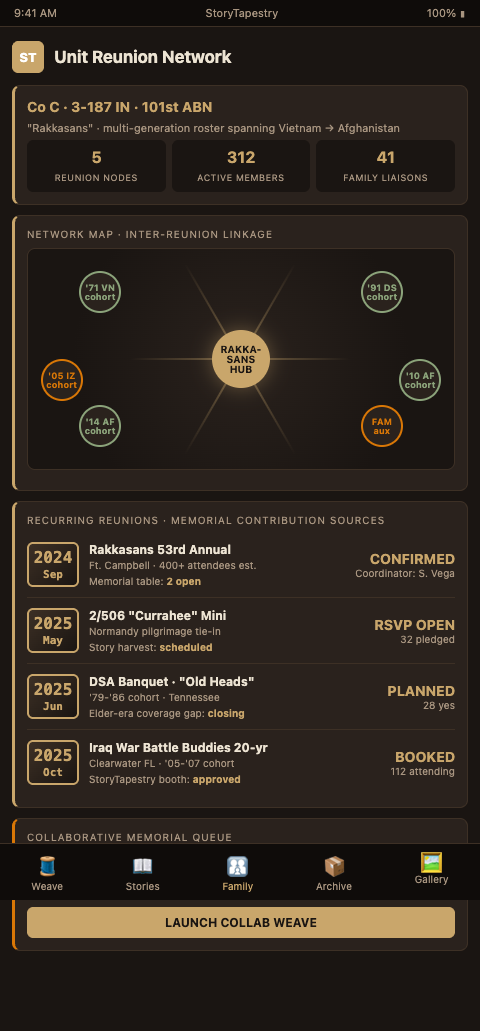
StoryTapestry's reunion protocol treats every unit reunion as a structured story collection event with four components: pre-reunion outreach, on-site collection infrastructure, post-reunion follow-up, and ongoing network maintenance. The protocol is designed so memorial program coordinators can run it without hijacking the social function of the reunion or feeling like uninvited guests at a private gathering.
The first component is pre-reunion outreach. Six to eight weeks before the reunion, the memorial program coordinator contacts the reunion organizer (usually a retired senior NCO or officer) and offers two things: a pre-reunion roster request where attendees can flag stories they want captured, and a list of recently deceased unit members whose families have requested memorial contributions. The organizer typically circulates both in the reunion newsletter, and attendees often arrive with prepared stories and photographs. The platform pairs this with locating unit members workflows that help coordinators find attendees who have dropped off unit contact lists, and the formal locating unit members protocol governs how contact leads get verified before outreach.
The second component is on-site collection infrastructure. A reunion collection booth requires three things: a quiet room with a table, a tripod-mounted recorder, and a volunteer from within the unit (not an outside interviewer) who knows the rhythms of veteran conversation. StoryTapestry ships a reunion collection kit with an iPad workflow that handles consent forms, short-form story capture (10 to 15 minutes each), and on-site photo digitization. Stories collected on site are tagged with the reunion event metadata, so they can be cross-referenced later when a family builds that veteran's tapestry. Volunteers from within the unit consistently yield better stories than outside interviewers because the veteran does not have to explain unit context.
The third component is post-reunion follow-up. Within 72 hours of the reunion ending, the coordinator sends a structured follow-up to every attendee containing a list of unit members whose families are currently building memorials, with a one-click consent path to share a short written memory for each. Response rates to 72-hour follow-ups run materially higher than responses to outreach sent three months later. The platform drafts the follow-up automatically from the reunion attendee list and a feed of active memorial programs in StoryTapestry.
The fourth component is ongoing network maintenance. The Unit Comrade Outreach Network treats reunion contact as the beginning of a relationship, not the end of a collection event. Attendees who consent to periodic outreach receive quarterly notifications when a unit member dies and a family begins building a tapestry. The network effect compounds: a 2024 reunion attendee who contributed a five-minute story becomes, by 2027, a contact point the coordinator can reach when another unit member's family needs a comrade voice. The network pairs with VFW Legion coordination for broader veteran service organization reach, and most coordinators layer in VFW Legion story outreach workflows during the same quarter.
Advanced Tactics: Regimental Association Integration, Virtual Reunion Capture, and Attendee Roster Preservation
Memorial programs working with active unit associations need three advanced tactics beyond the baseline reunion protocol.
The first is regimental association integration. Many regimental associations (4th Infantry Regiment, 101st Airborne Division, 1st Marine Division, and dozens of smaller unit associations) maintain historian roles and archival programs that predate any digital memorial platform. Memorial coordinators should partner with association historians rather than running parallel efforts. StoryTapestry supports association-wide accounts that let the historian administer contributions across every memorial for their unit's veterans, and the association's archive becomes a tapestry resource other families can draw from. This parallels the shared loss communities model in other memorial contexts, where a community already exists and the platform works with rather than around it, echoing the shared loss community approach used for bereaved parents.
The second tactic is virtual reunion capture. Since 2020, many unit reunions have included a virtual component for veterans who cannot travel due to health, geography, or VA appointments. Virtual reunions are often easier to record than in-person ones because the platform already handles capture. StoryTapestry integrates with common video conferencing platforms through a post-event import workflow that extracts individual speaker segments, runs transcription, and offers each speaker the opportunity to publish or archive their segment. Virtual capture often yields material from veterans too frail to attend in person, which is exactly the demographic most urgent for memorial collection.
The third tactic is attendee roster preservation. Many reunions dissolve when the founding cohort dies, and the attendee rosters from decades of reunions sit in a retired organizer's filing cabinet until they are thrown out after the organizer's own death. StoryTapestry offers a roster archive service where reunion organizers can deposit their historical rosters. Coordinators working on a future memorial for any veteran on those rosters can query the archive to find who attended which reunion and in which year, often surfacing comrade contacts who would otherwise be unreachable.
Coordinate Unit Reunion Memorials with StoryTapestry
Veteran memorial programs partnering with unit associations, regimental gatherings, and biennial reunions use StoryTapestry's Unit Comrade Outreach Network to turn reunions into structured story collection events without disrupting the social function of the gathering. Schedule a coordinator consultation 10 to 12 weeks before an upcoming reunion to plan pre-reunion outreach, on-site collection logistics, and 72-hour follow-up workflows. Programs that run the full protocol at one reunion typically recover story material for 15 to 30 memorials across the following 18 months. Reach out through the StoryTapestry program coordinator portal to begin reunion protocol planning for your next unit gathering.
The consultation covers your reunion-partner roster, the pre-reunion outreach script sent to registered attendees, the on-site capture booth staffing plan, the regimental association integration workflow, the virtual reunion capture pathway for hybrid events, and the attendee roster preservation protocol that keeps contact permissions fresh across the 18-month follow-up window. Pilot engagements include reunion-protocol onboarding for your two lead coordinators, a supervised first-reunion deployment with a named implementation specialist at the event, and a 72-hour post-reunion story-ingest review. Most programs complete the pilot protocol deployment at one reunion within 12 weeks of the consultation. Bring your lead coordinator, one family-services director, and one unit-association president or regimental historian — the consultation produces a reunion runbook the three of them can execute together at the next gathering.