Connecting Bereaved Parents with Shared Loss Communities Through Memorials
The Problem: Bereaved Parents Face a Public That Does Not Share Their Loss
A father three months after his son's stillbirth described returning to his office: "People either avoided me in the hallway or asked how I was doing with a look that made me say 'fine' and move on. I was not fine. I had no one to talk to who understood." His grief had no social venue. His wife's grief had similar gaps. The hospital bereavement coordinator had mentioned online support groups at discharge, but the father could not remember the names or URLs.
The evidence base for shared-loss community is strong. A review of online bereavement interventions documented that online support effectively reduces grief intensity. A study of social media communal load sharing found that social media spaces break the taboo around infant loss and generate meaningful support. An internet-based program study demonstrated measurable reduction in post-perinatal distress with structured online intervention. Established organizations have built on these findings: Postpartum Support International connects bereaved parents to specialists, the MISS Foundation supports grieving families internationally, Star Legacy Foundation runs free online support groups led by mental health professionals, and Return to Zero: H.O.P.E. provides a national directory of virtual support.
The gap is not absence of community options. The gap is that bereaved parents, in the raw weeks after discharge, cannot easily find, evaluate, and engage with the right community — and hospital bereavement programs lack infrastructure to introduce families to community in a structured way.
The Solution: Community Integration Woven Into the Tapestry Infrastructure
StoryTapestry extends the tapestry metaphor to community: each family's memorial is a tapestry, and bereaved parent communities are looms where multiple tapestries sit in visible proximity — preserving each family's privacy while offering the comfort of knowing other tapestries exist nearby. The platform offers four specific community pathways that hospital bereavement programs can offer families without replacing the specialized peer support organizations that already exist.
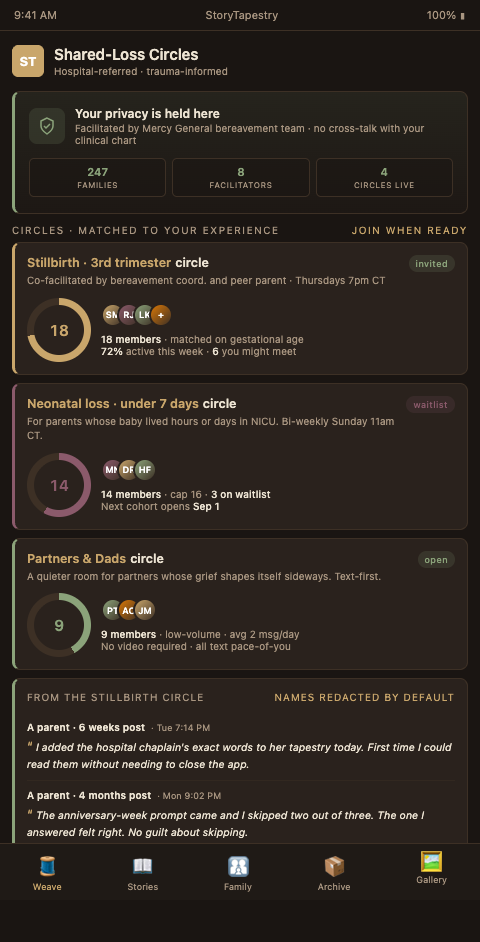
Private tapestry-sharing circles. Families can choose to make selected elements of their tapestry visible to small circles of other bereaved families — facilitated by the hospital bereavement coordinator or an affiliated funeral home. A family might share the one-paragraph memorial story they wrote with a circle of three other families from the same quarter's bereavement cases. The sharing is granular: they choose what to share, with whom, and for how long. Perinatal grief support research consistently shows that controlled sharing reduces isolation without imposing social burden.
Curated community connection pathways. StoryTapestry does not compete with established organizations — it introduces families to them at the right moment. At three weeks post-loss, a family receives a gentle, skippable resource highlight for organizations like Star Legacy Foundation, MISS Foundation, Return to Zero: H.O.P.E., and Postpartum Support International. The introduction respects the family's pacing and never transmits their data to external organizations without explicit consent.
Anniversary ritual infrastructure. Ongoing memorial rituals sustain community across years. StoryTapestry provides shared anniversary ritual tools: October 15 (Pregnancy and Infant Loss Remembrance Day), individual baby birthdays, family-chosen memorial dates. Families opted into community rituals can participate in shared moments — a simultaneous candle lighting, a shared reading, a coordinated memorial action — with privacy and pacing controls.
Multi-generational and geographic community threads. Bereaved families are often geographically dispersed across continents. StoryTapestry supports connecting scattered relatives' contributions into one family memorial — parallel to the scattered family connections approach we take across diaspora contexts. A grandmother in Manila, an aunt in London, and a cousin in Toronto can each contribute to the family's tapestry in their own language and time zone.
Community contribution to individual memorials. With explicit permission, bereaved parents who have done their own memorial work can contribute — anonymously or by name — to other families' tapestries, extending perinatal grief support pathways beyond the clinical bereavement window. A mother who lost her son four years ago might add a one-sentence message of support to a newly bereaved mother's memorial. This peer-to-peer contribution is moderated by bereavement coordinators and follows clear community guidelines to prevent harm.
The five pathways are designed to stack rather than compete. A family may begin with the curated organizational introductions at three weeks, join a private tapestry-sharing circle at three months, participate in the October 15 anniversary ritual at six months, and contribute to a newly bereaved family's memorial at eighteen months. Each step is optional and reversible. The coordinator does not prescribe a path; the platform surfaces the next opportunity and the family decides whether to engage. This matches how bereaved parents actually move through community — slowly, in their own sequence, with frequent pauses. Programs that impose a community schedule lose families; programs that offer opportunities at the family's own tempo keep them.
The underlying privacy architecture treats every community interaction as opt-in rather than opt-out. A tapestry is private by default. A circle is empty by default. A contribution is retractable by default. This is the inverse of the social media default, where sharing is assumed and privacy is a setting buried three menus deep. For bereaved parents, especially in the raw post-discharge window, the inverse default is what makes community safe to approach. A mother who opens her tapestry to a circle of three families and decides two weeks later it was premature can close the circle without destroying her tapestry, and her content returns to private without the three other families receiving any notification that she left.
Advanced Tactics for Bereaved Parent Community Building
Clinically-facilitated peer groups. Hospital bereavement programs with licensed mental health staff can use StoryTapestry as the digital infrastructure for clinically-led peer groups. Groups of four to six bereaved families meet virtually, with their tapestries available as shared reference points. A clinician facilitates discussion around specific tapestry elements — a song, a photograph, a memorial artifact — rather than abstract grief topics.
Anonymized tapestry viewing for early-phase families. Families in the first few weeks after loss often benefit from seeing that other memorials exist without the pressure of social interaction, and careful ongoing memorial ritual design shapes how these previews feel. StoryTapestry offers anonymized tapestry viewing — families can see the structure of other memorials, the kinds of moments other parents chose to preserve, the ways tapestries grow over time — without any identifying information. This addresses the preparation phase before families feel ready to share their own work.
Partner-specific community channels. Partners and fathers often find general bereavement communities dominated by mothers' voices, leaving their grief underserved. StoryTapestry supports partner-specific community channels with the same privacy and pacing controls, connecting fathers and non-gestational partners to peer communities tailored to their experience.
Language-native community threads. Bereaved parents from multilingual communities deserve community spaces in their native languages. StoryTapestry supports community threads in the family's preferred language, with translation as an opt-in feature rather than a forced convergence on English.
Community consent and revocation controls. A family's relationship to community is not fixed. StoryTapestry lets families join a community circle, leave the circle, or revoke shared access at any time without breaking their own tapestry. Community contribution is always reversible.
Affiliated funeral home community bridging. Funeral homes affiliated with hospital bereavement programs often serve multiple families from the same community, and scattered relative story threading helps those families assemble memorials across geography as well. StoryTapestry lets funeral homes — with explicit family consent — connect families who want to connect with other families they served, preserving privacy as the default and community as the opt-in.
Moderator training rotation. Community circles need human moderators, and the moderator role is emotionally heavy. Bereavement coordinators who take it on alone burn out within eighteen months. StoryTapestry supports a moderator rotation model where bereaved parents who are at least two years past their loss, have completed moderator training, and have supervision from a licensed grief clinician share the moderation load. Rotations are typically 90 days with optional renewal. This model extends coordinator capacity without dumping clinical judgment onto untrained volunteers. Programs that implement rotation report that the moderators themselves name the role as part of their own meaning-making — a continuation of their memorial work rather than an extraction from it.
Topical circle specificity. Generic bereaved parent circles often fracture under the weight of too many different loss circumstances. A mother whose baby died from a lethal congenital anomaly at 39 weeks and a mother whose baby was stillborn at 21 weeks from cord accident may both benefit from community, but they rarely benefit from the same circle in the first six months. StoryTapestry supports topical circles organized around loss circumstance, gestational age bands, and timing relative to loss. A coordinator running the program can configure which circles exist, who qualifies, and how families graduate between them as their grief trajectory shifts. Specificity costs more to coordinate but produces substantially deeper community bonds.
Anniversary coordination across time zones. October 15 is Pregnancy and Infant Loss Remembrance Day in the United States, but the international families served by many hospital bereavement programs observe loss on different calendar dates, and the 7pm Wave of Light crosses time zones for hours. StoryTapestry coordinates simultaneous ritual participation across time zones so that a family in Seoul lighting a candle at 7pm local time joins the same ritual as a family in Chicago lighting one six hours later. The shared tapestry visualizes the wave of participation as it moves across the globe, giving families the tangible sense of belonging to a community much larger than their own neighborhood.
For Hospital Bereavement Programs Ready to Offer Community Without Replacing Specialists
Your bereavement coordinator may already share flyers for Star Legacy Foundation, MISS Foundation, Postpartum Support International, and Return to Zero: H.O.P.E. StoryTapestry sits alongside these resources — not replacing them, but making them findable at the right moment. We pilot the platform with hospital bereavement programs that want to extend community connection without taking on the load of running full peer support themselves. The platform respects your consent practices, your affiliated funeral home partnerships, and the specialized expertise of the national bereavement organizations your program already trusts.
A typical community pilot runs six months with a cohort of twenty-five families across two quarterly intake cycles. The pilot tracks four metrics: opt-in rate into the curated organizational introductions, opt-in rate into private circles, completion rate for the October 15 anniversary ritual, and family-reported isolation scores at intake and six-month follow-up. The pilot produces a community architecture tailored to your unit's catchment: which topical circles exist, how moderator rotation works with your clinical staffing, how your affiliated funeral homes participate, and which external organizations receive referral introductions.
Reach out to discuss a pilot that includes your community resource introduction workflow. Invite your bereavement coordinator, a licensed social worker or grief clinician from your team, and one representative from an affiliated funeral home to a discovery conversation. We will walk through the five community pathways, map them onto your existing referral partnerships, and identify where the platform extends your program's reach and where it intentionally hands off to specialist organizations that your families deserve access to.