Building Ongoing Memorial Rituals Around Brief Life Tapestries
The Problem: Memorial Services Built for Closure That Does Not Come
Most hospital bereavement programs are built around a single memorial event — a service, a discharge ritual, a first-anniversary letter — and then the program ends. Grief does not follow that schedule. The VA clinical resource on anniversary reactions documents that trauma anniversaries produce intrusive memories, sleep disturbance, and emotional regression for years after the initial event, and that the intensity does not necessarily diminish linearly. A bereaved mother at year seven may experience an anniversary reaction that matches year one, especially when life-stage triggers — a sibling's first day of school, what would have been the baby's eighteenth birthday — layer on top.
Research on rituals alleviating grieving, by Norton and Gino at Harvard demonstrates that rituals reduce grief by restoring a sense of control, and that the benefit compounds with repetition. A systematic review of continuing bonds in the grief literature confirms that ritualized practices connecting the bereaved with the deceased are protective rather than pathological — the older grief-work models that treated "letting go" as the goal have been displaced by continuing-bonds frameworks in which ongoing connection is the healthy outcome. The foundational text on this shift, Continuing Bonds by Klass, Silverman, and Nickman, reframes ongoing rituals as the point, not a problem to resolve.
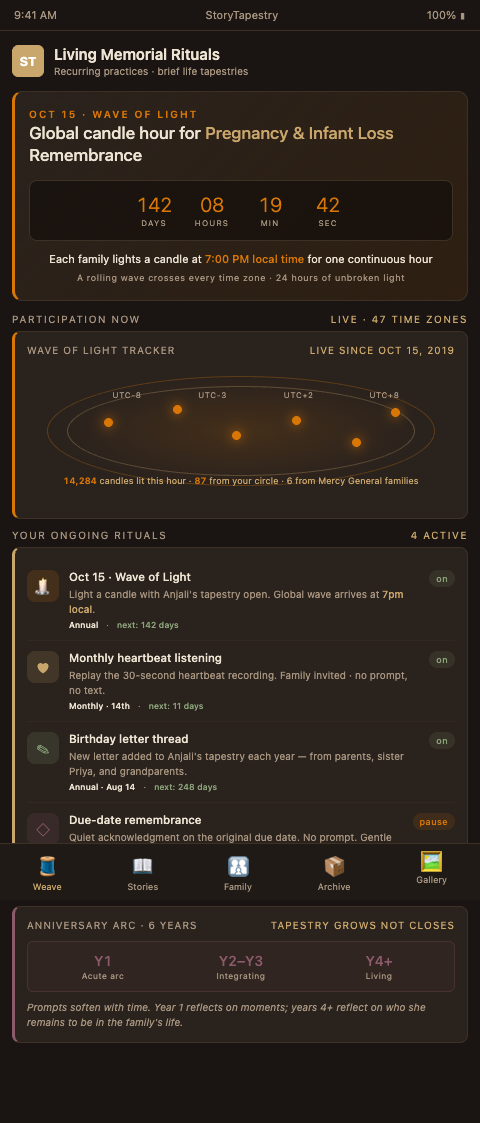
Community observances exist but are rarely integrated into hospital-provided memorial programs. The October 15 Wave of Light is a global annual ritual held at 7pm local time; the UK Baby Loss Awareness Week formalizes an entire week of observance. Hospital bereavement programs often do not reference these, and families discover them years later through online communities. The tapestry can host all of it.
Solution Framework: A Tapestry That Expects to Grow
StoryTapestry treats a brief-life memorial as a weave with permanent capacity, not a finished artifact. Ongoing rituals add new threads on a recurring rhythm, and the tapestry accommodates decades of additions without losing the original weave.
The first design principle is scheduled prompts without scheduled obligations. StoryTapestry knows the baby's date of loss, the due date (or the date of what-would-have-been delivery), the parents' birthdays, and the sibling milestones the family has opted to share. On each of those dates, the system sends a gentle optional prompt: "Would you like to add a thread today?" Parents can skip without explanation. Some years they add; some years they do not. The prompt is the ritual container — whether it is used that year is the family's call.
The second principle is ritual variety. Different families respond to different anchors. For some, the brief life memorials anniversary is central. For others, the Wave of Light or Baby Loss Awareness Week carries more weight. StoryTapestry offers a calendar of pre-built ritual anchors — individual (loss anniversary, due date, Mother's Day), communal (October 15, Baby Loss Awareness Week), religious (if the family identifies one), family-invented (the day the tapestry itself was first woven). Families opt into the anchors that resonate.
The third principle is low-friction thread types for recurring use. A parent who has already written the longform story of the loss does not need to rewrite it each year. StoryTapestry offers short-form recurring thread templates: a one-photo "where we were this year," a one-sentence "what I wish I could tell her this year," a voice note recorded on the anniversary morning, a candle photograph at the exact local-time moment of the Wave of Light. These take minutes. They accumulate into a sequence that is itself a ritual.
The fourth principle is communal weave alongside private weave. Anniversary memorial updates have a choice each year — private, family-only, or shared with a broader community of bereaved parents. Some families guard the anniversary tightly; others find that community observance is exactly what helps. A toggle on each thread controls visibility, so the same family can post a public Wave of Light candle photograph and a private letter on the same day without any conflict.
The fifth principle is deep context without forced re-engagement. A parent who visits the tapestry on the tenth anniversary may want to read everything accumulated since year one, or may want to add a single thread and leave. The interface supports both: a "deep view" that surfaces the full accumulated history, and a "single add" that opens a blank thread without showing prior years. Different grief culture rituals, including those developed in veteran-focused memorial programs for service members lost decades ago, use the same architecture — ongoing engagement has to tolerate wide variation in emotional capacity from year to year.
Advanced Tactics for Sustaining Ritual Engagement Over Decades
Four tactics help a memorial program survive the transition from acute to chronic grief.
First, build an opt-in community layer with strict moderation. Families who want communal ritual — a shared Wave of Light wall, a group candle image on October 15 at 7pm in their timezone, a shared Baby Loss Awareness Week thread — benefit from knowing other bereaved parents are doing the same thing simultaneously. Families who want privacy get none of this. A strict opt-in default (communal layer is off unless affirmatively toggled on) preserves safety for the majority while creating a rich shared space for those who want it.
Second, rotate the ritual prompts. A family that receives the same anniversary prompt word-for-word for nine years stops reading it by year four. StoryTapestry varies the prompt copy across a multi-year library: year one emphasizes presence, year two emphasizes change, year five emphasizes continuity, year ten emphasizes legacy. The prompts are grounded in the continuing-bonds literature and adapted to where the family is likely to be.
Third, design for blended-family evolution. Years after the loss, surviving siblings are born, parents sometimes separate and repartner, grandparents die, cousins grow into memorial participants. The tapestry's permission structure has to handle these changes without requiring a manual rebuild. A partner-change event, for instance, should present a simple wizard for transferring or subdividing access, not a silent gap that frustrates a parent during an anniversary visit.
Fourth, archive the tapestry's own ritual history. At year five, ten, twenty, the tapestry should surface "here is what you've built over this many years" without pressuring the family to continue. Some families find this view sustaining; others find it heavy. The view is opt-in, and it exists because the ritual itself is worth honoring — a decade of anniversary threads is its own form of faithful witness.
Finally, plan for tapestry transfer on parental death. When a bereaved parent dies fifty years after their baby, the tapestry should transfer to a designated heir (often a surviving sibling) with the ritual structure intact. Plan the succession at tapestry creation. The memorial outlives the first mourner.
CTA: For Hospital Bereavement Programs Extending Beyond Discharge
Your bereavement program is likely set up to deliver the first six weeks well and then taper off. The families you served at year one will be marking anniversaries for decades, and most of them will be doing it alone. StoryTapestry gives you a ritual calendar, thread templates, and communal layers that let your program extend its care without requiring continuous staff outreach. Schedule a 30-minute call with your bereavement lead and a social worker. We'll map a five-year ritual cadence for a specific case in your unit and show where scheduled prompts, communal observances, and private letters fit into the tapestry. The call covers the anniversary prompt library, the sibling developmental scaling framework, the opt-in communal layer that lets multiple families observe together, and a walk-through of year-one, year-five, year-15, and year-25 views of the same sample tapestry.
Pilot engagements include platform access for your bereavement coordinator, one social worker, and one chaplain, plus a named implementation lead who configures the ritual cadence for your first 10 family cases. Most programs onboard their first family inside four weeks of contract signing and reach steady-state anniversary-prompt coverage across all active cases by month six. Bring your bereavement coordinator, social work lead, and a representative from your alumni parent advisory council — the call produces a five-year ritual cadence document the three of them can review with hospital leadership before the pilot launches.