How to Create Meaningful Memorials for Lives Measured in Hours
The Problem: Brief Lives, Thin Documentation
A NICU nurse at a midwestern teaching hospital told a family their daughter lived for six hours — long enough for both parents to hold her, long enough for the grandmother to sing a Polish lullaby, long enough for the chaplain to baptize her in the incubator. Three weeks later, the parents had a photograph, a lock of hair, and a set of footprints. Every other detail — the chaplain's exact words, the lullaby title, the nurse's handwritten note about how the baby turned toward her mother's voice — had dispersed across seven different hospital systems and three memory boxes that never came home.
Perinatal loss sits at an uncomfortable statistical intersection. Nearly 20,000 US pregnancies end in fetal death every year according to CDC tracking, and roughly 1 in 175 pregnancies ends in stillbirth with another 1 in 100 live births ending within 28 days, a scale documented by Share Pregnancy & Infant Loss Support. Despite this volume, hospital bereavement documentation remains fragmented. Resolve Through Sharing has trained more than 65,000 professionals precisely because the standard of care varies so widely between units — and even within one unit between shifts.
The result: families grieve a life measured in hours with artifacts that take five minutes to review. Partners, siblings, grandparents, and extended family members each hold different fragments — a voicemail from the hospital chaplain, a photo the NICU nurse took, the name of the respiratory therapist who adjusted the oxygen. Without a structure to gather those fragments, they decay into isolated memories nobody can access together.
The Solution: Create Meaningful Memorials by Weaving Fragments Into a Permanent Tapestry
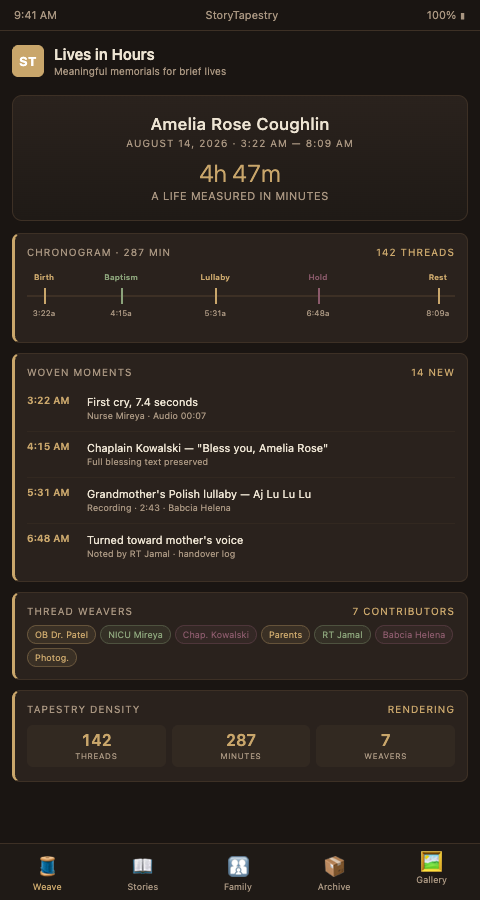
StoryTapestry approaches perinatal memorial work the way a weaver approaches a loom — every thread matters, and the pattern only becomes visible when the fragments are held together. The goal is to create meaningful memorials whose density matches the love inside those brief hours, not the bureaucratic paperwork that survived them. The tapestry metaphor is literal here: families contribute moments, medical staff contribute observations, siblings contribute drawings and voice notes, and the platform weaves each strand into one interactive memorial that grows across time rather than closing the day after the funeral.
Micro-Moment Amplification. A four-hour life contains hundreds of distinct moments, and the discipline of capturing brief life story fragments depends on prompts built for exactly this density. StoryTapestry's trauma-informed prompts ask families to describe the smallest specifics: the weight of the baby in the father's hands, the exact temperature of the NICU room, the brand of hat the volunteer knitter made. Each prompt maps to a specific thread color in the tapestry visualization, so that a brief life renders with visible density rather than empty space. Research on legacy-making in pediatric palliative care documents that tangible legacy items — heartbeat recordings, fingerprint charms, written letters — reduce long-term complicated grief risk, and StoryTapestry builds the digital equivalent by preserving audio clips of the heartbeat monitor, the father's whispered name, and the nurse's handover note all in one place.
Medical Team Moment Documentation. The chaplain, the bereavement nurse, the respiratory therapist, and the lactation consultant each witness moments the family cannot be in two places to see. StoryTapestry provides a consent-based medical contribution channel where staff can add their own observations — always read and approved by the family before they appear in the public tapestry. One NICU social worker described this as "finally giving the nurses a place to put the words they were already writing in their heads at 3 AM." The professional bereavement photography literature has long documented that third-party validation makes the experience feel real to parents months and years later; StoryTapestry extends this principle beyond photography to written narrative and voice.
Trauma-Informed Guided Storytelling. Families who have just experienced stillbirth or neonatal loss should never face a blank text box. StoryTapestry's prompts are written in consultation with perinatal bereavement clinicians and follow the structure of March of Dimes' "From Hurt to Healing" booklet. Questions arrive one at a time, can be skipped without judgment, and pause automatically after a family logs distress. Partners can answer the same prompt separately, preserving their differing perspectives as parallel threads rather than forcing a single consolidated voice.
Sibling and Family Inclusion Pathways. Older siblings often carry the deepest confusion about a baby who came home only in a memory box. StoryTapestry lets siblings contribute drawings scanned directly from a phone, voice notes describing the baby they never met, and — later — age-appropriate reflections they revisit on birthdays. Grandparents on another continent can record voice messages in their first language, which StoryTapestry stores alongside transcriptions. Now I Lay Me Down to Sleep provides remembrance portraits in 40+ countries; StoryTapestry makes those portraits the seed of a wider family tapestry rather than the end of the documentation.
Advanced Tactics for Hospital Bereavement Programs
Pre-loss contingency tapestries. When a family receives a lethal prenatal diagnosis at 22 weeks, hospital bereavement coordinators can open a tapestry during pregnancy rather than after loss. Parents add ultrasound recordings, name candidates, and letters to the baby — creating a memorial that exists whether the baby lives four hours or forty minutes or, in some cases, longer than doctors predicted. This approach aligns with perinatal palliative care models that emphasize preparation over post-event scrambling.
Multi-shift nurse documentation windows. Bereavement nurses usually work 12-hour shifts. A family whose baby lives 18 hours will be cared for by two or three different teams, each observing different moments that later become tangible memory keepsakes the parents hold for decades. StoryTapestry's shift-handover feature lets each nurse add observations before logging off, with a clear consent flag that marks whether the family has seen and approved each contribution. One affiliated funeral home reported that this structure also protects staff wellbeing — nurses no longer leave shifts carrying moments they had nowhere to record.
Chaplaincy integration. Hospital chaplains often lead baptisms, blessings, or naming ceremonies that the extended family cannot attend. StoryTapestry integrates directly with chaplaincy documentation, preserving the exact words spoken during these ceremonies along with audio when families consent to recording. Rabbis, imams, ministers, and nondenominational chaplains can each use the platform with terminology appropriate to their tradition.
Delayed-trigger anniversary prompts. Grief does not end at discharge, and the same long-arc documentation used for fragmented caregiver narratives in dementia bereavement applies to perinatal loss. StoryTapestry can send a gentle email to the family six weeks after loss — then at three months, six months, one year — inviting them to add new reflections if they feel ready. Each prompt is skippable, each prompt is trauma-informed, and each prompt expands the tapestry rather than reopening it. Funeral directors affiliated with hospital programs have noted that this long-tail engagement keeps families connected to the bereavement service long after the initial funeral invoice closes.
Memorial-keepsake fulfillment workflow. The tapestry is digital, but families often want something to hold. Hospital bereavement programs partnering with StoryTapestry can export select tapestry elements — a favorite photograph, a specific paragraph, a heartbeat waveform — into printed memorial artifacts fulfilled through affiliated funeral homes. This ties the digital narrative to tangible memory artifacts families can carry home.
For Hospital Bereavement Programs Ready to Offer More
If your hospital bereavement program currently hands families a memory box and a pamphlet at discharge, StoryTapestry helps you go further. Our platform was built in consultation with perinatal bereavement coordinators, NICU social workers, and affiliated funeral directors who work with lives measured in hours every week. We integrate with your existing bereavement protocols rather than replacing them, and every family engagement respects your consent and disclosure practices. Hospital programs piloting StoryTapestry typically begin with a single unit and expand as staff confidence grows. The same principles that honor brief life story fragments apply to programs built on other loss experiences, including the fragmented caregiver stories we support in dementia memorial work. Contact our hospital partnerships team to schedule a trauma-informed demonstration tailored to your unit.
The demonstration runs 60 minutes and covers the consent ladder, trauma-informed prompt library, clinical integration touchpoints with your existing bereavement pathway, and a walkthrough of a completed multi-contributor tapestry from a partnered program. Pilot engagements begin with a single unit — typically NICU or L&D — and include platform access for your bereavement coordinator, one social worker, and one staff chaplain, plus a named clinical implementation lead who shadows the first three family engagements. Most pilot programs onboard their first family within three weeks of contract signing and reach steady-state weekly case volume inside 90 days. Bring your bereavement coordinator, a unit nurse manager, and a representative from your affiliated funeral home — the demonstration produces a unit-level implementation plan the three of them can take to hospital leadership.