Gathering Fragmented Caregiver Stories for Dementia Memorial Tapestries
The Problem with Missing Primary Storytellers
Funeral directors partnering with dementia care facilities encounter an intake gap that obituary templates cannot solve. The person whose life is being memorialized often spent years unable to share coherent autobiography, and family members frequently live scattered across cities, holding only slivers of the whole. According to Frontiers in Neurology research on autobiographical memory in Alzheimer's, AD patients produce fragmented, depersonalized accounts with missing life events, which means the window for gathering first-person history often closes years before death.
The scale matters. The Alzheimer's Association 2025 Facts and Figures reports 7.2 million Americans age 65 and older are living with Alzheimer's in 2025, supported by more than 12 million unpaid caregivers. Each of those caregivers holds fragments, but no standardized intake process captures their input before grief and logistics eclipse the gathering window. BrightFocus Foundation's caregiver accounts describe how stories become treasures precisely because they are so hard to reconstruct after the fact. Funeral homes that default to a single family point of contact typically walk away with a two-paragraph obituary and an unfinished life.
Weaving Caregiver Fragments Into a Memorial Tapestry
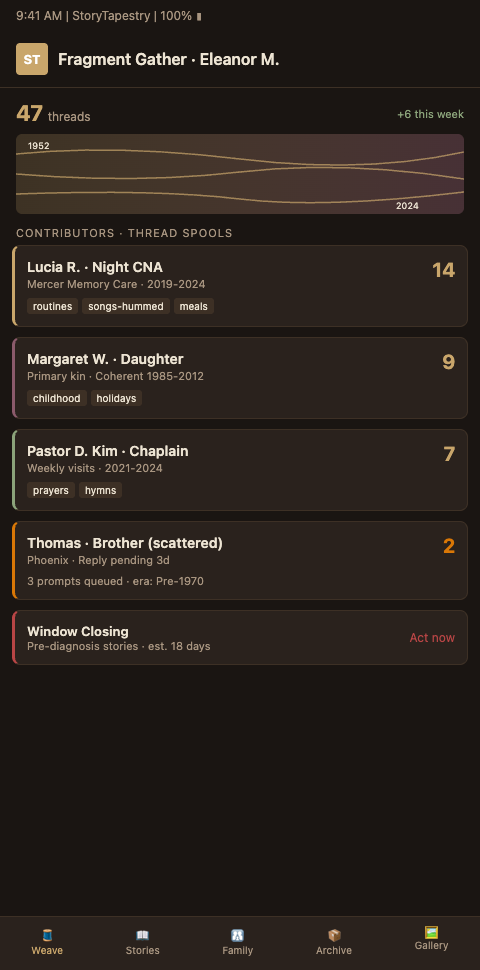
The reframe starts with abandoning the idea of one coherent source. StoryTapestry treats every caregiver, neighbor, former coworker, day-program aide, and distant relative as a thread holder. Each person contributes what they have, no matter how small, and the platform weaves those fragments into a permanent, interactive tapestry. A CNA who walked a resident to meals for three years holds different threads than a son who visited monthly, and both are irreplaceable.
Caregiver Fragment Collection becomes the operational core. When a funeral home begins a memorial, the intake form branches from "Who knew the person?" rather than "Who is the next of kin?" The platform sends cognitive-stage sensitive prompts to each contributor tailored to their relationship depth. A night-shift aide gets prompts about routines, songs hummed, meal preferences. A college roommate from 1967 gets prompts about dorm stories, early ambitions, nicknames. This approach aligns with Cochrane Review findings on reminiscence therapy, which shows reminiscence improves autobiographical memory recovery and quality of life when structured prompts meet the contributor's context.
Contradictory Memory Reconciliation addresses what funeral directors quietly dread: two siblings insisting their mother grew up in different towns. Rather than forcing a vote, the tapestry preserves both threads with attribution, letting readers see the memorial as a woven conversation. Storytelling as a conversation model for dementia research demonstrates that verbal reminiscences retain conventional narrative structure even when individual details drift, so preserving variation often yields a truer portrait than forced consensus. StoryTapestry also connects to broader efforts like the StoryCorps Memory Loss Initiative, which has collected more than 2,000 interviews with people living with memory loss for the Library of Congress, validating the model of gathering before the window closes.
Pre-Decline Proactive Gathering is where funeral home partnerships with memory care facilities pay off most. Once a resident enters moderate-stage dementia, the protocol triggers a caregiver intake session during care-plan updates. Staff contributions are archived as living drafts, ready when the family needs them. This connects directly to fragmented narrative building practices that assume gaps are the norm, not the exception.
The operational layer beneath these three pillars is contributor routing. StoryTapestry maintains a profile for every known thread-holder: the CNA who did morning care on weekdays, the hairdresser who visited monthly, the great-niece in Portland who sent cards. When intake opens, the platform sends three tailored prompts to each profile based on relationship depth and recency. A night CNA receives prompts about meal reactions and overnight routines. A retired coworker from 1982 receives prompts about early ambitions and office nicknames. The contributor answers by text, voice memo, or two-sentence email, and the reply is captured as an attributed thread without the family having to shepherd anyone. Directors report that this single routing layer doubles typical fragment counts within the first two pilot memorials because the 80% of story holders who would never have been contacted under a family-driven intake now receive a direct, easy ask in the medium they prefer.
Scaling Fragment Collection Across a Care Network
The common mistake is treating each memorial as a bespoke interviewing project. Funeral homes serving three or more memory care facilities quickly burn out directors if every intake is a blank slate. The fix is a shared contributor library. Once a CNA has submitted story fragments for one resident, her interview profile, preferred prompt style, and availability windows persist in the system. The next intake sends her targeted prompts within minutes, not a cold outreach.
Edge cases deserve scripting. When a contributor has only negative or conflicted memories, the platform routes those fragments to a family reviewer rather than the main tapestry. When a caregiver dies or leaves the facility before a resident, their partial contributions remain as named threads. These are the same principles that underpin scattered story reconstruction in other niches where primary storytellers are unavailable.
Another scaling discipline is prompt library maintenance. Directors who adopt StoryTapestry in their first quarter often find that the default prompts work for 70% of cases and that the remaining 30% need custom prompts tuned to their partner facilities and local demographics. A funeral home serving a Polish-American community in Milwaukee needs prompts that invite stories about church dinners and factory pensions; a firm serving retired military in San Antonio needs prompts that invite stories about base housing and unit reunions. The platform lets directors clone the base library, customize the prompt set, and track which custom prompts yield the longest fragments. After six months of tuning, the prompt library becomes a proprietary asset that distinguishes the funeral home's intake quality from general-purpose memorial tools.
Scaling also requires privacy discipline. Memory care staff sometimes know fragments residents would not want shared with estranged family. Role-based visibility, contributor-gated release, and family approval workflows keep the tapestry honest without weaponizing staff access. Teach directors to explain the process in two sentences during the first family meeting, and use family interview techniques as the bridge from general fragment collection to the family's own contribution session.
Contributor burnout is a real risk at scale. A single CNA who contributes meaningfully for three memorials per quarter will disengage by month six if the asks keep coming in the same format with no acknowledgment. Sustainable scaling requires a contribution cadence per contributor (no more than one active ask per month), a public acknowledgment flow when each memorial goes live, and an opt-out that respects the contributor without penalizing the funeral home's relationship with the facility. Directors who treat staff contributors as renewable resources burn through the pool; directors who treat them as long-term partners keep the pool growing.
Measurement closes the loop. Track three signals per memorial: total fragment count at service time, fragment-to-contributor ratio (high ratios signal a few dominant voices; low ratios signal healthy distribution), and 90-day post-service addition rate. Memorials with a 10:1 fragment-to-contributor ratio are usually dominated by a single family member working alone; the tapestry feels thin despite the word count. Memorials with 2:1 or 3:1 ratios come from actual distributed contribution and consistently earn higher family satisfaction. When a funeral home's quarterly review shows rising ratios alongside flat total fragments, it means the platform is running but contributor outreach has stalled. That is the operational signal to rebuild the prompt library or refresh director training before the next intake cycle begins.
Start Weaving Memorial Tapestries for Dementia Families
Memory Care Funeral Homes on the StoryTapestry waitlist are reshaping intake for families who arrive without a primary storyteller. If you partner with Alzheimer's or dementia care facilities and have watched obituaries shrink as cognitive decline advanced, StoryTapestry gives your directors a structured way to gather caregiver fragments from CNAs, neighbors, coworkers, and scattered relatives before the final call instead of after it. Join the waitlist to help pilot the caregiver-first intake workflow and shape how the platform handles contradictory memory reconciliation in your market.
The early partners we are onboarding get direct input into the prompt library refinements, the contributor acknowledgment templates, and the facility SSO integration patterns that will ship with the production release. Your directors will run their first caregiver-first intake on a real family with concierge support from the StoryTapestry product team, which means the first memorial you assemble on the platform reflects the realities of your partner facilities rather than generic assumptions. If your firm serves two or more memory care communities and has been searching for a way to honor residents whose primary storyteller is absent, the waitlist is the fastest route to both the workflow and the operational feedback loop that makes it work at scale. Reserve a pilot slot, and your directors will be among the first to walk families from shoeboxes and scattered threads to a woven memorial that feels like the life it represents.