How to Interview Family Members with Incomplete Recollections
The Problem with Standard Arrangement Conference Interviews
Funeral directors are trained to run efficient arrangement conferences. Ask about the deceased, capture essentials, move to service logistics. That model assumes the family arrives with retrievable memories. Dementia family interviews are different. Years of carrying caregiving exhaustion, ambiguous grief, and fragmented communication with the loved one often leave families feeling they have forgotten everything. NIA research on brief bouts of lucidity in dementia shows lucid intervals are common but unpredictable, which means families often have isolated memory-worthy moments scattered across years of otherwise difficult care.
The interview dynamic compounds this. Alzheimer's Society guidance on grief, loss, and bereavement for dementia families describes the complex bereavement experience that begins well before death. Families arriving at arrangement conferences are already in advanced grief and often self-silence, worried they will get details wrong or offend relatives with conflicting versions. A director who charges through standard intake questions produces thin obituaries and families who later feel their loved one deserved better.
Weaving Retrieval-Assisted Interview Technique Into Intake
The framework shift is applying established memory-enhancement interview methods to funeral home intake. The Office of Justice Programs cognitive interview technique is an evidence-based protocol for retrieving memory that would otherwise stay inaccessible. Its four core principles — context reinstatement, report everything, reverse order, and change perspective — translate directly to dementia family interviews. Context reinstatement becomes "let's start with where you were during the hardest year." Report everything becomes "even the small things, even if you're not sure they're right." Reverse order and perspective change shift the family out of the default linear obituary mode they expected.
PMC research on visual methods for communication with cognitive impairment supports the use of photo prompts as memory elicitation tools. Bringing a single photograph into the interview — an image the family has not looked at in months — can unlock twenty minutes of threads. The Smithsonian Institution Archives guide on oral history emphasizes open-ended questions that invite narrative rather than yes/no answers. KQED's practical guide to interviewing family members like an oral historian adds the practical discipline of silence: after a question, wait. Directors instinct is to fill space, and that instinct shuts down retrieval.
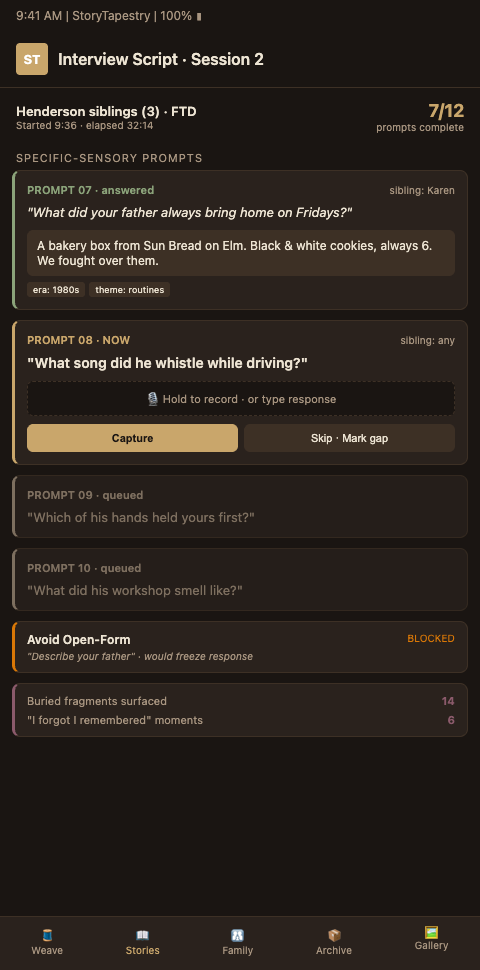
StoryTapestry builds these techniques into the intake workflow. Directors pull up a visual prompt library organized by era and theme. The family's photo archive is indexed and surfaced as prompts during the conversation. Fragments are captured in real time as threads in the tapestry, with attribution logged to the speaker. The director does not have to play stenographer while also running the interview. Post-session, the family receives a link to the threads gathered and can add material as memories surface in the following weeks — a practice aligned with visual memory prompts that help contributors retrieve what they could not recall on demand.
Cognitive-Stage Sensitive Prompts apply to families, not just patients. A sibling who was the primary caregiver during late-stage care holds different fragments than a sibling who visited monthly. The interview should route questions differently to each. Asking the primary caregiver "what was he like?" freezes her, because her answer feels impossibly large. Asking "what did he reach for at breakfast in the last year?" unlocks a specific thread. The tapestry metaphor holds throughout: each sibling contributes different spools, and the completed memorial weaves them together without forcing coherence.
Contradictory Memory Reconciliation happens naturally inside retrieval-assisted interviews. When siblings disagree on a detail, the trained director does not force a vote. They capture both versions and move on. Family trust building deepens when the family sees their disagreements treated with respect rather than as problems to resolve. The same dynamic applies across adjacent niches where multiple voices produce the strongest memorial.
Pacing matters as much as technique. A traditional arrangement conference often runs 60 to 75 minutes; a retrieval-assisted interview for a dementia family typically needs 90 to 120 minutes across one or two sessions. Directors who try to compress the interview into the standard slot produce superficial fragments, while directors who reserve adequate time see narrative density triple. The math favors the longer session: two hours of director time that produces a 55-thread tapestry beats one hour that produces a 20-thread obituary, both for the family's experience and for the firm's reputation with the facility partners watching what kind of memorial work the funeral home actually delivers.
Advanced Tactics for Incomplete-Recall Interviews
The most common director mistake is interviewing all siblings together in the first session. Group dynamics suppress retrieval. One or two dominant siblings fill space, and quieter family members defer. Better practice is a one-hour group session for context, followed by 30-minute one-on-one sessions per sibling. One-on-ones surface material the group would never produce, because siblings often hold different relationships with the deceased.
Edge cases worth scripting. Families with estranged members need a decision protocol for whether estranged siblings are invited to contribute. Families where the primary caregiver is depleted may need a deferred intake, with a written fragment-submission option. Families in conflict over care decisions during the illness often need a neutral third party to hold the interview, because the director becomes a target for displaced grief.
Sensory anchor prompts are undervalued. Music, food, and smell unlock threads that verbal prompts miss, and PMC research on visual methods for cognitive-impaired communication extends directly to sensory modalities beyond visual prompts. Ask what song the person hummed, what meal they made on Sundays, what cologne or soap they wore. These anchors are particularly effective for late-stage dementia memorials because they bypass the verbal autobiographical memory that the disease damages first. Bring physical artifacts to the interview when possible — a handwritten recipe card, a worn piece of fabric, a recording of a hymn — and allow families to hold them during the conversation. Directors who treat the interview as multisensory rather than purely verbal consistently surface fragments that pure Q&A cannot reach.
The same multi-voice principle extends into locating memorial contributors in veteran memorial work, where sensory prompts about unit songs, shared meals, and specific deployments unlock comrade fragments that direct biographical questioning never surfaces.
Scale the approach by building an interview prompt library organized per relationship type. Spouse prompts, adult child prompts, grandchild prompts, sibling prompts, longtime-friend prompts. Each set should include 15-20 prompts organized from easiest (factual, biographical) to richest (relational, sensory). Directors rotate through the library based on what produces material in each conversation, updating notes as they learn.
Measure interview quality with three signals: fragment count per interview hour, family ratings of "felt heard" versus "felt rushed," and post-interview addition rate (how often families add material in the following two weeks). Firms with rising addition rates are running the interview well because families leave confident that more can surface.
Debriefs between sessions matter for director learning. After each interview, the director spends 10 minutes logging which prompts worked, which produced silence, and which unlocked unexpected material. These logs aggregate across the firm into a shared knowledge base that accelerates new director training. Without the debrief discipline, insight stays locked in individual directors' heads and disappears when they retire or move on. StoryTapestry builds the debrief step into the workflow with structured prompts that capture the metadata without adding significant time.
Family experience after the interview is the long tail that funeral homes often underinvest in. A family that leaves an interview feeling heard typically adds fragments for the next two weeks as memories continue to surface in the shower, at dinner, during the drive to the service. Directors who send a follow-up message within 24 hours with the draft tapestry and three gentle prompts for further contribution unlock this additional material reliably. Families who hear nothing from the funeral home between interview and service stop contributing within 48 hours because the momentum dies. The follow-up is a five-minute task that frequently doubles the eventual tapestry depth.
Start Running Retrieval-Assisted Family Interviews
Memory Care Funeral Homes joining the StoryTapestry waitlist get access to the retrieval-assisted interview workflow, visual prompt libraries, and fragment capture tools designed for dementia family arrangement conferences. If your directors have watched families freeze during standard intake and leave with obituaries that feel thinner than the life deserved, this workflow gives them cognitive-interview-grade technique inside the platform. Reserve a pilot slot to help shape the relationship-specific prompt libraries and sensory anchor workflows for your local market.
Pilot partners receive supervised training on retrieval-assisted interview technique drawn from the Office of Justice Programs cognitive interview protocol, the cognitive interview framework adapted for bereavement settings, and the photo elicitation protocols that unlock the densest material from exhausted caregivers. Your directors practice the method on supervised pilot interviews with concierge product support during the first 60 days, which means the new technique is grounded in real family engagements rather than classroom abstractions. As an early partner, your firm's feedback shapes the production release of the prompt library, the sensory anchor toolkit, and the debrief workflow that turns individual director learning into firm-wide capability. Reserve your pilot slot now to move your arrangement conferences from the frozen responses that dementia families typically produce toward the interviews that surface material the family did not know they still held.