How to Locate and Interview Former Unit Members for Memorial Contributions
The Problem: Comrades Are Findable, Outreach Usually Is Not
A funeral director running a veteran memorial project knows the deceased served with the 3rd Battalion, 187th Infantry in Vietnam. The family mentions names the veteran repeated for decades. The director has access to VetFriends, the Military Reunion Network, and VVA locator services (VetFriends; Military Reunion Network; VVA). Finding the comrades is the solvable part. Designing outreach that respects trauma, warrior ethos, and the decades since those men last spoke is where most memorial projects stall.
Pew research documents that 68 percent of veterans express pride in their service after discharge, suggesting a large population willing to engage with memorial work when invited appropriately (Pew). The Library of Congress Veterans History Project has built transcription and interview methodology precisely because memorial contribution works when the process is right (Library of Congress). Poor outreach converts prideful veterans into declined invitations.
Oral history doctrine from the U.S. Army emphasizes structured interview protocol for accurate contribution, and trauma-informed methodology from the National Program for Healthy Minds adds explicit safeguards for interview subjects (U.S. Army; NPHM). Funeral directors rarely receive formal oral history training. The result is memorial contribution rates well below what the population would support if approached through methodology already documented and available.
Solution Framework: A Tapestry Thread Outreach System
Locating and interviewing former unit members for memorial contribution works when the funeral home operates as a structured oral history project rather than an ad hoc outreach effort. StoryTapestry provides the outreach and interview scaffolding, treating every comrade as a thread-holder whose contribution gets woven into the exact deployment, duty station, or post-service chapter where the relationship formed.
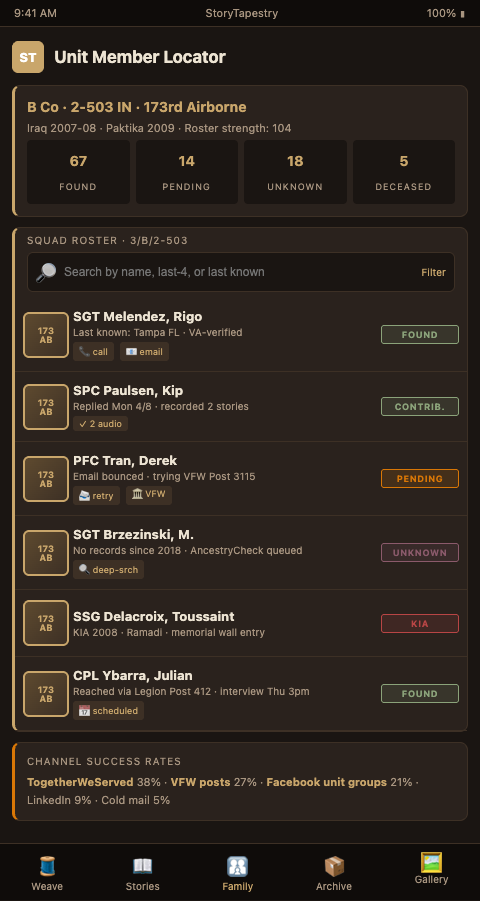
The location work starts with unit identification from the DD-214 and unit-reunion directories. Military Reunion Network maintains a searchable index of ship, unit, and squadron reunions; VetFriends hosts a directory of 10,000+ military units where members register to connect; VVA offers free locator services for Vietnam-era veterans (Military Reunion Network; VetFriends; VVA). StoryTapestry integrates query patterns for each directory so funeral directors can identify candidate comrades for a specific tour within an hour rather than a week.
The outreach protocol follows three phases. Phase one is the introduction message: a short, identified outreach from the funeral home that names the veteran, the unit, the dates, and the family's intention to build a memorial tapestry. Phase one messages succeed when they sound like the kind of note the VSO adjutant would forward, not a marketing pitch. Phase two is the contribution invitation: three options for how the comrade can participate, calibrated to introvert and extrovert preferences. Phase three is the scheduled interview or recorded contribution.
Interview methodology draws directly on the U.S. Army oral history guide and VHP transcription practice. Interviewers arrive prepared with unit history, maintain chronological flow, follow emotional clues rather than script, and close with explicit consent for use and editing (U.S. Army; Library of Congress). Trauma-informed protocol from NPHM adds breaks, consent reinforcement, and narrator control over final content (NPHM). StoryTapestry embeds these protocols as interview templates and consent flows so funeral directors practice the methodology without memorizing the doctrine.
Unit Comrade Outreach Network maintains contact histories across memorials. When the firm reaches out to a Marine veteran for one family's memorial and he contributes well, the system remembers the interaction (with his consent) so he hears from the firm appropriately if his name surfaces in another unit memorial. Over years, the firm builds trusted comrade relationships that raise contribution rates across every subsequent veteran intake. Funeral directors working on scattered comrade stories projects draw from this network repeatedly.
Deployment Timeline Reconstruction attaches each contribution to the specific tour or garrison where the contributor served with the deceased. Classified-Aware Story Frameworks ensure comrades can participate fully without crossing operational lines. Dual-Life Narrative Integration folds the interview contributions back into the family tapestry so the comrade's voice sits alongside the widow's memory of the same tour. This workflow aligns closely with unit reunion networks where reunion gatherings themselves become contribution harvests.
Interview consent flows handle the full spectrum of contributor preferences. Some veterans consent to full public attribution with video, some to audio only, some to written transcript only, some to contribution under first name and unit designation only, and some to contribution that the family will see but that will not appear on the public tapestry. StoryTapestry captures these preferences at the start of the interview with a structured consent form the contributor signs digitally, then applies those preferences automatically throughout the weaving workflow. Contributors who trust that their choices will be honored consistently contribute more fully than those who must repeatedly advocate for their preferences across a staff that may not track them reliably.
Advanced Tactics for Effective Comrade Outreach and Interviews
Prepare a unit brief before any outreach. Read the unit's deployment history for the exact dates the veteran served, note major operations, battalion commanders, and significant casualties. When the first outreach message references the unit accurately, response rates climb because the recipient sees the firm has done the work. This signals respect in a way the warrior ethos recognizes immediately.
Route outreach through VSO adjutants where possible. A message from the funeral home through the American Legion post or VFW adjutant for the unit's home state carries institutional cover that cold outreach lacks. The VSO adjutant vouches for the firm and its intention, and comrades who would never open an unknown email open the one forwarded by their post commander.
Record every interview with explicit consent, following VHP transcription guidance so the archive has lasting value beyond the immediate memorial (Library of Congress). The Library of Congress accepts qualifying VHP contributions into its national archive, and comrades often find contributing to both a family memorial and a national archive more meaningful than either alone.
Follow trauma-informed protocol on every interview. Offer breaks at predictable intervals, confirm consent about what gets included after the conversation, and give the narrator a draft of their contribution to approve before it appears in the tapestry (NPHM). Narrator control is not a procedural nicety but the ethical foundation of veteran oral history.
Pace outreach across the memorial lifecycle. The first wave in the two weeks before and after the funeral captures comrades ready immediately. A second wave at the three-month mark catches those who needed time. A third wave at the one-year anniversary often produces the longest contributions. Veterans Day and Memorial Day windows each surface additional participation.
Attribute every contribution with the contributor's rank, unit, and tour dates. This is what comrades care most about: that their service position is named correctly. A Marine who contributed as a Lance Corporal in Fallujah wants the tapestry to show "LCpl, 1st Battalion, 8th Marines, Fallujah 2004" alongside his words.
Batch your outreach by deployment cluster rather than one comrade at a time. When you identify fifteen potential contributors from the same 2006 Ramadi tour, send a coordinated outreach wave that acknowledges the shared context explicitly. Comrades who see that their platoon mates are also being invited contribute more willingly because the memorial feels like a unit project rather than an isolated family request. This approach also surfaces contributor recommendations from within the group, as former squad members often know where other members landed after separation and can forward the outreach laterally in ways that cold contact cannot achieve.
Handle the interview logistics with military precision. Arrive ten minutes early, test recording equipment in advance, confirm the interview location is free from interruption, and bring a printed copy of the veteran's DD-214 and unit assignment history as reference material the contributor can point to. Veterans notice logistics because their entire professional culture depends on them, and a funeral director who runs interviews with operational discipline earns respect that unmistakably translates into richer contributions. Conversely, a sloppy interview signals to the contributor that the memorial is not being handled with the care they would bring to it themselves, and the contribution narrows accordingly.
Track declined invitations separately from active contributors. Some comrades decline the first invitation for reasons that have nothing to do with the veteran or the funeral home: current grief, work travel, family medical crisis, or simply the timing of the request. Treat these declines as pauses rather than rejections, and reach out again at the 90-day or one-year anniversary with a softer framing. The tapestry that receives contributions over a two-year window usually holds twice the depth of one that closes at the funeral reception. The same patience applies to scattered relative connections, where finding distributed contributors across continents requires the same extended outreach cadence and the same willingness to let responses arrive on the contributor's own timeline.
Run Professional Comrade Outreach on Your Next Veteran Memorial
Veteran Memorial Programs serving families who want full unit witness need outreach and interview capacity that smaller funeral homes cannot build from scratch. StoryTapestry bundles directory integration, three-phase outreach, trauma-informed interview templates, and attribution management into a single workflow funeral directors can run confidently. Book time with our Veteran Memorial Programs team to see the outreach dashboard in action and bring professional oral history practice to the comrades still holding your next veteran's story.
The dashboard demonstration covers comrade discovery across three representative scenarios: a Vietnam-era Army helicopter crew chief whose unit reunion association maintains an active mailing list, a Cold War Navy submariner whose boat crew dispersed globally after decommissioning, and a post-9/11 Marine whose platoon stayed in tight Facebook-group contact through the years since separation. Each scenario surfaces different outreach mechanics, and the walkthrough shows how the platform adapts to the contributor culture of each era and branch. Your staff leaves with a working mental model for how the next outreach cycle will run, and with confidence that the trauma-informed interview protocols will hold up under the pressure of a combat veteran contributor who takes eight weeks to respond to the first invitation.
The veterans' community will notice when your firm runs outreach with the professionalism their service culture expects, and referrals from comrades satisfied with one memorial often generate intake requests from families planning ahead for their own losses six months or a year later.