Connecting Scattered Relatives for Collaborative Life Story Building
Why Distance Breaks Family Memory
Research published in Wiley Global Networks on transnational grandparenting captured the grief of distance in one quote from an interviewed grandmother: "I kiss the screen, but it is not the same." Distance fractures not only caregiving but memory itself. When relatives live on different continents for decades, the shared stories that used to be reinforced at weekly gatherings slowly dissolve into private fragments.
A PMC study of older Europeans' family networks documents that older adults sustain family connections across longer distances than previous generations, but those connections depend on intentional digital bridging. SAGE research on transnational families confirms that social media maintains long-distance family relationships, yet the same research notes that memorial moments often reveal gaps no Facebook thread can close.
The Taylor & Francis research on communication and family isolation shows that call frequency mediates the relationship between proximity and isolation. In families that never established a calling rhythm, the death of the matriarch exposes how little anyone knows about her siblings, her childhood, or her life before emigration. Geographically dispersed family remembrance requires a structured opportunity to ask, share, and reconnect.
A Tapestry Framework for Joint Memorial Creation Across Borders
The tapestry metaphor is uniquely suited to collaborative life story building online. A tapestry accepts contributions from many hands, woven over time, without requiring any single weaver to know the whole pattern. The completed fabric reveals connections the individual weavers never saw while they worked.
StoryTapestry organizes reuniting distant family for tributes around four collaborative patterns. First, a living family tree canvas lets any contributor add relatives they know about, flagging uncertainty where appropriate. A second cousin in Argentina adds her mother's siblings that nobody in the Phoenix branch remembered existed. The tree becomes a collaborative genealogical document, not a static diagram entered by one organizer.
Second, memory-prompt threading invites specific contributors to respond to specific stories. When a Tijuana aunt shares a childhood story about the deceased, the platform prompts her brother in Chicago with "Your sister mentioned this; what do you remember?" This chained prompting connects scattered caregiver stories across relationships, surfacing memories that would never emerge from an unstructured "share your story" form.
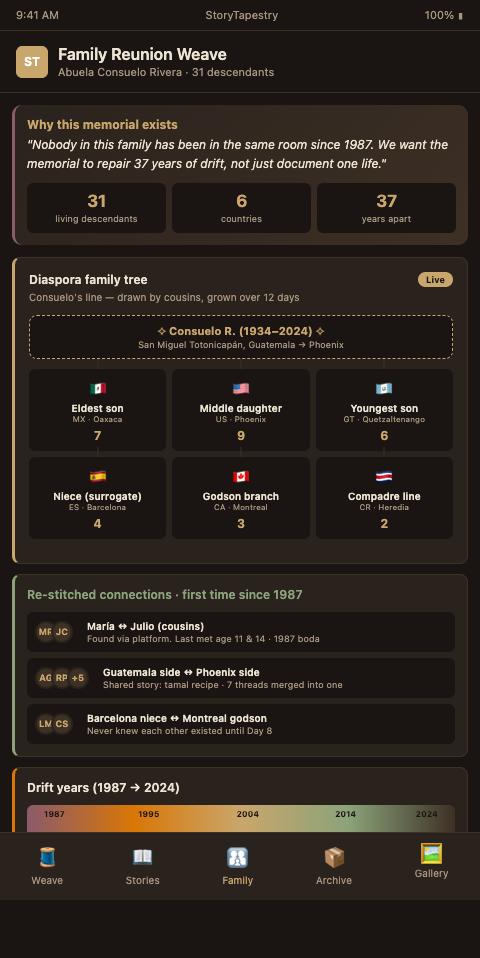
Third, cross-contributor discovery surfaces unexpected connections. Two cousins who have never met might both have known the deceased during her teaching career but in different decades. The platform identifies the overlap and suggests they each read the other's contribution. Families repeatedly describe this feature as the memorial's unexpected gift: rediscovering relatives through the deceased's woven story.
Fourth, ongoing contribution beyond the service converts the memorial into a permanent family archive. NBC News reported on VR family reunion projects that use 360-degree video to let separated immigrant families be present together, and StoryTapestry borrows that principle for asynchronous storytelling. A cousin who discovers a letter in 2027 can add it to the 2024 memorial, extending the tapestry rather than starting a new document. This parallels findings from SAGE Memory Studies research on StoryCorps about intergenerational memory narratives that evolve over time.
Building on the cross-continent collection architecture, the collaborative layer focuses less on intake logistics and more on connection. The platform asks: who among the contributors hasn't spoken in 10 years? What questions would one cousin love another to answer? Which generational gap deserves bridging while everyone is grieving together?
Generations United research on intergenerational immigrant families confirms that storytelling bridges cultural gaps across generations within immigrant families. A memorial moment, handled well, can repair decades of drift rather than simply documenting loss.
The platform's collaborative architecture also addresses one of the quieter injuries of diaspora life: the sense that relatives are strangers who happen to share ancestry. A second cousin in Manila who has never met her Vancouver cousins can, through the memorial, discover that those cousins loved their common grandmother in ways she recognizes. A Dominican-American nephew may learn that his uncle in Santo Domingo tells the same childhood stories about their grandfather in slightly different words, revealing a shared inheritance he never knew he had. StoryTapestry deliberately surfaces these moments of recognition through algorithmic prompts like "three contributors mentioned your grandmother's sewing machine" or "two cousins described the same rainy day in Kingston in 1971." These surfaced overlaps often become the starting point for relationships that outlast the memorial itself.
Advanced Tactics for Reuniting Distant Family for Tributes
Funeral directors coordinating scattered-family memorials add several layers of intentional practice. First, conduct a pre-service family tree interview. Spend 30 minutes with the primary family asking explicitly about relatives the memorial should include: siblings, cousins, in-laws, chosen family, godchildren. Families are often astonished at how many relatives surface once the question is asked directly rather than assumed.
Second, recruit branch coordinators from each geographic cluster. One cousin in Mexico, one in the United States, one in Spain, one in the Philippines, each responsible for reaching their local branch. This delegation honors how transnational families actually communicate (kin-group phone trees) rather than imposing a one-to-many email blast that gets ignored. Partnering with diaspora contributor networks formalizes the same principle at community scale.
Third, invite reconnection directly in the memorial. A section titled "Messages to each other, not just about her" invites cousins to write notes to estranged relatives using the memorial as a safe re-entry point. Funeral directors tell us this section is often the most tear-stained in the final printed tapestry.
Fourth, facilitate follow-up gatherings. Once the memorial has reconnected 31 descendants, some of them will want to actually meet. StoryTapestry includes gathering planning tools (venue polling, date scheduling, contribution tracking for shared costs) so the family can organize a one-year anniversary reunion in grandmother's hometown or a neutral location. The memorial becomes the on-ramp to a reunion that might otherwise never have happened.
Fifth, document the reconnection itself. As cousins who haven't spoken in 25 years reconnect through the memorial, encourage them to add a new story thread about that reconnection. "Reading your contribution, I realized..." or "After 25 years of silence, we spoke again because of her memorial..." These reconnection threads become part of the deceased's legacy, a concrete testament to the family she held together.
Sixth, plan translation bridges for relatives who have lost shared language. Second-generation cousins might only speak English while first-generation cousins only speak the heritage language. The platform's bilingual architecture lets them communicate through the memorial's translation layer, often leading to ongoing relationships that continue long after the service.
Seventh, navigate the emotional minefields that dispersed families carry. Some estrangements have solid reasons behind them: political disagreements from the old country, business disputes across borders, inheritance conflicts that fractured branches for generations. A memorial that naively invites every known relative without context can reopen old wounds rather than heal them. StoryTapestry's family mapping phase includes a sensitive question about known estrangements and their causes, so coordinators can decide whether to invite, to warn, or to skip particular relatives. This is judgment work that belongs to the family, not to the funeral director, but the platform surfaces the question rather than letting it surprise the intake during the service.
Eighth, allow relatives to contribute without attending if attendance itself feels too charged. Some cousins genuinely cannot face a large family gathering after decades of distance, but they can write a tribute from the safety of their own home. The option to contribute asynchronously without appearing on video or in person gives these relatives a way to participate that honors both their grief and their limits, and many families report that these quiet contributions become some of the most meaningful on the finished tapestry.
Ninth, protect contributors who are geographically vulnerable or politically exposed. Some relatives may live in countries where public association with diaspora family members carries real risks, whether from authoritarian surveillance, religious persecution, or political reprisal. A Uyghur cousin in Xinjiang, an Iranian relative in Tehran, a Belarusian niece in Minsk may each have reasons to contribute privately without appearing on a public memorial. StoryTapestry's tiered privacy architecture lets these contributors participate under pseudonym, through trusted intermediaries, or with their identity visible only to specific family members. Their voices remain part of the memorial without putting them at risk in their home country, which matters for families whose diasporic history was itself shaped by the need to leave such conditions behind.
Reconnect the Family Your Next Memorial Could Heal
Every scattered family contains relatives who haven't spoken in years. A memorial, handled with intention, can be the moment they reconnect rather than another missed chance. StoryTapestry was designed so the memorial's collaborative architecture surfaces relatives, sparks reconnections, and preserves the conversations that follow. Schedule a consultation with our diaspora services team to walk through a real reconnection case study, and we will help you plan your next scattered-family service as a legacy-building event rather than a logistical challenge. The consultation includes a walkthrough of the collaborative family tree canvas, the memory-prompt threading system, and the cross-contributor discovery algorithms. We also discuss the follow-up planning tools for families who decide to hold an in-person reunion months or years after the initial service, and the platform's handling of sensitive estrangement situations.
Funeral directors who adopt the collaborative memorial model typically report family feedback that transcends the grief itself, with relatives describing the memorial as the catalyst for reconnections they had given up on. Your next scattered-family service can be the moment 20 relatives across five continents remember they are actually a family, not a diaspora diagram, and your funeral home can be the institution that made that reconnection possible.