Building Contributor Networks Within Diaspora Community Organizations
Why Direct Outreach Fails Dispersed Diaspora Communities
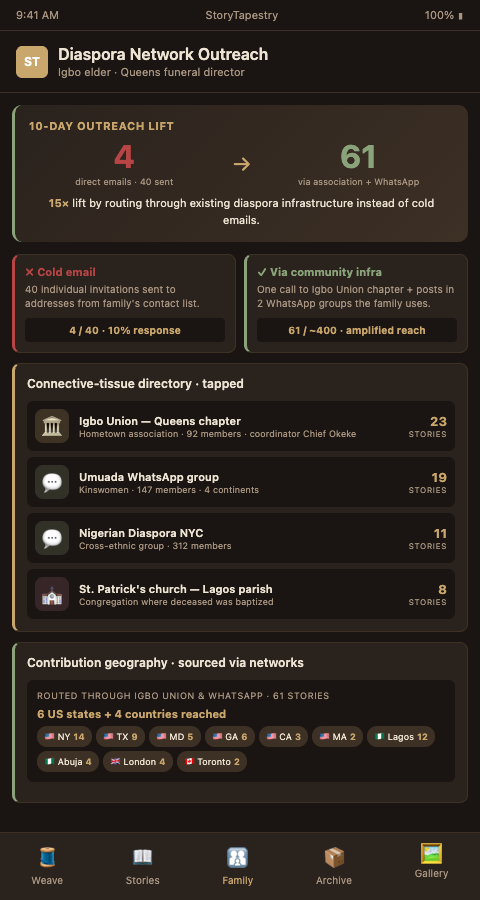
A Queens funeral director handling an Igbo elder's memorial sent 40 individual invitations and collected 4 tributes. The family network was not small — they were dispersed across six US states, Lagos, Abuja, London, and Atlanta — but the director's individual-email approach missed the connective tissue that actually holds these communities together. After one call to the local Igbo Union chapter, contributions flooded in: 61 stories in ten days from people the family didn't personally know had stayed in touch.
Hometown associations and ethnic community organizations provide this connective tissue. The Migration Policy Institute documented how HTAs serve as integration intermediaries for immigrants, and a parallel MPI paper on ethnic community-based organizations showed that ECBOs drive refugee integration as trusted liaisons between newcomers and institutions. For funeral services, these same organizations are the fastest path to recruiting story contributors from immigrant groups.
The scale is substantial. The World Bank reported $685B in remittances to low- and middle-income countries in 2024, and Pew Research tracks global migration data that shows community-based organizations are where financial and social flows across borders get coordinated. The University of Maryland CISSM report on diaspora communities and Taylor & Francis documentation of Chinese voluntary associations both emphasize that these organizations already function as social welfare and coordination infrastructure — memorial collection fits naturally into their existing operations if funeral services engage them the right way.
A Tapestry Framework for Diaspora Association Storytelling Partnerships
A tapestry is not woven by individual threads finding each other randomly. It requires a loom, and for diaspora memorial collection, hometown associations and ethnic organizations are the loom. StoryTapestry treats these partnerships as structural infrastructure, not as optional outreach channels.
The framework rests on six operational commitments:
1. Maintain an organization-level registry. StoryTapestry lets funeral services build and maintain relationships with diaspora organizations in their service area — Nigerian hometown associations, Filipino community organizations, Armenian cultural societies, Hmong clan groups. Each organization has a designated liaison, communication preferences, and documented outreach history. This registry is treated as a strategic asset that persists across individual memorial events.
2. Tiered outreach protocols. For any memorial with significant diaspora family presence, StoryTapestry surfaces relevant community organizations based on the deceased's origin region, language, and affiliations. Outreach cascades through three tiers: family direct contacts, organization liaisons, and broader community channels (WhatsApp groups, social media, local radio). This works precisely because scattered relative outreach flows naturally through the same organizational networks that families already participate in.
3. Organization-branded collection pages. When an Igbo Union chapter shares a StoryTapestry link, the page surfaces with chapter branding alongside family branding. This signals to members that contributions are sanctioned and appropriate, addressing the hesitance many diaspora contributors feel about submitting personal stories to an unfamiliar platform.
4. Language-matched intake via community liaisons. Organization liaisons typically speak the community's primary language and dialect, which shortcuts the dialect-routing problem StoryTapestry handles elsewhere. A Tagalog-speaking liaison collects from Tagalog-speaking elders; the platform handles transcription and tagging downstream.
5. Multi-channel presence including embassy coordination. For particularly dispersed communities, StoryTapestry integrates with embassy story contacts workflows, letting consular community-outreach officers extend collection into countries where the deceased had extended family.
6. Reciprocal value to partner organizations. StoryTapestry provides organizations with community memorial archives, member obituary notification infrastructure, and event-anniversary reminders. This reciprocity matters — organizations engage more deeply when partnership delivers value beyond one-off favors.
International platforms like iDiaspora connect diaspora organizations globally, and funeral services that plug into these networks tap pre-existing trust and coordination capacity rather than trying to rebuild it one email at a time.
The organization-first model also addresses a significant blind spot in conventional diaspora outreach: the organizations themselves often know facts about the deceased's community presence that the immediate family does not. A Ghanaian Asante hometown association may maintain records of who attended which community events over two decades, who served in leadership roles, who supported community crises financially or through volunteering. When the Asante association shares this context with the funeral home, the memorial can include community-facing stories the immediate family never knew about. A daughter discovering that her father quietly paid school fees for three village children throughout his life transforms her understanding of who he was. Organization partnership is not only about contributor reach; it is about narrative completeness.
Advanced Tactics for Community-Based Memorial Participation
Map your service area's diaspora composition systematically. Use census data, community directories, and introductory meetings with 5–10 organization leaders per community to understand who's who. Document clan, regional, or religious subdivisions — "Nigerian" subdivides into Igbo, Yoruba, Hausa, and many more; "Filipino" subdivides by region and dialect. Generic outreach misses these subdivisions; specific outreach lands.
Designate a community liaison role inside your funeral service. One staff member owns relationships with 15–30 community organizations, attends occasional community events, and maintains the partnership registry. This role pays back quickly — organizations return favors to people they know, not to a generic funeral home email.
Reuse contributor networks across veteran, religious, and community identities. For a deceased who was both a community elder and a veteran, layering community association outreach with unit reunion networks workflows multiplies reach. A person's full identity threads through multiple communities; the collection architecture should reflect this.
Respect organizational protocols. Many diaspora associations have president/secretary protocols for external communications. Routing outreach through formal channels signals respect and increases cooperation. Direct-messaging individual members bypassing leadership can generate friction.
Provide organizations with light-weight dashboard access. Let liaisons see how many contributions have arrived, from which members, in which formats. This visibility lets them make targeted follow-up calls (e.g., "we have nothing from the Abuja chapter yet") that funeral directors cannot make themselves without cultural context.
Plan for organizational succession. Community leadership rotates. Your liaison contact today may not be the liaison next year. Document the relationship, not the person. Introduce new funeral home staff to incoming association leaders at routine community events, not only when a memorial is imminent.
Handle sensitive intra-community tensions deliberately. Some communities have factional splits (hometown vs. city-wide, religious vs. secular, older vs. younger generation). Don't assume one association represents everyone. Work with multiple overlapping organizations where needed.
Invest in community-benefit initiatives, not just referral relationships. The strongest partnerships form when your funeral home contributes to the community beyond funeral services. Sponsoring a community health fair, hosting a cultural education workshop, providing meeting space for an association's monthly gathering, or contributing to a scholarship fund all signal that your relationship with the community extends beyond transaction. Community associations notice which funeral homes invest in community well-being versus which ones only appear when there is a potential referral, and that observation shapes which homes they recommend.
Respect language and communication preferences specific to each community. Some Nigerian associations prefer WhatsApp group coordination; some Filipino associations use Facebook community pages; some Ethiopian associations rely on physical bulletin boards at Ethiopian Orthodox churches; some Cambodian associations coordinate primarily through temple networks. A generic email from your funeral home may never reach members who don't check email regularly. Matching your outreach channel to each community's actual communication practices dramatically improves response rates and signals cultural competence to association leadership.
Coordinate with multiple overlapping associations for communities that span distinct subgroups. Indian diaspora communities often have Tamil associations, Punjabi associations, Gujarati associations, Malayalee associations, and many more, each serving distinct subpopulations. Nigerian communities similarly span Igbo, Yoruba, Hausa, Ibibio, and other hometown-specific associations. A single "Indian community outreach" or "Nigerian community outreach" misses most of the actual community structure. Work with multiple subgroup-specific associations to reach the communities your families actually belong to, and let each association handle the outreach that fits their network.
Turn Your Funeral Service's Community Relationships Into a Memorial Collection Engine
The most transnational diaspora families in your service area are one phone call away — but only if you've already built the relationship with the hometown association, cultural society, or community liaison. StoryTapestry structures these partnerships so your funeral service doesn't scramble when a memorial arrives. Contact our team to map your service area's diaspora organizations and configure reciprocal partnership workflows. Your families will experience outreach that reaches every cousin, every elder, every community elder who should have been part of the story. The initial mapping exercise typically identifies 15 to 40 diaspora organizations within a metropolitan service area, spanning hometown associations, cultural societies, heritage churches and temples, professional associations for specific immigrant communities, and informal WhatsApp or social media networks.
We help you prioritize the five or six highest-leverage partnerships based on your current caseload and your community's future demographic trajectory, and we structure reciprocal value arrangements that give partner organizations concrete benefits. Funeral homes that implement structured community partnerships typically see measurable referral growth within two or three quarters, with the growth compounding as each successful service generates word-of-mouth within the partner community. Your competitive position in diaspora memorial services is ultimately determined by which community organizations trust you enough to route families your way, and that trust is built over years through deliberate relationship investment.