Why Scattered Caregiver Stories Matter for Complete Memorials
The Problem with Treating Family as the Sole Source
Traditional funeral home intake privileges family memory as definitive and treats everyone else as supplemental. That logic falls apart in dementia care. PMC research on family caregivers of people with dementia describes these caregivers as the "invisible second patients," bearing physical and emotional loads that often exceed what any single person can process into coherent biography. By the time they sit with a funeral director, they have spent years in a survival mode that leaves little bandwidth for story curation.
The gap widens when family caregivers are isolated. PMC on burnout syndrome in informal dementia caregivers reports roughly 50% of dementia caregivers experience loneliness and 37% social isolation, which means they often lack the conversational partners who would help them surface stored memories. A director asking "tell me about your mom" receives what exhausted grief produces: essentials, a few high-points, and a profound sense of having forgotten everything that mattered. The stories are not lost — they are distributed across dozens of people the family has not yet thought to call.
Weaving Scattered Threads Into a Complete Memorial
The solution framework starts with rejecting the primary-source model and embracing distributed authorship. StoryTapestry organizes memorials around the insight that a life lived inside a memory care community generates stories across staff, neighbors, longtime community members, and distant relatives. Each holds fragments the family never witnessed, and each fragment becomes a thread in the tapestry. The platform's job is to find and weave those scattered threads without burdening the grieving family with the logistics.
This reflects established practice. A PMC review of life story resources in dementia care emphasizes that life stories bring together multiple sources to produce a richer record than any single contributor can offer. Innovation in Aging research on CNA perspectives on dementia documents that CNAs spend roughly 4.1 hours per day interacting with residents, often far more one-on-one contact than any family member. PMC on comparing family and healthcare professional perspectives shows that HCPs and family caregivers assess dementia experience differently, which means their story fragments often complement rather than duplicate one another.
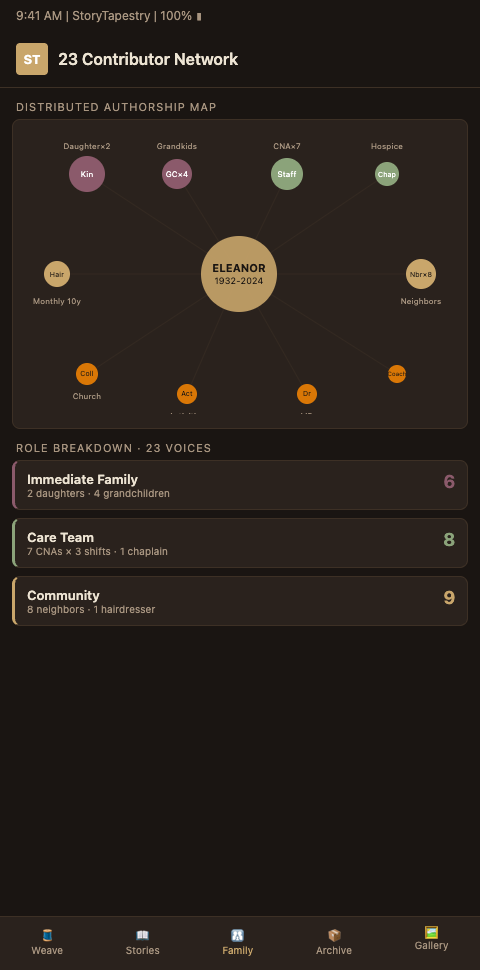
Operationally, StoryTapestry makes scattered contribution cheap. A hairdresser who saw the resident monthly for a decade receives a text with three prompts tailored to her vantage point. She records 90 seconds of voice memo and uploads a photo. That becomes a permanent thread. A night-shift CNA logs a two-sentence observation during her shift handoff. That becomes another thread. The family never has to coordinate outreach, because the platform routes prompts based on facility records, visitor logs, and family-provided contact lists.
Contradictory Memory Reconciliation matters more when contributor count grows. Two CNAs may disagree about whether a resident preferred coffee or tea. Two siblings may disagree on their mother's college major. The tapestry preserves both with attribution rather than forcing a vote, which connects to practices around conflicting memory management. Families often find the disagreements endearing once surfaced, because they reveal how many people held pieces of the person.
The core metaphor applies literally here. A tapestry's strength comes from weaving many short threads from different spools. No thread carries the weight alone, and each is visible in its place. Scattered caregiver stories, woven, produce memorials that a single grieving family could never build on their own. This approach complements caregiver story gathering at the intake stage.
Contributor outreach operationalizes the framework. When a funeral home opens a tapestry, StoryTapestry pulls contact data from three sources: the family's shared contact list, the facility's approved visitor log, and the hospice agency's caregiver roster. Each identified contributor receives a three-prompt outreach tuned to their relationship type, usually within 24 hours of memorial opening. The text or email includes a one-minute video explanation from the funeral director, a statement that contributions of any length are welcome, and a simple submission path that accepts voice memo, photo, or short text. Contributors who do not respond in 72 hours receive a single follow-up; those who still do not respond remain on the list but are not contacted again unless the family specifically asks. This cadence respects the contributor's autonomy while still opening the door wide enough that threads the family never would have thought to seek can find their way in.
Advanced Tactics for Distributed Authorship
The most common funeral home mistake is underinvesting in contributor prompt design. A generic "share a memory" form yields thin submissions. Prompts tailored by relationship type — 5 for CNAs, 5 for neighbors, 5 for adult grandchildren, 5 for former coworkers — yield dense material that directors can weave without heavy editing. Their Life Stories' approach to obituary writing treats obituaries as mini-biographies requiring multi-source input, which is the right frame for distributed contribution too.
Edge cases worth scripting. Contributors who submit adversarial or damaging content need family reviewer routing before anything is visible. Contributors who submit long recordings need an auto-transcription path so the family is not asked to listen to six hours of raw material. Contributors who submit identical fragments (common in residential facilities where staff share anecdotes) should be merged at review time rather than deleted, preserving the multiple attributions as a signal that the detail was widely known.
Scaling the distributed model across a funeral home network requires contributor library hygiene. Once a CNA has contributed to three memorials, her prompt preferences, typical response length, and availability window become predictable. The next outreach is a 90-second send, not a cold ask. Funeral homes operating at scale should also script the "last contact" closing: every contributor receives an acknowledgment when the memorial goes live, which preserves relationships for future residents the same staff will know.
Measure the model's health with three metrics: mean number of non-family contributors per memorial, percentage of contributors who submit at least one fragment after prompt delivery, and family satisfaction ratings on completeness versus depth. Memorials with 15+ contributors consistently rate higher on both dimensions than memorials built from family alone.
Post-service growth is where distributed authorship compounds. A memorial tapestry that stays editable for 12 months after the service typically gains another 15-25% of fragments from contributors who only heard about the death through obituary channels. Some of these late contributors are former coworkers who moved away decades ago, college roommates the family had lost touch with, or neighbors from earlier homes who saw the obituary and want to contribute. StoryTapestry keeps the tapestry open with a gentle monthly nudge to the family, and the late contributions often include the specific stories families describe as surprising gifts. A father-in-law from the 1970s sending a three-paragraph recollection six months after the service can reshape the family's own understanding of their loved one, and the tapestry holds it permanently alongside the service-era threads.
Contributor retention across memorials deserves attention from multi-facility funeral homes. A CNA who contributed meaningfully to three resident memorials in the past year becomes a repeat contributor whose preferences, prompt styles, and availability windows are already known to the system. The fourth outreach reaches her with a 30-second ask that respects the relationship rather than a cold prompt that asks her to re-explain herself. Over time, this creates a contributor community — a group of 200-400 caregivers, neighbors, and extended relatives across a funeral home's territory who have each contributed to memorials they cared about. Their collective memory about the funeral home and its care for the families they served becomes a durable asset that no advertising can replicate.
Gather Scattered Stories for Complete Memorials
Memory Care Funeral Homes on the StoryTapestry waitlist are among the first to pilot distributed contributor intake designed specifically for dementia families. If your firm serves memory care facilities and regularly sits with exhausted families who feel they have forgotten too much, this workflow gives your directors a structured way to reach CNAs, neighbors, and scattered relatives without overloading the family. Reserve a pilot slot to help shape contributor prompt libraries, privacy routing, and acknowledgment workflows for your region.
Early pilot partners work directly with the StoryTapestry product team during the first 90 days to tune the outreach cadence, the relationship-specific prompt sets, and the privacy routing rules for your partner facilities. Your directors receive supervised training on distributed intake practice, and your first three memorials on the platform are assembled with concierge support so the transition from family-only intake to distributed authorship happens with structure rather than guesswork. As a pilot partner, your firm's feedback shapes the production release of the contributor library management features, the acknowledgment templates that keep contributors engaged across memorials, and the reporting dashboards that let your directors see how distribution is evolving across the facility network. For firms that also serve families with scattered family connections across distances, the same distributed authorship infrastructure adapts naturally to transnational cases.
Reserve a pilot slot to move your memory care memorials from the thin two-paragraph obituary default toward tapestries woven from the CNAs, hairdressers, neighbors, and scattered relatives who actually hold the fragments of the life.