Managing Conflicting Memories in Dementia Bereavement Stories
The Contradictory Recollection Problem in Dementia Bereavement
Memory research over three decades has established that family recollections of shared events diverge systematically, not randomly. Mothers and adult children reach different conclusions about the same childhood events when interviewed independently, with agreement rates on specific details often falling below 50% (PMC - Long-Term Recall Agreement Study). When the family matriarch has died from Alzheimer's disease, there is no authoritative voice to settle disputes, and the contradictions surface precisely when funeral directors need a unified narrative for the service.
The problem intensifies in dementia bereavement because primary caregivers often hold memories that the rest of the family cannot verify. The daughter who managed the last seven years of appointments remembers conversations about her mother's first marriage that none of the other siblings ever heard. A sister-in-law insists a beloved family story about a grandfather's military service is a fabrication his wife told to impress in-laws. Natural family conversations can actually generate entirely new false memories through social reinforcement, creating shared but unreliable narratives (PMC - Natural Conversations and False Memories). Funeral directors partnering with memory care facilities regularly find themselves mediating memory disputes that families cannot resolve among themselves, often in the emotionally charged hours before a service.
Managing Conflicting Stories in the Memorial Tapestry
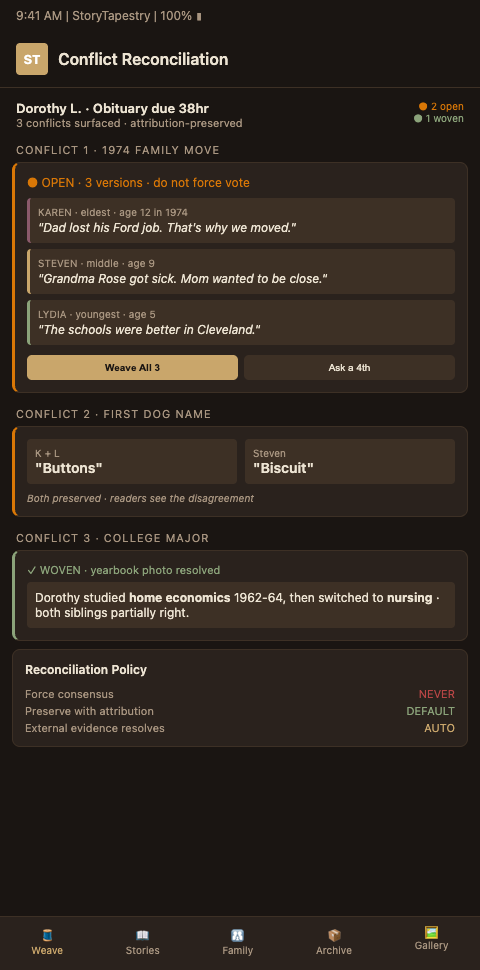
StoryTapestry treats contradictions as features to preserve rather than errors to eliminate. Managing the conflicting stories families bring into an arrangement conference is the core skill this workflow was built around. The tapestry metaphor matters here because a real life contains genuinely different perspectives, and a flattened consensus version erases the texture that family members recognize as authentic. When three siblings submit three different reasons for the 1974 move, the platform captures all three as threads and tags them with contributor attribution.
The Contradictory Memory Reconciliation feature surfaces disagreements during the intake process rather than at proofreading. When a contributor submits "Dad worked at Raytheon from 1968 to 1985" and another contributor submits "Dad left Raytheon in 1983 for the Bedford office," the system flags the overlap for the funeral director to investigate. This mirrors 30 years of research by Elizabeth Loftus showing that memories are malleable and that specific details drift under social influence (Learning & Memory - Loftus & Palmer Misinformation). The point is not to catch liars but to surface the natural variation that every family carries and preserve it in the archive. Eyewitness memories suffer systematic errors and biases even under ideal conditions, and bereaved families are operating under the opposite of ideal conditions (Noba Project - Eyewitness Testimony and Memory Biases).
StoryTapestry offers three reconciliation modes for each flagged contradiction. "Authoritative" picks one version based on documentary evidence (tax records, employer verification, photos with timestamps). "Pluralistic" presents both versions in the memorial with attribution ("According to his daughter Susan... his son Mark recalls..."). "Suspended" marks the detail as uncertain and omits it from the written tribute while preserving both submissions in the private family archive for later review. Memory care funeral homes report that pluralistic mode produces the memorials families describe as most authentic, because it captures the genuine shape of family recollection rather than imposing a false unanimity on a life nobody can now confirm directly.
The attachment context matters too. Research on adolescent-parent memory reconstruction shows that secure attachment predicts more favorable but not necessarily more accurate reconstructions (PMC - Adolescent-Parent Memory Reconstruction). In dementia bereavement, the adult child who was closest to the deceased during decline may carry the most tender version, while the sibling who moved away carries the version from before the disease. Both are real. StoryTapestry preserves both through the family interview strategies that structure separate contributor sessions rather than forcing a group consensus.
The director's posture during reconciliation sessions is its own craft. A director who signals the "correct" version through tone or body language causes quieter family members to withdraw their contradicting memories, which collapses the reconciliation work before it begins. A director who maintains genuine neutrality — capturing each version without implicit correction, using affirming language for each contributor's contribution, and modeling respect for the difference — produces tapestries that family members describe as feeling fair. Training directors in facilitative neutrality takes deliberate practice. It is not a temperament most funeral directors naturally bring, because the profession rewards decisive synthesis. The reconciliation role requires the opposite discipline, and firms that invest in the training see measurably different family satisfaction outcomes compared with firms that expect directors to figure it out on the job.
Advanced Tactics for Dementia Bereavement Reconciliation
Five advanced tactics help memory care funeral homes handle the hardest contradictions. First, adopt the independent-then-shared interview sequence. Research on memory manipulation demonstrates that once a group discusses an event together, individual recollections contaminate each other and original variations disappear (APA - Speaking of Psychology Memory Manipulated). Interview each contributor separately first, then share the reconciled draft for review. The reverse sequence destroys the evidence you need.
Second, treat emotionally charged memories with heightened care throughout the reconciliation process. Traumatic memory retrieval follows different rules than neutral memory, and high-stakes family events (a parent's illness, a sibling's death, a divorce) often produce the sharpest contradictions (SAGE - Traumatic Memory Retrieval). When three siblings give three versions of the week their father entered memory care, do not force consensus. The variation is the data, and capturing it faithfully is the director's actual job. Pair contradictory memories with sensory narrative threads where physical details (the color of the hospital room, the music on the car radio) anchor emotional recollection even when timelines diverge.
Third, handle dialect narrative management explicitly in multilingual and multicultural families. When a Cuban-American family's grandmother is remembered in Spanish by her oldest children and English by her youngest, the contradictions are often translation artifacts, not memory disputes. StoryTapestry tags language-of-origin on each submission, which prevents the director from "correcting" a Spanish idiom into a flattened English equivalent that nobody recognizes.
Fourth, use documentary anchoring when available. A tax return, a wedding announcement, a yearbook entry, or a military DD-214 can resolve certain factual disputes (dates, places, ranks, occupations) without requiring the director to mediate between contributors. The documentary anchor does not override memory threads; it supplements them. A memorial that says "his DD-214 shows service from 1968 to 1972; his wife remembers him leaving in the spring" captures both the factual record and the embodied memory without collapsing either. Families often appreciate seeing their memories supported or gently corrected by documentary evidence more than they mind the minor disagreement, because the document signals that the director did the research rather than guessing.
Fifth, preserve the discovery itself when meaningful. Sometimes family members discover during reconciliation that they had been carrying different versions for 40 years without realizing it. The moment of discovery is itself a piece of the family's story. When appropriate and with consent, capture the discovery as a thread in the tapestry: "her children did not realize until 2026 that they had remembered her graduation year differently for decades." This kind of meta-thread often becomes a touchpoint of family conversation for years after the service, because it acknowledges the way love and memory interact across a lifetime without requiring perfection from either.
Offer Reconciliation as a Memory Care Partnership Deliverable
When your funeral home can handle contradictory dementia bereavement memories with professional reconciliation rather than awkward family arbitration, you relieve memory care facility administrators of a persistent pain point. Families that leave arrangement conferences feeling heard across all their different perspectives return as advocates for your facility partnerships. StoryTapestry equips your team with the infrastructure to capture, flag, and reconcile contradictory memories without forcing consensus or erasing authentic family voice. Schedule a demonstration with StoryTapestry to see how memory care funeral homes use reconciliation workflows to produce memorials that families describe as true to the complex person they actually knew.
Pilot partner funeral homes receive direct product team support during the first 90 days for reconciliation workflow setup, director training in facilitative neutrality, and supervised assembly of the first three memorials that include contradictory fragments. Your feedback shapes the production release of the three reconciliation modes, the documentary anchoring integration, and the training modules that teach directors to hold space for contradiction rather than forcing synthesis. Your firm also contributes to the edge-case protocol library we maintain for the industry, which means the situations your directors encounter in the early pilot months inform the templates other firms use when they adopt the workflow later. Memory care facility administrators increasingly evaluate funeral home partners on their ability to handle complex family dynamics without escalating conflict, and reconciliation workflow is the most visible signal of that capability.
Schedule a demonstration to see how StoryTapestry positions your firm as the memory care bereavement specialist that treats contradictory memories as material to preserve rather than problems to resolve.