Managing Dialect Differences in Multilingual Memorial Narratives
Why Standard Translation Fails Dialect-Rich Memorial Narratives
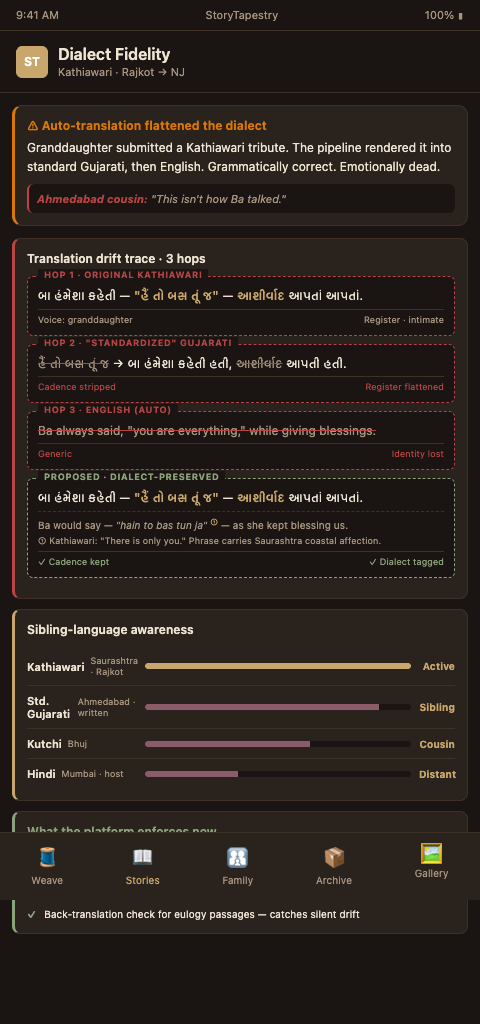
A Gujarati woman who spent 62 years in Rajkot before emigrating to New Jersey died in 2024. Her granddaughter submitted a tribute in Kathiawari, the coastal Gujarati her grandmother actually spoke. The funeral home's auto-translation pipeline rendered it into standard Gujarati first, then English. The result was grammatically correct and emotionally dead. The cousins in Ahmedabad immediately recognized that "this isn't how Ba talked."
This mismatch is not a translation error in the traditional sense. It is a dialect-erasure problem that machine translation systems are known to cause. A comprehensive survey of NLP for dialects documents persistent performance gaps between standard language models and regional variants, with some dialects seeing accuracy drops of 20–40% even in state-of-the-art systems. A separate industry analysis from Powerling found that dialect variation introduces systematic misinterpretations that flatten regional voice into generic standard.
The stakes extend beyond accuracy. UNESCO's Atlas of Languages in Danger categorizes 2,473 languages by endangerment level, and many diaspora memorial narratives are the last living recordings of specific regional variants. When a Kathiawari-speaking great-aunt dies and her memorial is translated into standard Gujarati, a piece of the language dies with her, and the memorial becomes complicit in that loss. Multilingual narrative dialect challenges are therefore not just quality problems — they are preservation problems.
A Tapestry Framework for Preserving Dialect Authenticity in Eulogies
Imagine a tapestry woven from silk threads of 12 different regions. A Gujarati textile made only from Rajkot silk reads differently than one blending Rajkot, Ahmedabad, Kutch, and Surat silks side by side. Both are Gujarati; both are legitimate; neither should be uniformized. Dialect memorial management works the same way.
StoryTapestry treats each dialect as a first-class thread, not a rendering error. The framework rests on five principles:
Preserve source audio before any translation. The original recording is the ground truth, and StoryTapestry stores it immutably. Translations and transcripts are layered annotations, not replacements. This aligns with what the ScienceDirect foundational text on dialect and language variation argues: you cannot analyze a dialect you have already flattened.
Tag at the sub-language level. StoryTapestry's taxonomy goes below "Gujarati" to record dialect, sub-region, and approximate era. A Kathiawari speaker who left in 1962 speaks differently than one who left in 2005. These tags matter for cross-referencing among distributed contributors.
Use bilingual transcription, not translation-replacement. Every dialect submission generates three layers: the original transcription, a standard-language version, and an English reading. Readers pick their viewing depth. The dialect is never overwritten; it is merely accompanied.
Recruit dialect-native reviewers. StoryTapestry's reviewer marketplace lets funeral directors match each submission to a native speaker of that specific variant. A Kutchi reviewer handles Kutchi; a Manado-Malay reviewer handles Manado-Malay. This is more expensive than auto-translation and produces 5–10x more usable output for diaspora families.
Cross-reference dialect narratives through language barrier strategies and grief translation weight documentation. Dialect preservation is one axis of a broader multilingual memorial problem; linking to companion methodologies prevents funeral directors from treating each issue in isolation.
The Wikipedia sociolinguistic entry on African-American Vernacular English illustrates the same principle: AAVE is a rule-bound dialect with its own regional sub-variants, not a corruption of standard English. A memorial for a speaker of Southern AAVE translated into Midwestern-neutral English is not "cleaner" — it is wrong. StoryTapestry treats all dialects this way.
The dialect-preservation framework also addresses a subtle class problem that monolingual speakers often miss. In many diaspora communities, speaking the regional dialect marks someone as authentic while speaking the national standard marks them as urbane or educated. A memorial that renders all contributors into the national standard inadvertently erases the rural-urban class distinction that many elders spent their lives navigating. A Neapolitan grandmother in Brooklyn may have spoken a specific dialect all her life as a marker of her Napoli roots, and forcing her tribute into standard Italian strips away the specific identity she insisted on preserving. StoryTapestry treats dialect choice as identity choice, not as a translation decision for staff to optimize.
Advanced Tactics for Managing Vernacular Memorial Storytelling
Map contributor networks to dialect expertise. Before collection starts, ask each contributor to self-identify their dialect variant. This lets you route specific submissions to specific reviewers and catch errors like a Mumbai-raised cousin transcribing a Rajkot-native auntie's narrative. Dialect errors concentrate at the intake layer more than at the translation layer.
Build dialect glossaries per family. Each diaspora family has its own micro-vocabulary: the word "Ba" for grandmother in Gujarati, "Ajja" in Kannada, or the specific honorifics a family uses for a paternal aunt. StoryTapestry auto-extracts these from early submissions and builds a family-specific gloss that all subsequent submissions can reference.
Handle dialect-content overlaps carefully. Parental content disagreements show how dialect choice sometimes encodes deeper family tensions — which in-law's region gets prominence, which cousin's pronunciation is "right." Adjudicate these with documented conventions rather than ad-hoc edits.
Partner with endangered-language documentation programs. The Endangered Languages Documentation Programme has funded 500+ documentation projects, many covering diaspora languages like Ladino, Wukchumni, and N|uu. Funeral homes serving communities that speak endangered variants should coordinate with these programs; memorial recordings sometimes become part of the language's last corpus.
Plan for cross-generational dialect drift. A first-generation parent speaks a different dialect than their second-generation child. A memorial that quotes both should show this drift rather than uniformize it. StoryTapestry's annotation layer lets contributors flag generational variation without editing the source.
Audit machine-translation output before publication. Even excellent MT systems miss dialect-specific metaphors. Build a dialect-native reviewer into the publication flow, not just the collection flow. One hour of native-speaker review catches issues no post-edit pass will surface.
Offer dialect-specific intake interviewers for deep submissions. When the deceased's most significant stories involve a specific regional variant, such as Sylheti Bengali, Kutchi Gujarati, Jamaican Patois, or Trinidadian Creole, consider pairing key elder interviews with a volunteer or paid interviewer who speaks that specific variant. The difference in narrative depth between a Kutchi-native interviewer and a standard-Gujarati interviewer working with a Kutchi elder is substantial; the elder relaxes into familiar rhythms and shares material they otherwise guard.
Treat dialect metadata as long-term archival value. Even if your current memorial project has limited budget for dialect fidelity, capturing the dialect metadata (region, approximate era, contributor self-identification) at intake costs almost nothing and creates durable archival value. Fifty years from now, linguistic scholars or family genealogists may want to know precisely which variant of Tagalog, Tamil, or Tigrinya the recording preserves. Future value requires present documentation, and StoryTapestry's dialect taxonomy captures this metadata automatically when contributors fill in the language fields.
Handle colonial language layers as their own dialect category. A Portuguese-speaking Mozambican elder speaks Portuguese differently than a Brazilian elder, and both differ from a European Portuguese speaker. English carries similar variation: Indian English, Nigerian English, Caribbean English, Scottish English, and dozens of other varieties each have distinct patterns. A memorial for a Jamaican grandmother in London should preserve her specific English cadence rather than forcing her speech into received pronunciation. Colonial language dialects deserve the same fidelity as heritage languages because they are often exactly how the deceased identified themselves.
Coordinate dialect review with caption generation for audio and video. Automatic caption tools trained primarily on standard language variants produce particularly bad results on regional dialects. A native-speaker caption reviewer working alongside the dialect reviewer ensures the written captions match the spoken dialect rather than normalizing it to standard. This is especially important when the captions will be displayed alongside the audio for family members who prefer reading to listening, because incorrect captions undermine the dialect fidelity the audio preserves.
Offer Your Diaspora Families a Memorial That Speaks Their Region, Not Just Their Language
Standard-language memorials erase the very thing diaspora families most want preserved: the specific sound of home. StoryTapestry's dialect-aware tapestry gives your funeral service a concrete alternative — not generic multilingual support, but regional-variant fidelity. Your Kutchi families get Kutchi. Your Tigrinya-Asmara families get Tigrinya-Asmara. Contact our team to configure dialect tagging and native-reviewer routing for your service. Your contributors will hear the grandmother they actually knew, not an edited echo of her. The configuration work begins with an audit of the dialect variants most represented in your service area: specific South Asian regional languages, Caribbean creoles, African national and regional variants, Central American indigenous language overlays, Southeast Asian regional tongues, and any other sub-variants that matter for your families. We then build dialect-specific reviewer routes, intake prompts, and archival metadata schemas matched to your caseload.
Funeral homes that adopt dialect fidelity typically hear directly from family members within the first two or three services about how the memorial captured the grandmother's voice in a way no previous service they attended had managed. That feedback is exactly the word-of-mouth signal that establishes your home as the provider of choice for specific regional communities, and it accumulates into sustainable referral pipelines that outlast individual marketing campaigns.