Overcoming Language Barriers in Global Memorial Storytelling
The Emotional Compression Problem in Translated Tributes
Ethnologue catalogs more than 7,000 living languages, and every one of them contains grief vocabulary that does not map one-to-one onto English. Research published in PMC on the languages of grief documents how Japanese "hitan" and Portuguese "saudade" carry cultural weight that English terms simply cannot replicate. When a bereavement story moves from one language to another, something always compresses, shifts, or vanishes.
This is not a theoretical concern. The AMA Journal of Ethics reports that 60.6 million Americans speak a non-English language at home, and many of those families interact with funeral homes exclusively through English-speaking directors. A Baylor University study on Latino bereavement found funeral directors openly worry that "something is lost in translation" during memorial planning.
A Frontiers in Computer Science analysis of machine translation confirms this intuition: automatic translation consistently loses emotional depth and cultural details, especially around death and mourning. The multilingual memorial storytelling challenges facing transnational families are not solved by pasting Portuguese into an English memorial card.
A Tapestry Framework for Multilingual Grief Expression
The tapestry metaphor is literal here. When weavers from different cultures contribute threads to the same fabric, they do not force every thread into one dye lot. The tapestry celebrates the variation, and so should a bilingual memorial.
StoryTapestry treats language as a contributor-controlled property of each story thread rather than a site-wide setting. A grandson writing in Vietnamese, a sister writing in French, and a colleague writing in English all contribute in their native language, and the platform preserves each original alongside opt-in translations. Visitors choose whether to read the original, a professional translation, or both side-by-side.
This approach respects the neurolinguistic reality documented in PMC research on code-switching: bilingual speakers code-switch more often during emotional moments, and memorial writing is about as emotional as writing gets. Forcing a Hindi-English bilingual contributor to pick one language suppresses the exact expressiveness a memorial is meant to preserve.
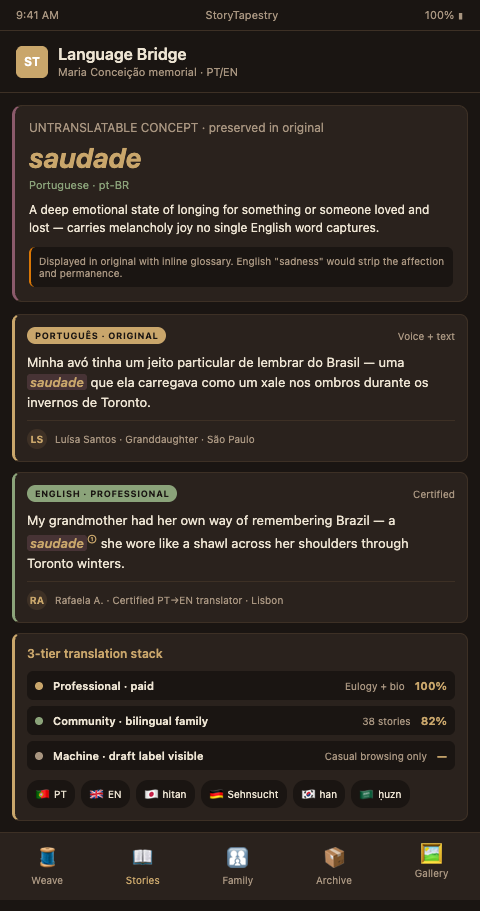
The platform layers three translation modes. Professional human translation, available on a per-story basis, is reserved for the eulogy and primary biographical narrative where accuracy matters most. Community translation lets bilingual family members contribute translations for each other, which often captures cultural nuance that paid translators miss because they lack the family context. Machine translation with a visible "rough draft" label serves as an optional layer for casual browsing but never replaces the original.
For bilingual memorial tapestries, StoryTapestry also handles the thornier problem of untranslatable concepts. When a contributor uses saudade, hitan, duende, or any grief-specific term that resists translation, the platform offers an inline annotation: the original word stays in its original script, and a small glossary entry explains the concept to readers who do not share the language. This preserves what NCBI research on sociocultural bereavement calls the distinct cultural idioms through which distress is articulated.
The platform also handles a subtler problem that most tools miss entirely: the emotional register shift that occurs when a speaker moves from one language to another. A Haitian-American mother may speak tenderly about her late son in Kreyol and practically about funeral logistics in English, and collapsing both into a single English voice flattens her actual grieving self. StoryTapestry's register tagging lets contributors mark which passages carry intimate, ceremonial, or factual weight, and translators preserve those distinctions rather than normalizing everything into a single neutral tone. Funeral directors working with Vietnamese, Cantonese, Arabic, and Yoruba-speaking families report that register preservation is often the difference between a translated tribute feeling like the deceased's family and feeling like a stranger describing her.
Liturgical language creates another distinct layer that deserves explicit platform support. Quranic verses, Hebrew blessings, Sanskrit mantras, Latin prayers, Church Slavonic hymns, and Classical Arabic eulogies carry sacred weight that translation permanently fractures. A memorial for a Syrian Orthodox grandfather may include Aramaic phrases his priest considers untranslatable on theological grounds, while his American grandchildren need enough English context to understand what the prayers mean. StoryTapestry displays these passages in original script with optional romanization, plays audio recordings of the original recitation where available, and offers conceptual explanations rather than word-for-word translations. This approach respects the distinction religious communities draw between translation and transliteration, and prevents the well-meaning but theologically incorrect practice of rendering sacred phrases into casual English equivalents.
Advanced Tactics for Translating Tribute Narratives
Careful funeral homes add several practices that separate good bilingual memorial work from flattened translation dumps. First, recruit a family linguistic liaison. One relative, typically second-generation and comfortable code-switching, serves as the editorial voice for translation decisions. They approve professional translations, settle disputes between community translators, and flag moments where English lacks the right word.
Second, record rather than transcribe when possible. A grandmother narrating in Tagalog about her late husband reveals tone, pacing, and emotional texture that writing cannot capture. Audio contributions paired with translated written captions preserve both the original voice and the accessibility for non-speakers. This connects to broader dialect narrative differences that emerge even within the same named language, where Cuban Spanish, Argentine Spanish, and Mexican Spanish each carry distinct memorial registers.
Third, commission back-translation quality checks for critical passages. A professional translator renders the eulogy from the original language into English, then a second independent translator renders it back. Discrepancies reveal where nuance is slipping. This practice is standard in medical translation for exactly the reasons that matter here.
Fourth, invest in script and font fidelity. Arabic, Chinese, Tamil, Amharic, and dozens of other languages use scripts that require proper rendering rather than transliteration. A memorial that displays a name in original Tamil script alongside a romanized version honors the deceased far better than forcing everything into Latin characters. StoryTapestry supports full Unicode rendering and right-to-left layouts for Arabic, Hebrew, Urdu, and Farsi contributions natively.
Fifth, for audio contributions in less-common languages, use community members rather than AI captioning. Whisper, Deepgram, and similar tools perform well for major languages but fail on Yoruba, Hmong, Amharic, Sinhala, and dozens of others. A bilingual family member producing captions in 20 minutes beats an hour spent correcting AI errors. The same principle applies when achieving memorial narrative depth for grief experiences where every word matters.
Sixth, coordinate sibling languages intentionally. Serbian, Croatian, and Bosnian share substantial vocabulary but carry meaningful identity distinctions; Hindi and Urdu are linguistically close but politically divergent; Mandarin, Cantonese, and Hokkien all appear in one Chinese diaspora family with different generational patterns. A Cantonese-speaking grandmother may not read simplified Mandarin text, while her Mainland-raised son-in-law may not read traditional Cantonese characters. StoryTapestry lets each contributor specify the exact language variant rather than forcing a lowest-common-denominator choice, preserving the specific identity each branch of the family claims.
Seventh, protect elder dignity in the translation workflow. When an elder contributes in their native language and the published tapestry shows awkward English phrasing alongside their words, they can feel exposed rather than honored. Professional translators working with StoryTapestry produce English alongside the original specifically so that grandchildren reading both see care in both directions. The bilingual presentation signals that the family invested in getting each language right, not that one language was the "real" memorial and the other a rough afterthought.
Eighth, handle idiomatic proverbs as cultural artifacts rather than translation problems. A Yoruba elder's tribute may include the saying "Bí a kò bá tẹ́tí sí olódùmarè, àtẹ́tí ẹ̀dá ló ma dáàbòbò ni," which carries centuries of meaning no English sentence captures. Leaving such proverbs in the original with a brief contextual gloss preserves exactly what the speaker meant to invoke. Funeral directors should resist the editorial impulse to smooth these moments into generic inspirational phrasing. A Ghanaian, Greek, Persian, or Polish proverb in its original language, displayed prominently, teaches younger generations something about their heritage while honoring how the elder actually spoke.
Close the Translation Gap Before Your Next Service
Funeral homes serving diaspora communities can stop apologizing for the translation gap. StoryTapestry was built from the ground up to preserve multilingual grief expression online without forcing families to choose between languages. Schedule a live demo with our diaspora services specialists, bring a real family name with their languages, and we will build a sample thread showing how the bilingual view would look. You will see immediately why machine translation alone never satisfied your transnational clients. Our demo team covers the translation workflows most relevant to your service area, whether that is Spanish-English, Vietnamese-English, Amharic-English, Arabic-English, or any other pairing your community regularly requires.
Bring one real scenario where a past bilingual memorial felt incomplete, and we will walk through how the platform would have handled the original language, the professional translation tier, the community translation tier, and the inline annotation layer. Most funeral directors leave the demo with a clear plan for their next bilingual case, including which family members to recruit as linguistic liaisons and which passages to route to professional translators. The bilingual families you already serve will feel the difference on your very next service, and word-of-mouth in linguistically bound communities spreads faster than any marketing investment your funeral home could make.