Creating Bilingual Memorial Tapestries for Transnational Families
Why Dual-Language Tribute Pages Are Harder Than They Look
Most "multilingual" memorial websites hide one language behind a small flag icon in the corner, effectively presenting two parallel monolingual sites. That approach fails transnational family memorial creation for a simple reason: families are not monolingual, so their memorials should not be either. Research in PMC on code-switching documents that bilingual speakers intensify code-switching during emotional moments, exactly the behavior a memorial is meant to capture.
A Pew Research analysis of the Hispanic digital divide found only 47% of Spanish-dominant Latinos were online compared to 74% of bilinguals. For memorials serving mixed-fluency families, the design question is how to welcome the Spanish-dominant grandmother without requiring her to "select a language" and cutting her off from her English-dominant grandchildren.
The U.S. Web Design System two-languages pattern establishes an important best practice: present language options in their native script, not in translated labels. "Español" belongs on the button, not "Spanish." Weglot's multilingual UX research adds that layouts must accommodate longer translated strings, right-to-left scripts, and character-density variation. Most memorial platforms get none of this right.
A Tapestry Framework for Multilingual Grief Expression
The tapestry metaphor becomes literal when two languages share space on one memorial. Each story thread is woven with two strands: the original voice and the translation, visible simultaneously rather than hidden behind a toggle. The whole cloth is stronger for containing both.
StoryTapestry implements bilingual tapestry design for grief through four structural patterns. First, side-by-side story rendering places the original language and translation in visually balanced columns, with a subtle divider that never privileges one over the other. A Spanish original sits on the left, English translation on the right, or vice versa according to family preference. Readers who speak one or both can read however they wish.
Second, inline bilingual headings preserve the memorial's structural text (section titles, navigation, contributor labels) in both languages simultaneously rather than swapping between them. This reinforces the two-language remembrance websites principle that both languages belong to the memorial equally.
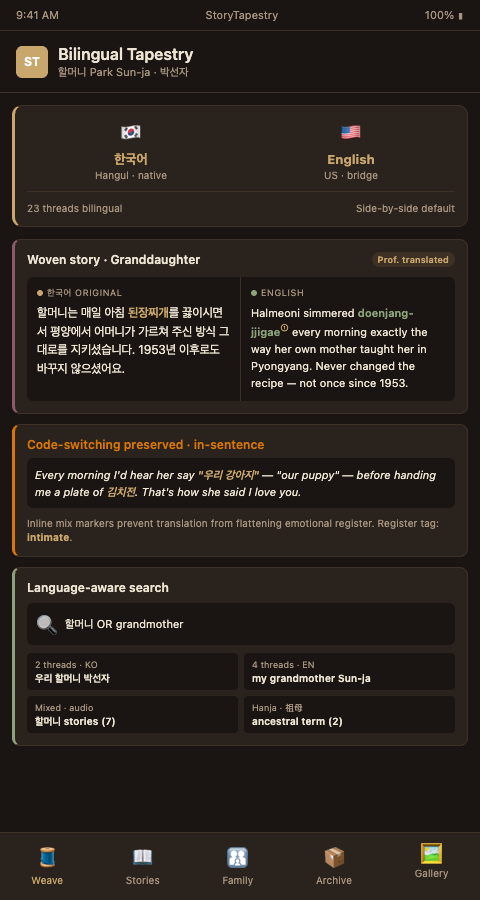
Third, code-switching preservation honors passages where the contributor blends languages within one sentence. Many bilingual speakers naturally move between languages for emotional emphasis, and flattening that movement is a form of cultural erasure. The Springer research on digital storytelling and hybrid identities confirms that bilingual expression reveals layered identity, and MDPI research on translanguaging shows translanguaging affirms linguistic identity. StoryTapestry preserves code-switched passages in both the original and the translation, with annotations explaining untranslatable moments.
Fourth, language-aware search lets a visitor search "abuela" and find both Spanish-original and English-translated mentions, or search "grandmother" and get the same result. Family members searching for specific memories do not have to know which language a relative contributed in. Connecting language barrier solutions across every feature of the platform is how bilingual memorials stop feeling like afterthoughts.
Online memorial platforms surveyed by Everplans increasingly allow multilingual contributions, but few structure the bilingual presentation as architecture rather than feature. StoryTapestry makes the dual-language tribute pages the default rather than an option, which changes the family experience from opt-in tolerance to welcoming design.
Supporting translating grief expression means more than running contributor text through an API. It means honoring the specific ways each language metabolizes loss. Japanese hitan, Portuguese saudade, Arabic huzn, Korean han, and German sehnsucht each carry cultural weight that a careful bilingual memorial preserves rather than flattens.
The bilingual tapestry also supports a practical reality that monolingual platforms ignore: different family members prefer different reading languages even when they are all technically bilingual. A Filipino-American family may include a grandfather who prefers Tagalog prose, a mother who reads Tagalog but writes in English, grandchildren who can only read English, and cousins in Manila who want the original Tagalog with optional English subtitles for their own kids. Forcing any of these readers into a single-language experience makes the memorial feel designed for someone else. StoryTapestry's side-by-side rendering with per-user default language settings lets each family member experience the memorial in the configuration that fits their own comfort, while the underlying data stays bilingual across every story.
Advanced Tactics for Transnational Family Memorial Creation
Experienced funeral homes serving bilingual families add several layers on top of the platform's defaults. First, ask the family to designate a lead translator. Often a second-generation cousin becomes the editorial voice, reviewing machine translations, commissioning professional translation for the eulogy, and settling between competing family translators when two cousins disagree on a word choice.
Second, commission professional translation for the core biographical narrative and eulogy, and use community translation for contributor stories. Professional translators charge roughly 20 to 30 cents per word and can turn around an eulogy in 48 hours for most major languages. Contributor stories at scale exceed professional translation budgets, but family members are often happy to translate a cousin's paragraph.
Third, use audio-first intake for elderly contributors. A grandmother who is uncomfortable typing in either language can record a voice memo in her native language, and the platform produces a transcribed version plus translation. The audio preserves her voice; the text enables searchability and accessibility. This intake approach dramatically improves participation rates from first-generation relatives.
Fourth, handle mixed-script families gracefully. A Korean-American family might have grandparents who prefer Hangul, parents who prefer mixed Hangul-Hanja (older generation), and grandchildren who prefer romanization. StoryTapestry supports all three script variants for Korean, Japanese, Chinese, and other languages with multiple writing systems.
Fifth, plan the physical service's bilingual presentation to match the digital memorial. Printed programs, slideshows, and reception materials should mirror the side-by-side visual logic of the online tapestry. Families tell us this consistency between the service and the website reduces the "two separate memorials" feeling that bilingual services often evoke. Research on life tapestry building confirms that coherent narrative architecture strengthens every kind of memorial, not only bilingual ones.
Sixth, handle the cultural politics of language choice with care. Some bilingual families carry tension between the heritage language and the host-country language, with elders feeling the diaspora has abandoned their tongue and younger generations feeling pressure to perform heritage competence. A memorial that insists on perfect heritage-language contributions can alienate grandchildren who grew up assimilated; one that defaults to English can exclude elders who never became fluent. StoryTapestry's architecture lets each contributor choose without judgment and makes the resulting mosaic feel welcoming to both sides. Funeral directors should explicitly reassure both groups during intake that their contribution is welcome in whichever language they are most comfortable with.
Seventh, accommodate trilingual and quadrilingual families without forcing them into two buckets. A Punjabi-Hindi-English family in Brampton may naturally operate across all three languages, with different relatives favoring different pairs. A Francophone Ivorian family in Paris may blend French, Baoulé, and Arabic depending on which side of the family is speaking. Trilingual presentation takes more layout work than bilingual, but StoryTapestry supports up to five simultaneous languages on a single story when the family needs it, rather than forcing artificial reduction.
Eighth, align intake form language with the family's actual comfort level, not the family coordinator's. A Salvadoran-American family may have an English-fluent organizer who tells you "everyone speaks English," but her aunt in San Miguel is far more forthcoming in Spanish on a Spanish-language form. Offer every contributor the intake experience in their preferred language from the first click, detected by device locale where possible and selectable always. Families consistently report that 15 to 30 percent of contributions come from relatives the organizer assumed would not participate, often because those relatives finally received an invitation in their strongest language rather than in the organizer's.
Build a Memorial That Honors Both Languages Equally
Families who built memorials elsewhere and came to us for the bilingual version describe the difference as night-and-day. StoryTapestry treats every language as a first-class thread in the memorial tapestry, never a hidden toggle. Book a 30-minute demo where we will configure a sample memorial for the language pair most common in your region, and you will see exactly how a transnational family's grief reads when both voices share the page. Bring your next bilingual intake to the call and we will start building together. The demo includes a walkthrough of professional and community translation tiers, an example of how the platform handles script-specific rendering for your language pair, and a preview of the mobile bilingual view that grandchildren and elders both tend to use most.
We also cover the bilingual printed program workflow, because the physical deliverable matters just as much as the digital one for families who distribute paper keepsakes within their community. Funeral homes that adopt bilingual-first workflows typically report a measurable uptick in referrals from linguistically bound communities within the first two or three served families, because bilingual competence is the exact signal these families share with their networks. Getting the first bilingual memorial right is usually enough to secure a sustained referral pipeline from that specific language community.