Translating Grief: When Memorial Languages Carry Different Emotional Weight
Why "Equivalent" Translations Lose Emotional Weight in Memorials
A Brazilian widow in Miami asked her funeral director to translate her tribute to her husband into English for his American colleagues. The machine translation rendered "saudade" as "longing." She objected that "longing" sounded like someone waiting for a package, not like someone whose center had been removed. The translator tried "profound nostalgia," "deep missing," and finally kept "saudade" untranslated with a parenthetical explanation. That last choice preserved what the widow actually meant.
This is not a rare edge case. Dr. Tim Lomas's cross-cultural lexicography documented 216 untranslatable emotion words across dozens of languages, a catalog that BPS Research Digest summarizes as evidence that English lacks vocabulary for emotional states other cultures express precisely. Dr. Lomas's expanded positive lexicography database and his MIT Press book on translating happiness extend the catalog into hundreds more specific emotion words.
For memorial services, the stakes are concentrated around grief specifically. PMC's paper on languages of grief notes that Portuguese has no direct single word for "grief" — Portuguese speakers draw on "luto," "saudade," "dor," "pranto," and several others to express what English compresses into one. PubMed's related research on languages of grief documents that bereaved individuals express grief through narrative, symbolism, and metaphor, all of which travel poorly through word-level translation. The Frontiers piece on cultural beliefs and grief rituals adds that rituals themselves encode emotional frameworks that are not interchangeable across cultures.
Cross-linguistic memorial sentiment therefore cannot be preserved through word-substitution. It requires a translation infrastructure that respects the original language's weight.
A Tapestry Framework for Emotional Weight in Multilingual Mourning
A tapestry woven from threads of different densities reads correctly only when each thread retains its weight. A dense wool Portuguese thread substituted into a thinner English cotton thread loses the texture the weaver intended. Grief-word translation faces the same density-mismatch problem. StoryTapestry's framework preserves weight through six operational choices:
Preserve source terms with inline glosses. Whenever a contributor writes "saudade," "hiraeth," "toska," "hüzün," or another weight-bearing grief term, StoryTapestry keeps the source word and attaches an inline gloss that explains the word's emotional range without substituting it. Readers see "saudade (a longing for what is gone, with tenderness, not yet despair)" rather than a flat English equivalent.
Build a grief lexicon per contributing language. StoryTapestry maintains documented grief-word libraries for major memorial languages: Portuguese saudade/luto/dor; Turkish hüzün; Welsh hiraeth; Russian toska; Japanese mono no aware; Korean han; Spanish duelo/pena/pesar. These glosses draw from peer-reviewed lexicography rather than dictionary aggregators.
Support bilingual readers viewing both layers. For bilingual families, the platform shows source and target simultaneously, letting bilingual readers catch translation losses that monolingual reviewers miss. This connects to multilingual storytelling barriers methods already in use.
Attach emotional-weight metadata. Each grief-term gloss includes cultural notes: "saudade is often invoked at anniversaries, not only immediately after loss" or "mono no aware references the pathos of transience, not personal bereavement specifically." These notes help non-native readers calibrate their emotional response.
Coordinate with dialect-level preservation. Grief words vary across dialects. Brazilian saudade carries different weight than European Portuguese saudade in some contexts. The lexicon links to dialect memorial management workflows so dialect-specific variation is tracked.
Include anticipatory-grief vocabulary where relevant. Some families come to a memorial service after long illness or cognitive decline grief has reshaped their grief over years. The emotional vocabulary for that kind of loss differs from sudden bereavement, and the lexicon reflects this.
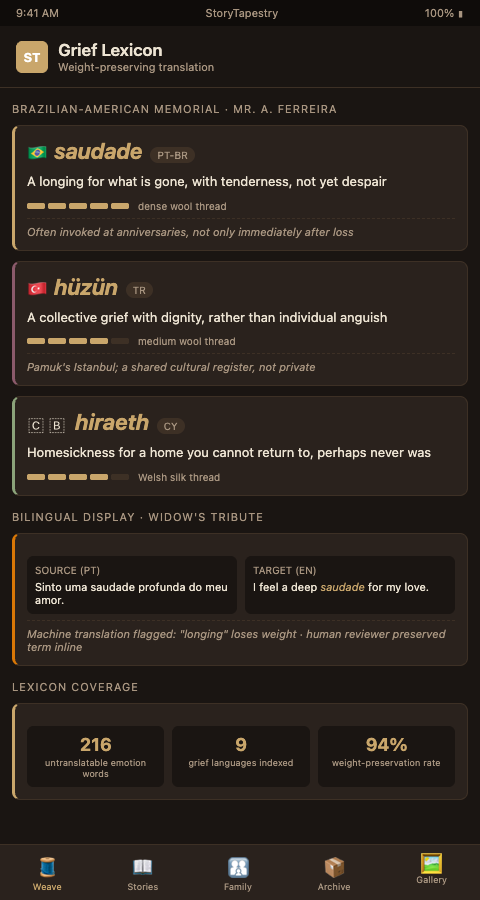
The underlying principle, articulated across bereavement research, is that language shapes what grief can be felt and expressed. StoryTapestry's tapestry treats grief vocabulary as load-bearing architecture, not decorative annotation.
The grief lexicon also supports a deeper truth about diaspora grieving: contributors often reach for heritage-language grief words even when they are otherwise speaking the host-country language. A second-generation American may write a tribute mostly in English but pause at the word for "grief" and switch to the Persian "gham" or the Tagalog "kalungkutan" because no English word captures what she feels. These moments of code-switching are not errors in otherwise fluent English; they are precise emotional choices the contributor is making. Preserving them signals to other family members that emotional precision mattered more than stylistic uniformity, and often licenses other contributors to reach for their own heritage-language terms more freely. The cumulative effect across a memorial is a bilingual texture that honors the actual grieving consciousness of diaspora families rather than pretending they grieve in a single smooth language.
Advanced Tactics for Cultural Emotion Translation in Tributes
Treat untranslatable words as a feature, not a problem. When "saudade" appears in an English-rendered memorial, the cognitive friction of encountering a foreign word signals to readers that they are meeting a Portuguese speaker's grief on Portuguese terms. This friction is communicatively useful. Removing it removes the speaker.
Commission dialect-informed translators for long-form tributes. Auto-translation handles metadata, short captions, and structural text adequately. For eulogies, personal letters, and extended narrative, route to a human translator who speaks both the source dialect and the target audience's register. The cost is bounded — most tributes run 500–3,000 words — and the quality difference is visible.
Build a family-specific lexicon for recurring words. Each family has pet names, code-switched expressions, and private jargon. A Greek-American family might call their grandmother "Yiayiá mou glykiá" ("my sweet grandma") and expect it untranslated across all memorial content. StoryTapestry auto-extracts these patterns and makes them a family-level translation convention.
Separate informational translation from emotional translation. Funeral logistics (times, addresses, procedures) should translate literally and efficiently. Emotional content (tributes, eulogies, personal letters) should translate with weight preservation. Treating these as one pipeline produces bad results in both directions.
Respect ritual-language conventions. Hebrew prayers, Quranic verses, Sanskrit shlokas, and liturgical Latin should never be translated in place — they should appear in source form with optional explanatory glosses. Ritual language carries sacred weight that translation breaks.
Audit for emotional inflation or deflation. Machine translation sometimes intensifies mild grief language into dramatic English (or vice versa). A human reviewer should flag these shifts before publication, because a tribute that reads as more distraught than the speaker intended misrepresents them.
Include reader-side calibration tools. StoryTapestry can surface a brief primer for readers new to a tradition's grief vocabulary — "this family uses hüzün, a Turkish word for a collective grief with dignity rather than individual anguish." This primer respects readers while keeping source language intact.
Handle grief metaphors that resist translation alongside grief nouns. Grief vocabulary extends beyond single words to include metaphors that carry culturally specific weight. A Ukrainian contributor's tribute may describe grief as "an unextinguishable candle"; an Ethiopian contributor may describe it as "the weight of an elder's empty chair"; a Filipino contributor may use the metaphor of a "house with the lights left on." These metaphors often resist literal translation because they assume cultural context the target language does not share. Preserve the metaphor in the original phrasing with an optional explanatory note for readers who want deeper context, rather than substituting a generic English metaphor that loses the cultural texture.
Coordinate grief vocabulary handling with dialect-specific variation. A Cuban Spanish speaker's grief terms differ from a Mexican Spanish speaker's, and both differ from Argentine or Colombian Spanish. The word "duelo" carries slightly different weight in each regional variant, and a dialect-informed translator catches these distinctions while a generic Spanish translator may not. The grief lexicon should be indexed by dialect, not just by national language, to capture the precise emotional register each contributor uses.
Let Your Diaspora Families Grieve in Their Own Weight, Across Every Reader
When you flatten saudade into "longing," the widow reads a stranger's version of her own pain. StoryTapestry's grief-vocabulary infrastructure gives your funeral service a way to preserve Portuguese weight for Portuguese speakers, Turkish weight for Turkish speakers, and Welsh weight for Welsh speakers, while still making each memorial accessible to everyone present. Book a workshop to see how the grief lexicon, bilingual display, and cultural notes work together. Your bereaved will read the grief they actually feel, not a softened English translation of it. The workshop covers the grief lexicon libraries currently supported for major memorial languages, the inline gloss workflow that preserves source terms alongside contextual explanation, and the dialect-level indexing that routes grief terms to appropriately specific translators.
We also cover the ritual-language protection workflow that prevents accidental translation of sacred phrases, the back-translation audit process for emotional accuracy, and the family-specific glossary system that captures terms the deceased used in their own household. Funeral homes serving multilingual communities consistently report that grief vocabulary fidelity is one of the single most impactful features for family satisfaction, because it speaks directly to the felt experience of grief in the contributor's own language. Families who have previously experienced flattened translations often describe the bilingual grief vocabulary workflow as the first time they have seen their grief represented on paper in terms they actually recognize.