Managing Parental Disagreements on Memorial Content Inclusion
The Problem: Grief That Runs at Different Speeds
Couples who lose a baby together often grieve at incompatible tempos, and the memorial is where those tempos collide. A study in PMC on marriage outcomes after pregnancy loss found miscarriage raises the probability of relationship breakup by 22%, and stillbirth raises it by 40%. Much of that rupture traces to incongruent grief — the partners want different things from remembrance and cannot reconcile what the memorial should say.
Research on men's grief following pregnancy loss documents that fathers frequently internalize their grief and prioritize their partner's emotional needs, which looks from the outside like emotional absence but is often protective restraint. A paper on pregnancy loss as disenfranchised grief frames the loss as culturally coded maternal, leaving fathers in a doubly-disenfranchised position where their preferences around memorialization are deprioritized before they are even expressed. Complementary research on paternal experiences of perinatal loss describes fathers wanting emotional recognition but tangled up in masculinity expectations that suppress it. The PMC review of sorrow shared in recurrent miscarriages describes how incongruent grief becomes the central driver of couple conflict after loss, and memorial decisions surface it fastest.
When a bereavement coordinator hands a couple a memorial form to fill out together, they often walk into this conflict without knowing it. One parent wants the 31-hour timeline visible. The other wants one photograph and a name. A scheduling note on the couple's calendar becomes a two-hour fight in a bereavement office.
Solution Framework: Separate Threads, Shared Weave
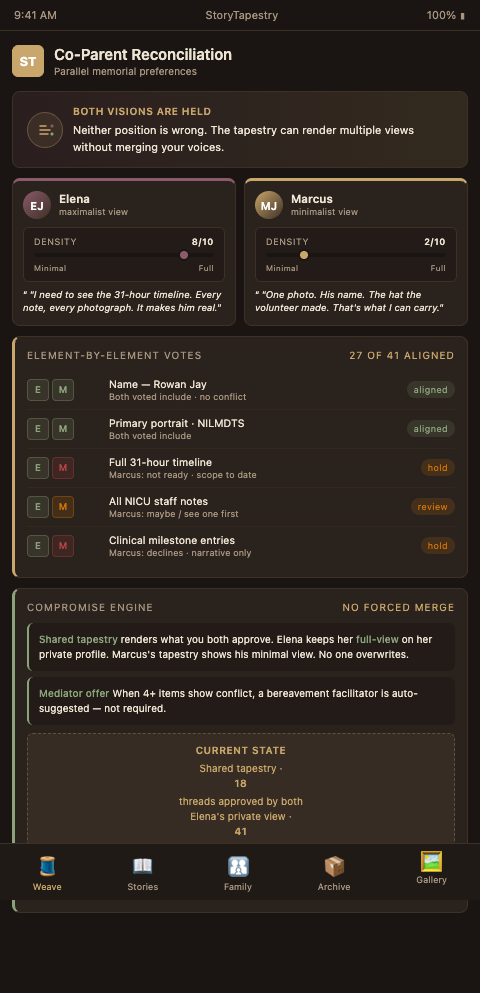
A tapestry can hold threads of different colors without the colors fighting. StoryTapestry treats a co-parent memorial as a weave composed of both parents' distinct threads, with a shared wash tying them together. Neither parent has to agree with the other's choices — each parent's threads remain theirs — and the memorial preserves the marriage as well as the child.
The foundation is a dual-authorship model. Each parent has a named channel inside the memorial. Threads placed in the mother's channel appear under her attribution; threads in the father's channel appear under his. Shared threads — the ones both parents want included — live in a third channel that requires both signatures. This replaces the single-form binary decision with a three-lane structure so that "I want this and you don't" resolves to "this goes in my lane" rather than "this gets vetoed."
The second layer is private content. A father may want to write a letter he is not yet ready for anyone to see, including his partner. A mother may want to preserve the ultrasound sequence in a form her partner finds too painful to revisit. StoryTapestry gives each parent a private vault attached to the same memorial, visible only on that parent's login. Content can later be promoted into the shared weave with a single action, or left in the vault indefinitely. This aligns with findings on tailored resources for fathers' perinatal grief that emphasize private space as a precondition for any later sharing.
The third layer is a facilitated negotiation workflow. When one parent drafts a thread that the other flags as too painful, the system does not delete it. It routes both parents to a bereavement coordinator who holds a 30-minute conversation using scripted sensitivity story guidelines. The conversation does not force agreement; it surfaces which lane the thread belongs in — shared, single-parent, or private vault. Most disputes resolve inside one call because the parents realize they were not actually disagreeing on whether to remember, but on where the remembrance should live.
The fourth layer is a revision window. Grief changes. A father who wanted no photographs at month one often wants the complete set at month eighteen; a mother who wanted the entire timeline visible at month three often wants a pared-back version at year three. StoryTapestry preserves version history so that content can be re-promoted from vault to shared weave, or moved back out, without loss. The tapestry is rewoven, not rewritten.
This structure also extends to extended family. Sibling memorial inclusion and grandparent contributions each get their own channel with their own consent structure, so a memorial with six contributors does not collapse into a six-way fight.
The lane model produces a second-order benefit that coordinators notice within the first few cases: it converts "no" from a relational rupture into a routing decision. When a father hears that his wife wants to include the 31-hour timeline and says "not in ours, not together," the historical interpretation is rejection of her grief. The lane interpretation is that the timeline belongs in her channel. He has not vetoed her memorial work; he has declined to attribute her work to his name. The relief that follows this reframing — often visible in the father's posture within the same coordinator session — is what programs cite most often as the difference between a dual-channel memorial and a single-form one. "No, not together" is a survivable answer in a way that "no" is not.
The revision window addresses a second pattern that bereavement coordinators know well: the fathers who want nothing at month one and everything at month eighteen. Traditional memorial systems force the decision at month one and lock it in. Dual-channel architecture keeps the month-one decision reversible. A father who filed everything to his private vault in the first weeks can promote selected threads to the shared weave at month twelve when he is ready, and the mother's earlier shared threads have been waiting for him rather than existing as a parallel solo project she built without him. The tapestry has remembered both paces. Neither parent has been left behind.
Advanced Tactics for Reducing Memorial Conflict
Three practices consistently lower couple conflict during memorial building.
First, sequence decisions by emotional cost, lowest first. A bereavement coordinator who opens with "do you want to include the ultrasound images?" triggers conflict immediately. Opening with "what name is going on the memorial?" builds a shared decision before any charged content enters the room. StoryTapestry's default intake flow orders prompts from name and date (consensual) to photographs (variable) to medical timeline (often contested) so couples accumulate agreements before they hit disagreements.
Second, time-box disagreements. When a thread is contested, StoryTapestry marks it "in revision" for 14 days. During the window, neither parent can publish it to the shared weave without the other's release. If the window closes without agreement, the thread automatically drops into both parents' private vaults rather than being deleted. This prevents the "we fought about it, then never decided" limbo that leaves memorials unfinished.
Third, bring a third party into contested threads. Bereavement coordinators who participate in memorial-building sessions are not mediating a divorce — they are witnessing a grief process and gently reframing. Scripts that work: "This is a thread from your baby's life. Who in the room is best positioned to tell this part of the story?" reframes a veto into a handoff. Techniques for narrative difference management developed for diaspora memorials transfer well here because both contexts involve multiple legitimate versions of the same story coexisting in one artifact.
Coordinators should also track which units are producing the highest disagreement rates and audit the intake workflow for those units quarterly. A unit with 40% disagreement escalation often has an intake nurse asking charged questions before a coordinator is present, and the fix is procedural, not relational.
Handle coordinator hand-offs with explicit disagreement inheritance. When the coordinator who opened a case goes on leave or rotates units, the new coordinator needs to know which threads are contested, which are in a revision window, and what the last coordinator learned about each parent's pace. StoryTapestry includes a case-handoff summary that renders automatically when coordinator access changes, highlighting contested threads, the facilitation notes from prior conversations, and any unresolved emotional dynamics the outgoing coordinator flagged. Programs that build this handoff into their staffing transitions avoid the pattern where a contested memorial goes cold because the new coordinator, unaware of the history, does not know to reach out.
Train coordinators on the parent-visibility distinction. A father who says "I don't want her to know I'm writing anything" is not asking for deception; he is asking for emotional privacy inside a marriage that is holding a lot of weight. The private vault supports this. Coordinators need scripts for the moment when a parent asks whether the other will see the vault content: the honest answer is "not unless you promote it to the shared weave or to your partner's view specifically." Parents who understand this distinction use the vault; parents who suspect the vault might leak do not, and the memorial loses the most honest content. Training coordinators to name the architecture clearly, without euphemism, is the difference between a vault that holds and a vault that goes unused.
Build a pattern library of resolved disputes. After eighteen months of dual-channel practice, most programs have seen thirty to fifty contested threads resolve through the facilitation workflow. Documenting these resolutions — with parent permission and de-identification — gives the next generation of coordinators a pattern library of which conversations tend to work. A father who initially rejected the ultrasound images and later promoted them from his vault once his wife wrote a private-to-him letter about what the images meant to her is a pattern worth preserving. The resolutions are the curriculum.
Refer to clinical specialists when disagreements escalate beyond coordinator scope. A 30-minute facilitation session will resolve most memorial-content disputes, but some disputes signal deeper couple distress that the bereavement coordinator is not licensed to treat. StoryTapestry includes a referral workflow to perinatal grief counselors with couples-therapy credentials, triggered when a thread remains contested after two facilitation sessions. The memorial itself pauses until the couple completes at least one clinical session, which reframes the dispute as a couple issue rather than a memorial issue and routes it to the person qualified to help.
CTA: For Hospital Bereavement Programs Mediating Couple Grief
Couples in your unit are not failing at grief when they disagree about memorials — they are grieving at different speeds with no structure to hold both paces. StoryTapestry gives your coordinators a dual-channel architecture, a facilitated-conversation workflow, and a revision window that keeps memorials from becoming breakup triggers.
Book a 30-minute walkthrough with two coordinators and one social worker from your unit. Bring one de-identified contested case from the last six months — ideally one where the memorial remains unfinished or where the coordinator felt the dispute eroded the relationship more than the loss itself. We will map the case to the three-lane model, replay the facilitation conversation with the revised scripts, and show what the negotiated outcome would have looked like with private vaults, a 14-day revision window, and coordinator handoff support.
Programs that pilot the dual-channel model typically run a three-month cohort of ten to fifteen contested or high-risk cases, supervised by your unit's senior coordinator and reviewed in a final session with the nursing leadership and affiliated couples-therapy referral network. The pilot produces a set of facilitation scripts tailored to your patient population, a coordinator training protocol for new hires, and a set of metrics — resolution rate, time-to-resolution, coordinator-reported distress — that make the program's impact visible to finance committees and clinical leadership alike.