Essential Sensitivity Guidelines for Infant Loss Story Collection
The Problem: Well-Intentioned Story Collection Can Cause Harm
A bereavement coordinator described a family who had consented to memorial photography during their stillborn daughter's brief hours in the hospital. Three weeks later, the photographer reached out to ask if the family wanted to review and edit their images. The mother, still in acute grief, received the email as a demand to perform grief on someone else's timeline. She spent a week unable to sleep. The photographer had followed standard practice; the standard practice had not accounted for trauma pacing.
Sensitivity in perinatal loss story collection is a documented clinical concern. A qualitative analysis of 104 parents on ethical bereavement photography identified consent, timing, and preparation as the three pillars of ethical practice. Research on normalizing perinatal bereavement photography emphasized that ethical practice requires informed consent tailored to each family's specific situation. A professional bereavement photography analysis documented that the consent process is complex with grieving parents — simple binary yes/no does not suffice.
The professional guidance is clear. ACOG's perinatal palliative care committee opinion emphasizes individualized care plans developed with families. AAP/ACOG guidelines for supporting perinatal loss state explicit goals of helping families start the process of normal grief rather than imposing external structure. A systematic review of seeing and holding the baby found that preparation and follow-up prevent maternal mental health harm. AWHONN's perinatal bereavement resources emphasize unbiased attitudes among care providers as a prerequisite for ethical story gathering.
Without trauma-informed infrastructure, even well-meaning collection can compound grief. Bereaved parents need systems that accommodate their pacing, not systems that require them to accommodate the system's pacing.
The Solution: Sensitivity Guidelines Built Into Every Tapestry Interaction
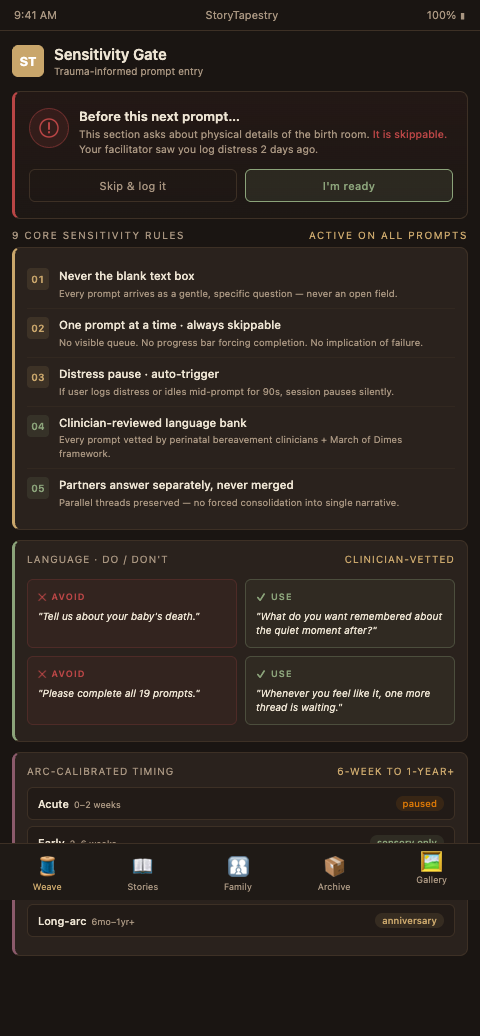
StoryTapestry operationalizes sensitivity as infrastructure rather than exhortation. The tapestry metaphor captures the principle: every thread in the weaving was added when the family was ready to add it, and no thread was forced into the pattern. Sensitivity appears in how prompts are worded, when they appear, how they can be paused, who can see them, and how they can be retracted.
Pacing autonomy as default. Every prompt in StoryTapestry is skippable without judgment. Every partial answer is preserved. Every prompt can be deferred with one tap. The platform never imposes narrative completion — a family that answers three prompts and closes the tab has a valid tapestry. This default respects the NICU staff story gathering approach we take across the platform: the system accommodates the person, not the other way around.
Consent granularity. Consent in StoryTapestry is not a single checkbox at the start of engagement. Each artifact, each contribution, and each viewing permission is consented separately. A family can consent to preserve an ultrasound image while declining to make it visible to extended family. A family can consent to share a written memory with grandparents while keeping it hidden from cousins. A family can revoke any consent at any time, and the platform honors the revocation immediately.
Trauma-informed prompt wording. StoryTapestry's prompts are developed in consultation with perinatal bereavement clinicians and reviewed against established trauma-informed care principles. Prompts avoid coercive language ("tell us about..."), avoid toxic positivity ("celebrate her life..."), and avoid framings that imply the family should already be past grief ("looking back..."). Prompts acknowledge difficulty explicitly and offer clear skip paths. This language development parallels family trust building practice we support across bereavement contexts.
Distress detection and pause triggers. The platform monitors engagement patterns — not content, but structural signals — that may indicate distress: rapid skipping, repeated backtracking, sessions abandoned mid-prompt. When patterns suggest a family is struggling, the platform gently pauses additional prompts for 72 hours and offers support resources. A bereavement coordinator is notified if the pattern persists, with the family's pre-approved consent.
Cultural and religious sensitivity adaptations. Grief practices vary across cultures and religions. StoryTapestry includes adaptation layers that hospital bereavement coordinators can configure per family — terminology appropriate to Jewish, Muslim, Christian, Buddhist, Hindu, and secular contexts, with clear pathways to customize for specific traditions. A Muslim family's tapestry follows different prompt phrasing than a Catholic family's tapestry. Ongoing memorial rituals integration respects each tradition's mourning practices.
Partner asymmetry accommodation. Partners often grieve differently and at different paces, and the same principle governs our NICU staff contribution gathering work on the clinical side. StoryTapestry does not force joint engagement. One partner may answer prompts weekly while the other engages only twice in the first year — both patterns are valid, and the tapestry accommodates both without pressuring the less-engaged partner.
Advanced Tactics for Sensitivity-Calibrated Story Collection
Pre-loss preparation for known lethal diagnoses. Families with fatal prenatal diagnoses often have weeks to prepare. StoryTapestry's preparation mode lets bereavement coordinators introduce the platform during pregnancy in a low-pressure, educational framing — families can explore without obligation and decide later whether to engage. Preparation reduces the cognitive load of first engagement during acute loss.
Disclosure-before-prompt architecture. Before any prompt that may surface difficult memory, StoryTapestry displays a one-sentence disclosure: "This prompt asks about [specific topic]. You can skip, pause, or come back later." Families know what is coming before they encounter it, preventing surprise-activation of trauma and layering with ongoing memorial ritual support that spans months after discharge.
Bereavement coordinator observer mode. With explicit family permission, bereavement coordinators can observe a family's tapestry engagement patterns — not the content, but the structural indicators of wellbeing. This allows the coordinator to reach out with support at the right moment rather than waiting for the family to initiate contact. Observer mode can be revoked instantly.
Content warning and retraction tools. A memory a parent chose to preserve in month one may feel differently in month six. StoryTapestry provides easy tools to add content warnings, hide specific threads, or fully retract contributions — without losing the surrounding tapestry structure. Grief evolves; the platform evolves with it.
Clinician contribution sensitivity protocols. NICU staff contributions follow specific sensitivity protocols: clinical details are redacted before family review, staff observations are staged for bereavement coordinator review before reaching the family, and the family has final approval authority, a structure that carries over from our family trust cultivation work in memory care programs. This mirrors the broader sensitivity-first architecture.
Sibling-appropriate prompting by age. Prompts for siblings scale by developmental age. A four-year-old sibling receives drawing prompts and short voice memo prompts. A twelve-year-old receives reflection prompts. An eighteen-year-old returning to the tapestry for the first time receives contextual framing about when the memorial was created and how their contributions fit. Each age layer is reviewed by child-life specialists.
For Hospital Bereavement Programs Committed to Sensitivity-First Story Collection
Sensitivity cannot be added to a story collection system as an afterthought. It has to be built into the infrastructure — the prompt wording, the consent model, the pacing, the revocation tools. StoryTapestry was designed with perinatal bereavement coordinators, NICU social workers, and child-life specialists to operationalize sensitivity at every touchpoint. If your hospital bereavement program is ready to offer families structured story collection that respects acute trauma from the first interaction forward, we can walk you through the sensitivity framework and pilot configurations for your specific unit. Reach out to schedule a consultation with your bereavement program leadership and your hospital's patient experience team.
The consultation runs 60 minutes and covers the full sensitivity framework — prompt wording calibration, consent model layering, pacing rules tuned to acute-phase grief, retraction tools, and the child-life specialist review process for every sibling-age prompt variant. Pilot engagements include platform access for your bereavement coordinator, one NICU social worker, one child-life specialist, and one patient experience representative, plus a named clinical implementation lead who staffs the first three sensitivity review cycles. Most programs complete the sensitivity configuration within four weeks and onboard their first family the week configuration closes. Bring your bereavement coordinator, patient experience director, child-life lead, and one family advisor from your existing parent advisory council — the consultation produces a sensitivity audit report your team can present to hospital leadership before the pilot launches.