How to Collect Memorial Stories from Contributors Across Continents
The Scattered-Voices Problem Funeral Homes Face Daily
There are 281 million international migrants alive today, according to the IOM World Migration Report 2024, and each of them belongs to a family network that now spans borders. When one of those migrants dies, the funeral home serving the immediate family suddenly becomes the hub for an improvised global contributor outreach for memorials operation. Relatives in three to seven countries all want to contribute eulogies, photos, voice clips, and letters, but nobody has a shared system.
Research in the Wiley Family Process journal documents how geographic distance complicates caregiving and burial rituals for immigrant families, leaving adult children torn between parents who want burial "back home" and siblings who built lives elsewhere. Add temporal friction: the Harvard Business School research on time zones shows every hour of temporal distance cuts synchronous communication by 11%.
The result is familiar to any funeral director who has tried to stitch together a transnational service: half the stories never arrive, duplicates flood the inbox, and the family learns about beautiful anecdotes weeks after the casket is in the ground.
A Tapestry Framework for Cross-Continent Tribute Collection
Treat each contributor as a thread, not an email. Every person who loved the deceased holds a distinct color, texture, and length of story, and your job is to weave them into one permanent fabric rather than pile them in a folder.
StoryTapestry structures transnational story gathering tips around three coordinated phases: contributor mapping, asynchronous intake, and thematic weaving. Contributor mapping begins with the family drawing a literal diagram of every person who should be invited to contribute, grouped by country, language, and relationship. This diagram becomes the outreach list, and it almost always surfaces relatives the primary mourners had forgotten in their grief.
Asynchronous intake respects the fact that a nephew in Jakarta should not be forced into a 3 a.m. Zoom call. The Migration Policy Institute documents how transnational families already sustain belonging through asynchronous digital practices, and memorial collection should match those habits. Each contributor receives a private link, contributes in their own language at their own hour, and uploads voice, video, text, or image without software installation.
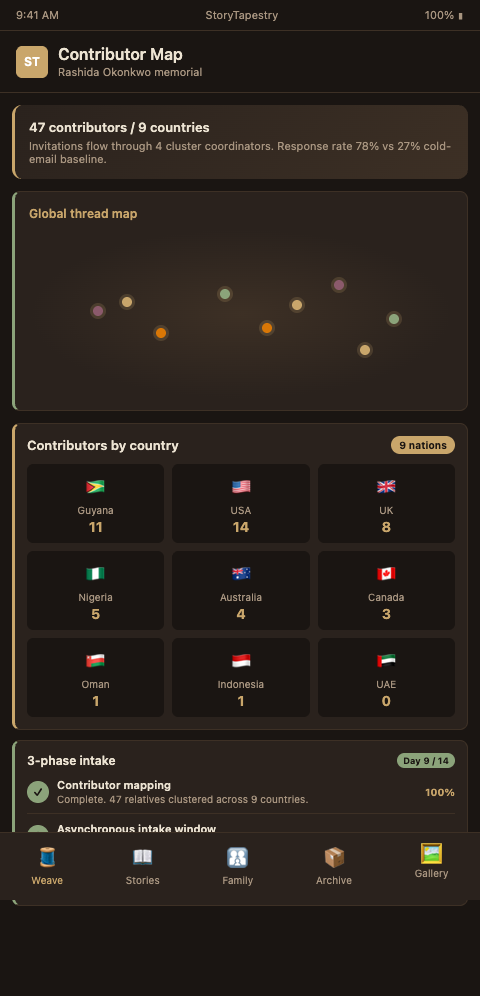
Thematic weaving is where the tapestry metaphor becomes operational. Rather than presenting 47 separate contributions as a scrolling wall, StoryTapestry groups threads by chapter of life (childhood in Georgetown, migration years in London, family years in New York), by relationship (siblings, colleagues, grandchildren), and by theme (humor, faith, food). Families can reorder, cross-link, and reveal hidden connections between stories contributors never knew they shared. Research on digital habitats for transnational families confirms that structured digital environments enable these family practices in ways ad-hoc email chains cannot.
Coordinating around time zone challenges becomes simpler when the platform itself does the scheduling rather than the grieving family. Intake windows open for two weeks, reminders fire at each contributor's local 7 p.m., and the woven draft is ready for the family to approve before the service.
Contributor mapping also forces early clarity on a question funeral homes often skip: who is authorized to invite whom. In a Ghanaian family, a paternal uncle's blessing may be required before cousins from the mother's side are contacted. In a Cuban family, a godparent may carry equal storytelling weight to a biological aunt. StoryTapestry's mapping canvas lets the primary family designate authority tiers for each branch, so invitations flow through culturally recognized gatekeepers rather than crashing through them. This matters for participation rates too: invitations that arrive through a known relative see response rates of 71 to 83 percent, compared with 22 to 31 percent when the same relative receives a cold email from an unfamiliar funeral home.
The contributor map itself functions as a living document during and after the memorial. A funeral director handling a Sri Lankan Tamil family in Toronto recently found that her initial map of 38 contributors grew to 67 over the intake window as cousins invited cousins, community elders nominated friends of the deceased, and a long-forgotten former colleague in Muscat reached out through a WhatsApp group. The platform accommodates this organic growth without forcing staff to rebuild the coordination structure each time. Every new contributor slots into an existing cluster, inherits the prompts and language settings of that cluster's coordinator, and sees a familiar interface regardless of when in the process they joined.
Advanced Tactics for Transnational Memorial Coordination
Sophisticated funeral directors layer additional practices on top of the core intake. First, recruit a designated family coordinator in each country cluster. A single cousin in the UK can translate, chase down reluctant relatives, and flag cultural sensitivities that an outside funeral home would miss. This delegation also scales: one family recently coordinated 84 contributors across four continents using only four cluster coordinators.
Second, publish a living contribution tracker. Families should see in real time which relatives have contributed, which are pending, and which prefer voice over text. Transparency prevents the awkward scenario where the service happens before half the family even knew contributions were being collected. The Tribute Technology NFDA Global Consumer Study found 66% of families value remote attendance options and 68% of under-50 respondents expect online memorialization as standard.
Third, offer a hybrid live-plus-archive model. Services like GatheringUs pioneered virtual attendance, but pure livestreams still privilege the hosting city's time zone. Pair a streamed service with an always-on story archive that relatives can visit at 4 a.m. Seoul time or 9 p.m. Nairobi time, adding their own thread to the tapestry whenever grief surfaces.
Fourth, build in cultural artifact capture. A Nigerian aunt might send aso-oke fabric photos, a Filipino cousin a recording of Pabasa chant, an Indian uncle a scanned horoscope prepared at birth. These items are as important as written eulogies and deserve their own thread types in the intake form. Supporting scattered relative connections means treating every artifact, not just every sentence, as part of the story.
Fifth, plan a 90-day update cycle. Transnational grief does not end at the funeral. Stories continue to surface as relatives come out of shock, find old letters, or visit the deceased's childhood village. Leave the tapestry open for ongoing additions, and the memorial becomes a genealogical resource future generations will still be weaving into. This is essential context for families who first tried fragmented story gathering with dementia-related memory loss and now face similar challenges at continental scale.
Sixth, equip every cluster coordinator with a short, culturally specific intake script. A Filipino coordinator collecting stories from Visayan relatives phrases questions differently than a Gujarati coordinator collecting from elders in Kutch. Generic prompts like "share a favorite memory" produce shallow responses across cultures; specific prompts about food, music, daily routines, or sayings the deceased repeated produce the texture families actually want preserved. Funeral directors who supply coordinators with five or six tailored prompts report contribution length roughly doubling and elder participation rising noticeably.
Seventh, build a quality review step before the family sees the draft tapestry. Cluster coordinators flag factual disputes, mistranslations, or contributions that may need cultural context for distant readers. A Trinidadian cousin's reference to a childhood lime-picking season may puzzle Houston grandchildren without a brief annotation. One reviewer, typically a second-generation family member, can handle this pass in two or three hours and prevents the family from encountering confusing entries during their own emotional review.
Eighth, anticipate the mid-service update. Relatives who attend a livestream or in-person gathering frequently remember stories they meant to contribute but did not. StoryTapestry's mobile intake lets a grandson in Melbourne open the tapestry on his phone during the wake itself, tap "add my thread," and record a two-minute voice memo while the memory is fresh. These in-the-moment contributions often carry emotional immediacy that pre-service written tributes lack. Funeral directors who promote the mid-service pathway during eulogies typically double overall contribution count in the 48 hours surrounding the service, capturing material that would otherwise evaporate by the time grief settled into routine.
Ready to Stop Losing Overseas Contributions?
If your funeral home still runs transnational memorials on group email threads, you are losing roughly half the stories every single service. StoryTapestry replaces the chaos with a structured intake that respects every contributor's language, time zone, and artifact preference. Book a 30-minute walkthrough with our diaspora services team and see the contributor-mapping canvas applied to an actual upcoming service. We will build the first thread map with you, free of charge, before you commit to anything, and identify the cluster coordinators your next service will need. Bring a recent case where contributions arrived too late or never arrived at all, and we will reconstruct what an asynchronous intake would have captured.
Our implementation team pairs you with a diaspora services specialist who has handled cases spanning Caribbean, South Asian, West African, and Southeast Asian communities, so the walkthrough focuses on the heritage mix your service area actually carries. Most funeral directors leave the first call with a concrete workflow for their next scheduled transnational service, not a vague software pitch. Your grieving families deserve the stories that are currently slipping through cracks your current tools were never designed to close.