Understanding Time Zone Challenges in Real-Time Memorial Assembly
Why Synchronous Memorial Collaboration Fails Across Continents
The Harvard Business School research on remote work time zones found that each hour of time separation reduces synchronous communication by 11%. For a family with relatives in Sydney, Nairobi, London, and Los Angeles (a 20-hour span when daylight saving shifts apply), the compounded reduction makes real-time participation mathematically near-impossible. Yet most funeral livestreams still operate on a "pick one time" model that privileges whichever city hosts the service.
Rice Business Wisdom research adds that extreme time zone differences elevate stress and isolation even in normal work contexts. Grief multiplies that stress. INFORMS Organization Science research documents how temporal distance forces participation into personal hours, which for bereaved families means someone is always losing sleep, missing work, or skipping prayer time to "attend."
The MIT Technology Review analysis of Zoom funerals captured the emotional cost: "Zoom funerals feel lonely," and real-time synchronization across zones is difficult enough that many distant relatives simply opt out, carrying ungrieved loss for years afterward. Coordinating global memorial events must be redesigned around asynchronous architecture rather than livestream-first.
A Tapestry Framework for Scheduling Memorial Contributions Worldwide
The tapestry metaphor solves the time zone problem elegantly. A tapestry is woven thread by thread over time, not assembled all at once. No weaver expects every contributor to work on the loom simultaneously. The finished fabric looks unified even though each thread was added at a different hour.
StoryTapestry implements real-time tribute building across zones through four temporal patterns. First, asynchronous contribution windows open for 5 to 14 days around the service, letting each relative contribute during their own waking hours. A Tokyo uncle records at noon his time; a Sao Paulo cousin writes at 9 p.m. hers; a London aunt uploads photos at 7 a.m. hers. No one has to match anyone else's clock.
Second, rolling notification scheduling delivers reminders at each contributor's local evening (typically 7 p.m. in their time zone), not at the hosting family's hour. This respects MIT Sloan research on matching technology to task: the task of contributing a story does not require synchronous presence, so scheduling should match each person's natural rhythm.
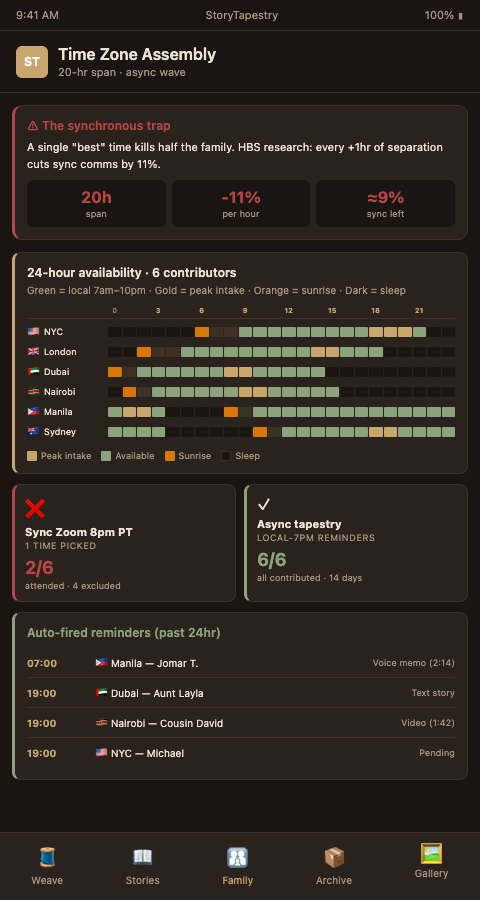
Third, hybrid synchronous-asynchronous ceremonies combine a live service with always-on participation. The family hosts a primary service at a reasonable hour for the majority cluster, livestreams it to anyone who can attend live, records it permanently, and invites asynchronous contributions before, during, and after. Atlassian's asynchronous communication research suggests a 75% async / 25% sync ratio with a 3 to 4 hour overlap window, and that ratio translates well to memorials.
Fourth, multi-zone ceremonial broadcasts repeat the service at two or three different times so each geographic cluster experiences a "live" moment. A Sydney-Manila-Jakarta cluster views at one time, a London-Lagos-Nairobi cluster at another, and a Los Angeles-New York-Toronto cluster at a third. The underlying service is the same, but each cluster gets the dignity of a real-time gathering.
Livestream platforms like TribuCast handle the broadcast mechanics, but time zone intelligence goes beyond streaming. The tapestry approach treats every asynchronous contribution with the same weight as a real-time attendance, so a grandson who recorded his eulogy at 3 a.m. local time appears alongside the in-person speakers in the final memorial. Building around collecting stories across continents principles ensures nobody gets relegated to "could not attend" status.
The platform's asynchronous story collection architecture prevents the false urgency of "we must all be on Zoom together or the memorial doesn't count." Research increasingly shows that grief is served by sustained remembrance, not by single synchronous moments. Full integration of asynchronous story collection is what distinguishes memorial platforms built for transnational families from those built around a Western assumption of geographic proximity.
The platform also handles the subtle tax that time zone coordination imposes on whichever family member is playing coordinator. A daughter in New York trying to herd eight cousins across Lagos, Nairobi, Dubai, Karachi, Bangkok, Sydney, Auckland, and Santiago is running essentially a 24-hour project for the two weeks leading up to the service. She loses sleep, skips work, and often arrives at the funeral emotionally depleted from logistics rather than present for grief. StoryTapestry's automated scheduling lifts this burden off her completely: reminders fire at each contributor's local evening without her involvement, translation queues process overnight, and dashboard summaries arrive in her inbox at a time she chooses rather than whenever a cousin happened to complete a contribution. Coordinators repeatedly describe this automation as the feature that let them actually mourn rather than project-manage.
Advanced Tactics for Coordinating Global Memorial Events
Funeral directors coordinating multi-zone memorials add several layers of sophistication. First, build a time zone spreadsheet before sending any invitations. Map every expected contributor's city, calculate the UTC offset, identify the three to five clusters, and pick broadcast times that respect the majority of each cluster. This five-minute exercise prevents the all-too-common 3 a.m. Manila Zoom disaster.
Second, use relative time language in communications. "Monday evening your time" confuses fewer people than "8 p.m. EST," which many international recipients mentally mis-convert. Platform-generated messaging should default to per-recipient localization so every family member reads the timing in their own frame of reference.
Third, plan the main service in a "bridge zone" when possible. A service held at 6 p.m. UTC reaches 6 p.m. London, 1 p.m. New York, and 2 a.m. Sydney, which is bad for Sydney but workable for most of Europe, Africa, the Middle East, and the Americas. If Sydney is primary, host at 9 a.m. Sydney (12 a.m. UTC), which is 6 p.m. East Coast previous day. Compromise is inevitable; intentional compromise is kinder than default Eastern Time assumptions.
Fourth, invest in recording quality. If two-thirds of attendees will watch the livestream recording asynchronously rather than live, the recording is the primary artifact. Multi-camera coverage, dedicated audio capture, and post-production captioning matter more than the live-streaming polish.
Fifth, maintain the memorial site as a 90-day rolling tapestry rather than closing it the day after the service. Grief arrives at different moments for scattered relatives. A cousin in Jakarta might not hear of the death until a week later, and the platform should accept her contribution with the same visual weight as those who contributed on day one. For diaspora families with veteran relatives, this 90-day arc often overlaps with VFW post coordination for military honors that may happen weeks after the initial service.
Sixth, schedule observance touchpoints in each contributor's local calendar rather than the funeral home's. A 30-day Catholic memorial Mass, a 40-day Orthodox commemoration, a 49-day Buddhist observance, and a first-year yahrzeit each represent moments when distant relatives often want to contribute again. StoryTapestry sends observance-aware reminders at appropriate local times for each contributor, recognizing that a 3 a.m. alert about a grandmother's 40-day commemoration damages the observance more than supports it. The reminders also include the specific cultural language appropriate to the occasion rather than generic "one month ago" phrasing.
Seventh, avoid the hidden cost of overlapping service times across multiple ceremonies. When a family holds services in both the adopted country and the country of origin, scheduling must account for travel, documentation delays, and the distinct cultural expectations each location carries. A common mistake is scheduling the host-country service on a day that coincides with a major observance day in the origin country, making it impossible for the origin-country relatives to participate in either. A five-minute consultation about the origin-country calendar, which StoryTapestry surfaces automatically based on the family's cultural profile, prevents this mistake.
Eighth, document Daylight Saving transitions in the intake window. A two-week collection window that crosses a DST shift can cause schedule drift that confuses contributors, especially when the adopted country observes DST and the origin country does not, as is common for families connecting the US with India, Japan, or most of Africa. The platform handles this automatically, but the family coordinator benefits from being told that relatives in Mumbai will experience a consistent clock while relatives in London shift by an hour mid-window. This small piece of explanation prevents the confusion of "I thought the reminder came earlier yesterday."
Stop Asking Grieving Families to Solve Time Zone Math
Every transnational memorial your funeral home handles is currently being scheduled by someone who should be grieving, not playing human time zone calculator. StoryTapestry takes the scheduling math off the family's plate and respects every contributor's natural rhythm. Reach out to our diaspora services team for a walkthrough of a recent 47-contributor, 9-country memorial, and we will show you exactly how the scheduling was handled without a single Zoom mismatch. Your next transnational service can run the same way. The walkthrough includes the actual dashboard views the family coordinator used, redacted of personal information, so you can see the cadence of reminders, contribution arrivals, and translation queue processing across the 11-day collection window.
We also cover the hybrid synchronous-asynchronous ceremony format, which has become the default for families with relatives spanning more than five time zones, and the multi-broadcast model that lets major geographic clusters each experience a real-time service. Funeral directors who adopt time zone intelligent scheduling typically report their transnational service delivery time dropping by 40 to 60 percent because they stop absorbing the coordination burden that previously fell between family and staff. Your families deserve memorials that do not punish them for living where opportunity took them, and your funeral home deserves tools that match the complexity of the work you actually do every week.