Coordinating with VFW Posts and American Legion for Story Outreach
The Problem: VSO Infrastructure Is Underused by Memorial Programs
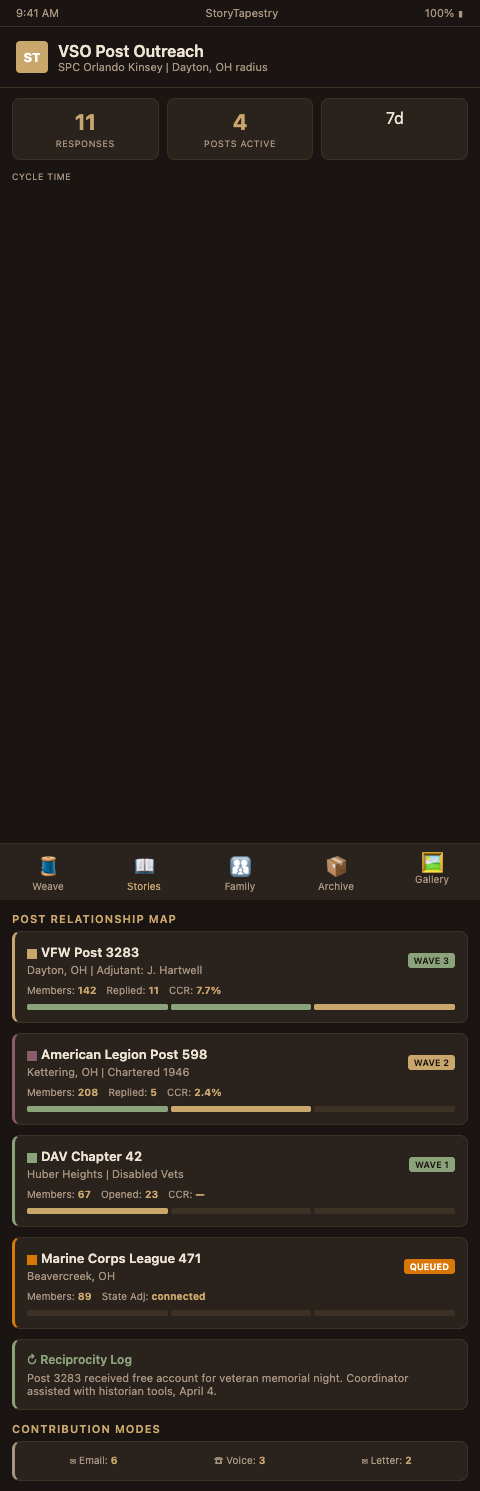
When Army Specialist Orlando Kinsey's family began planning his memorial in Dayton, Ohio in 2023, his daughter called VFW Post 3283 on a hunch because her father had mentioned meetings there for 40 years. The post's adjutant responded with a roster of 11 post members who had served with or near Kinsey, and within a week the family had more comrade stories than they could use. This is the outcome when VSO coordination works. In most memorial programs, it does not happen, because coordinators do not know which posts to contact, what to ask for, or how to structure the partnership.
The infrastructure is genuinely enormous. The VFW traces back to 1899 and maintains approximately 1.4 million members across its posts and auxiliary. The American Legion, chartered in 1919, counts more than 2 million members across roughly 13,000 posts worldwide and played a central role in drafting the GI Bill. The Legion maintains a public reunion directory at the post level, which makes structured outreach technically feasible. Pew Research estimates 18 million living veterans, 78 percent of whom served during wartime, and the VA's VetPop2023 projects the population through 2053.
The underuse is structural. Memorial program coordinators often come from funeral services, veteran cemetery administration, or VSO auxiliary backgrounds, and their familiarity with the post network is partial. Coordinators who know the state department adjutants do not always know how to query posts at scale; coordinators who know one post rarely have the infrastructure to query 50. The result is that the largest peer network in the veteran memorial ecosystem goes mostly unasked, and memorial programs do the equivalent of cold-calling strangers while sitting across the street from a community center full of people who knew the veteran.
The StoryTapestry Framework: A Tapestry Woven Through Post-Level Outreach
StoryTapestry's VFW and American Legion outreach framework treats posts and Legion halls as the load-bearing social infrastructure for veteran memorial coordination, and weaves outreach workflows that respect post autonomy while enabling the coordinator to query at scale. The framework rests on four components: post relationship mapping, graduated outreach, contribution workflow, and ongoing reciprocity.
The first component is post relationship mapping. Before any memorial outreach begins, the coordinator builds a map of posts and Legion halls within a defined geography, usually the veteran's lifetime residence radius plus any post where the veteran held formal membership. The platform pulls from public post directories (the Legion's 13,000-post network is publicly searchable), and coordinators annotate the map with contact names, adjutant email addresses, typical response rhythms, and any prior memorial coordination history. Posts that participated in a prior memorial often respond faster to subsequent outreach because the relationship already exists. The mapping pairs with post-service organizations workflows for broader VSO reach, and extends naturally into post-service organization tapestries for veterans active in multiple groups.
The second component is graduated outreach. The framework sends three waves of increasingly specific queries. The first wave is a brief notification to the post adjutant ("Mr. Kinsey's family is building a memorial tapestry; if you knew him, would you like to contribute a story?"). The second wave goes to post members who responded to the first ("Here are the specific questions the family is asking about"). The third wave invites in-person or video contributions to the tapestry. Waves one and two can be automated; wave three is coordinator-assisted. Graduation prevents cold-outreach fatigue while still reaching everyone who might contribute. The workflow connects with reunion network building to leverage both VSO and unit association channels, and coordinators who have already run unit reunion network building can recycle contact lists across both channels.
The third component is contribution workflow. Post members contributing stories often prefer asynchronous contribution (a typed email, a voicemail, a mailed handwritten letter) over a scheduled video interview. The platform supports all four modes with identical provenance tracking, so a 79-year-old post member who mails a three-page letter receives the same acknowledgment and integration as a 52-year-old post member who records a video from their car. Modality flexibility dramatically improves response rates, especially from older post members who find video calls unfamiliar.
The fourth component is ongoing reciprocity. VFW posts and American Legion halls have their own memorial needs: deceased post members, anniversary commemorations, and post-history projects. Memorial programs that use post infrastructure for one-way outreach exhaust the relationship quickly. The framework treats reciprocity as structural, offering posts free accounts that support their own memorial work and periodic contributions from the coordinator's skill set (help with post historian tools, support for anniversary programs, training for junior auxiliary members). The reciprocity component parallels association memorial partnerships used in diaspora memorial contexts, mirroring the cultural association memorial partnership playbook with modest adjustments for VSO culture.
Advanced Tactics: State Department Adjutants, Post History Integration, and Cross-Organizational Outreach
Memorial programs working with families across broad geographies need three tactics beyond the baseline framework.
The first is state department adjutant relationships. Both the VFW and the American Legion organize state-level departments with adjutants who oversee coordination across dozens to hundreds of posts within a state. A coordinator with a working relationship with a state adjutant can query the state network in a single email rather than contacting 50 posts individually. State adjutants generally respond to coordinators who have demonstrated good faith with individual posts first, so the relationship builds from local to state rather than the reverse. StoryTapestry's coordinator dashboard tracks adjutant contacts and post membership histories so relationship-building is cumulative rather than scattered across emails.
The second tactic is post history integration. Many VFW posts and Legion halls maintain their own history archives, often informal: a scrapbook maintained by the post historian, a binder of 50 years of newsletters, a wall of framed photographs from post events. These archives frequently contain material about deceased members that families have never seen. With post consent, coordinators can digitize post archive material into the memorial tapestry, giving the post a digital backup and the family access to photographs and newsletter mentions they did not know existed. Post historians are often retired military librarians or former unit historians who welcome the digitization partnership.
The third tactic is cross-organizational outreach. Veterans often held simultaneous membership in the VFW and the American Legion, plus DAV, Military Order of the Purple Heart, or service-specific organizations like the Marine Corps League. Rather than querying each organization separately, the coordinator can send a single cross-organizational query to each identified membership, with tracking that prevents duplicate contact. Veterans whose extended service involved 20 or 30 years of active VSO participation often yield rich material when the full network is queried simultaneously rather than sequentially over six months.
Coordinate VSO-Partnered Veteran Memorials with StoryTapestry
Veteran memorial programs partnering with VFW posts, American Legion halls, and other veteran service organizations use StoryTapestry to handle post relationship mapping, graduated outreach, and ongoing reciprocity at a scale that cold-call coordination cannot reach. Schedule a coordinator consultation to review your current VSO relationships and bring a recent memorial program where VSO outreach could have gone further. Programs implementing the full framework typically see VSO contributor response rates rise several fold within the first two memorials, and post adjutants begin proactively referring families who need coordination help. Reach out through the StoryTapestry program coordinator portal to begin a VSO partnership framework setup.
The consultation covers your current VSO relationship map, the post-adjutant outreach sequencing protocol, the state department adjutant integration workflow, the post-history narrative thread that weaves the local VSO into the memorial, and the cross-organizational outreach playbook that coordinates across VFW, American Legion, DAV, AMVETS, and branch-specific associations. Pilot engagements include VSO-partnership onboarding for your two lead coordinators, a supervised first-memorial deployment with a named partnership specialist on the call, and a 60-day audit of VSO contributor response rates against the baseline. Most programs complete initial post-mapping and begin running the outreach sequence on the next veteran memorial within 14 days of the consultation. Bring your lead coordinator, one family-services director, and one VSO post commander or adjutant — the consultation produces a post-mapping worksheet the three of them can fill out together before the next memorial intake.