What Post-Service Organizations Can Contribute to Veteran Life Tapestries
The Problem: Post-Service Institutional Memory Stays Outside the Memorial
A funeral director meets with the family of a retired Army veteran who spent 35 years in civilian work and 40 years as a VFW post member. The family prepares the memorial around the service years they knew second-hand and the home life they lived alongside. The VFW post commander is not invited to contribute. The DAV chapter officer who helped the veteran navigate 25 years of disability benefits is not contacted. The American Legion post that named a scholarship after him does not hear about the memorial until after publication. The richest layer of post-service institutional memory stays outside the tapestry.
Post-service organizations are built for exactly this memory work. The American Legion, chartered by Congress in 1919, maintains accredited officers at post level who carry deep knowledge of local veteran lives (American Legion). The VFW traces its roots to 1899, counts more than 2 million members, and operates at community scale through posts that function as extended military families (VFW). DAV has supported disabled veterans with memorial and burial benefits since 1920 (DAV).
Post-9/11 veterans find community through IAVA and the Wounded Warrior Project, which run programs for Iraq and Afghanistan veterans that accumulate institutional memory comparable to older VSOs (IAVA; Wounded Warrior Project). TAPS, since 1994, provides 24/7 peer support for military loss and hosts institutional memory of every family that has used their services (TAPS). Gold Star services through the Army's Survivor Outreach Services program support bereaved families regardless of component (Army.mil - Gold Star). Each organization holds thread-ready material for veteran memorial tapestries; few funeral homes activate the pathways.
Solution Framework: Weaving VSO Contributions Into the Tapestry
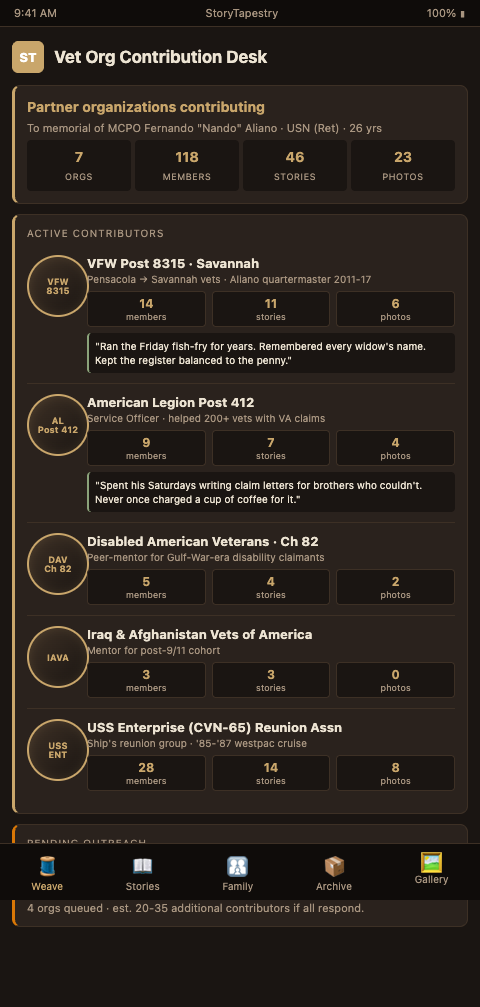
Activating post-service organizations as contributors transforms the memorial tapestry into a community artifact. StoryTapestry integrates VSO outreach pathways, organization-specific contribution templates, and accredited-officer coordination so funeral directors can engage the American Legion, VFW, DAV, IAVA, WWP, TAPS, and Gold Star networks as structured contributors rather than afterthought invitees.
The contribution architecture operates on four VSO relationship types. First, membership-based organizations like the American Legion, VFW, and DAV hold post-level records of the veteran's involvement: offices held, programs led, scholarships endowed, honor guard participation. The tapestry includes a dedicated VSO involvement chapter that surfaces these threads as first-class memorial content. Second, era-specific organizations like IAVA (post-9/11) and the Wounded Warrior Project (post-9/11 wounded) hold programmatic connections specific to the veteran's generation (IAVA; Wounded Warrior Project).
Third, bereavement-specific organizations like TAPS and Gold Star services provide both contribution and support: they can contribute to the memorial if the veteran was involved in bereaved-family work, and they offer resources for the current family navigating the loss (TAPS; Army.mil - Gold Star). Fourth, disability-oriented organizations like DAV offer both memorial contribution and practical support for surviving spouses navigating VA benefits after the veteran's death (DAV).
Unit Comrade Outreach Network extends naturally into VSO outreach because many veterans' closest post-service relationships run through their post membership. A VFW post adjutant who served 15 years alongside the deceased often holds more post-service narrative than any individual family member. The platform routes outreach through post-level VSO contacts, confirms accreditation where relevant, and coordinates contribution windows across the VSO calendar. This VSO-aware outreach builds on beyond family perspectives approaches that open contributor circles past blood relation, and connects directly to VFW Legion outreach protocols calibrated for the two largest VSOs.
Deployment Timeline Reconstruction anchors VSO contributions to the veteran's post-service chapter specifically, with sub-panels for each organization's involvement window. A veteran who joined the American Legion in 1972 and served as post commander from 1985 to 1989 receives timeline nodes for each role. The VSO involvement arc reads as narrative rather than list.
Classified-Aware Story Frameworks rarely apply to VSO contributions since post-service involvement typically sits outside operational security concerns. The exception is veterans whose careers in restricted roles meant their VSO involvement stayed under official radar; the platform accommodates those cases with standard frameworks. The deeper pattern here is that contributor communities enrich memorial depth through non-family institutional memory across many loss contexts.
Dual-Life Narrative Integration closes the weave. The VSO involvement chapter runs parallel to the civilian career chapter in the post-service timeline, showing how the veteran built community through two simultaneous tracks. The memorial tapestry renders the full post-service life with the institutional weight it carried.
VSO involvement often carries distinctive ritual practices that belong in the memorial. An American Legion post commander's funeral may include the presentation of a post flag folded according to Legion protocol; a VFW post chaplain may deliver a pastoral reflection framed by VFW ritual language; a DAV chapter adjutant may present a final certificate of service to the surviving spouse. StoryTapestry captures these ritual moments as dedicated tapestry panels with photographs, participant attribution, and the specific ritual language spoken during the ceremony. These panels become among the most revisited memorial content because they represent the formal honors the veteran's post-service organizations performed in parting, and because the ritual language carries deep meaning for the VSO community the veteran inhabited.
Advanced Tactics for Activating VSO Contributions
Map the veteran's VSO involvement at intake through direct questioning. "Which posts did he belong to? Did he hold office? Did he participate in honor guard, color guard, or Honor Flight? Did he mentor younger veterans through his post?" These questions surface contribution pathways the family often forgets when grief compresses the conversation to immediate logistics.
Contact post commanders and adjutants early. American Legion and VFW posts typically have accredited officers who can confirm the veteran's membership, offices held, and specific contributions, and who often know the comrades still living nearby (American Legion; VFW). A respectful phone call from the funeral home identifies the firm as culturally fluent and opens memorial contribution pathways the post is glad to support.
Engage DAV for surviving-spouse benefits alongside memorial contribution. DAV officers help widows navigate VA survivor benefits while the memorial work proceeds, and the dual engagement often produces memorial contributions from the officer who walked the veteran through decades of benefits navigation (DAV). Practical support and memorial contribution weave together rather than competing for the family's attention.
For post-9/11 veterans, engage IAVA and the Wounded Warrior Project early. Both organizations maintain event records, program participation histories, and peer community records that can enrich memorial content for younger veterans whose VSO involvement ran through newer organizations (IAVA; Wounded Warrior Project). The cultural register for post-9/11 veterans differs from older VSOs; IAVA and WWP staff know the community idiom.
Route TAPS engagement through family consent. TAPS operates peer support for military loss survivors; engaging them on a memorial project where the veteran was a TAPS volunteer or program participant requires family permission, and their contribution window differs from other VSOs because of the bereavement-focus of their work (TAPS).
Coordinate Honor Guard contributions across VSOs. American Legion, VFW, and veteran motorcycle associations often provide honor guards at committal services, and their participation is a memorial thread worth capturing as an official tapestry panel. Photograph the guard, identify the members by name and post, and include the panel in the published tapestry.
Verify accreditation status before relying on VSO outreach. Accredited VSOs operate under VA oversight and carry legal authority to represent veterans in benefits claims. The VA maintains a public search for accredited VSOs, and the funeral director who confirms a contact's accreditation before routing benefits-related communication through them avoids referring the widow to someone without the standing to help effectively. Memorial contribution outreach does not require accreditation, but survivor benefits referrals do, and mixing the two without verification can damage the family's benefits timeline.
Connect with Survivor Outreach Services at the nearest Army installation when serving Army Gold Star families. SOS operates at every Army installation and provides specialized grief support, memorial coordination, and benefits navigation for Army-component Gold Star families. Navy, Marine Corps, Air Force, and Space Force each operate analogous survivor support programs through their respective casualty assistance programs. A funeral director who knows which program to contact based on the veteran's component earns trust immediately through demonstrating familiarity with military casualty support structures.
Distinguish between combat-era VSOs and peacetime-service organizations. The VFW historically restricted membership to veterans who served in specific overseas combat theaters, while the American Legion admits any veteran with honorable wartime service. Some newer organizations focus specifically on post-9/11 veterans, while others serve specific identity-based communities within the veteran population. Knowing which organization a veteran belonged to based on eligibility alone tells you something about the veteran's service profile, and the outreach language adapts accordingly. The same institutional-memory discipline echoes birth worker contributions in very different loss contexts, where doulas and bereavement midwives bring distinct professional memory that families alone cannot reconstruct.
Bring VSO Institutional Memory Into Your Veteran Memorials
Veteran Memorial Programs gain their deepest community dimension when post-service organizations participate as structured contributors rather than afterthought mourners. StoryTapestry organizes American Legion, VFW, DAV, IAVA, Wounded Warrior Project, TAPS, and Gold Star service engagement into a coordinated outreach workflow with post-level contacts and organization-specific contribution templates. Talk with our Veteran Memorial Programs team about activating the VSO contributor network for your next veteran family, and turn the memorial from a family assembly into the community artifact the veteran's post-service life earned.
The walkthrough covers regional VSO activation patterns for your specific service area, including identification of the American Legion and VFW posts nearest your funeral home, introduction templates for post commanders and adjutants, and honor guard coordination scripts your staff can use for committal services. Firms serving communities with strong VSO culture—rural Pennsylvania, central Texas, northern Wisconsin, upstate New York, and countless other regions where American Legion and VFW posts function as community anchors—find that VSO-integrated memorials dramatically strengthen their reputation among veteran families. Firms in urban areas where VSO culture is less visible still benefit from VSO activation because the post commanders and chaplains who participate bring institutional memory and ritual depth the memorial could not otherwise access.
Bring a pending veteran intake to the walkthrough, whether the veteran was a 60-year American Legion member whose post named a room after him or a post-9/11 veteran whose WWP peer-support relationships held him through medical recovery, and see how the VSO outreach workflow adapts to each veteran's specific institutional memberships. The memorial that results honors the community the veteran built, not only the family the veteran came home to.