What Doulas and Birth Workers Can Contribute to Loss Memorials
The Problem: Birth Workers Hold Labor-Phase Memorial Material No One Else Witnesses
A bereavement doula described attending a 19-hour induction for a 23-week loss. She was in the room when the family named the baby. She was there when the father first held his son. She took the photographs the parents later described as their most treasured images. She wrote down the words the mother said to the baby in the minutes after birth. When the family was discharged, the doula handed over her notes — and most of them never made it into the hospital's bereavement records.
Birth workers hold a unique position in perinatal loss care. Star Legacy Foundation's guidance for birth doulas describes specific companionship practices during loss-affected labor. Bereavement doulas help with death certificates and arrangements in ways hospital staff often cannot. Carrying To Term describes the role of bereavement doulas as companioning families through labor and memory-making. DONA International — the world's leading doula certification organization — has developed professional standards that include bereavement work. Three Little Birds Perinatal documents bereavement doula support specifically through lethal prenatal diagnoses.
The clinical literature supports this integration. A study on support after stillbirth documented that multidisciplinary support — including doulas and birth workers — aids family coping. ACOG's perinatal palliative care opinion recommends birth plan development that includes doula support where families choose it. Yet most hospital bereavement infrastructure does not include a structured channel for doula and birth worker contributions. The observations, the photographs, the ritual work, the late-night text messages — all of it often lives in a doula's personal notes and never reaches the family's memorial.
The Solution: Doula and Birth Worker Contribution Woven Into the Tapestry
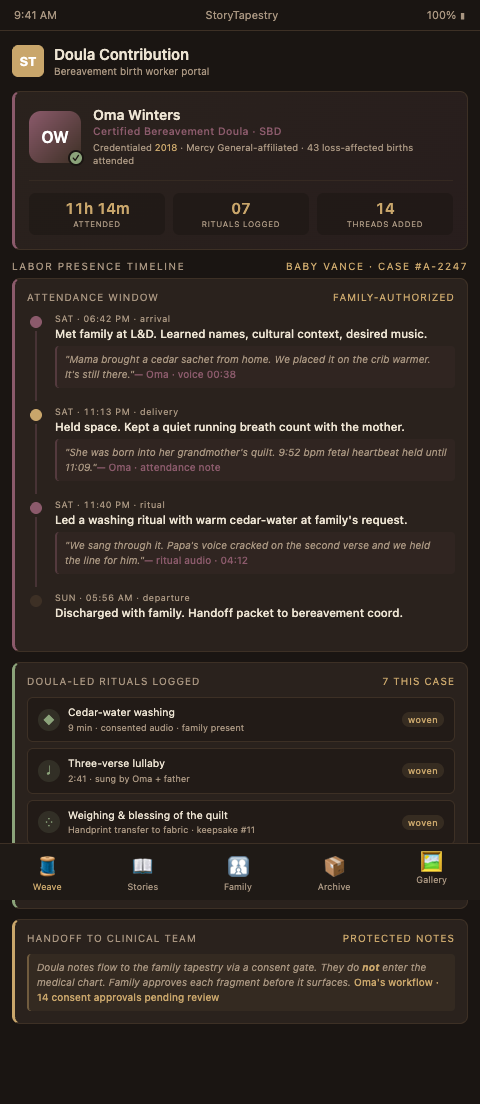
StoryTapestry provides doulas and birth workers a consent-controlled contribution pathway that preserves the labor-phase and immediate-postpartum moments they witnessed — with the family's explicit approval at every step. The tapestry metaphor holds: the doula's observations are threads, the birth worker's photographs are threads, the family's responses to those contributions are additional threads, and the full weaving shows a labor and immediate aftermath with the density that lived reality had.
Birth worker invitation and consent workflow. The family invites the doula or birth worker into their tapestry — not the other way around. The invitation is revocable, scope-limited, and role-specific. A bereavement doula receives a different prompt set than a birth photographer, who receives a different set than a lactation consultant. Each role has contribution boundaries calibrated to their work.
Labor-phase observation prompts. StoryTapestry's doula prompt library covers the specific territory doulas hold: the rhythm of labor, the family's words, the rituals performed during or after birth, the photographs taken, the keepsakes created. Prompts are designed to capture what hospital clinical records cannot — the emotional and ritual dimensions of loss-affected birth. This complements the hospital bereavement support approach without overlapping clinical documentation.
Photography and visual media integration. Many birth workers are also photographers or work closely with bereavement photographers, and the intake is designed to feed hospital bereavement support teams without duplicating clinical workflows. StoryTapestry accepts photographic contributions with metadata (timing, lighting, consent level for each image) and the photographer's narrative context. Families retain full control over which photographs are displayed, who can see them, and in what order.
Ritual and ceremonial documentation. Doulas often lead or co-lead small rituals during loss-affected birth — washing the baby, dressing the baby, saying blessings, lighting candles. StoryTapestry preserves these ritual moments with the exact words spoken (when families consent to recording), the sequence of actions, and the cultural or religious context. Rituals become permanent tapestry threads rather than fading into the doula's personal memory.
Post-discharge doula continuity. Many bereavement doulas stay in touch with families for months after loss. StoryTapestry provides a doula-family continuity channel where the doula can add new reflections, check in with gentle tapestry-linked messages, and (with family consent) contribute to anniversary observations. This parallels the sibling memorial voices pathway where ongoing contribution is the norm rather than the exception.
Certification and verification badges. Families need to trust the doulas and birth workers adding to their tapestries. StoryTapestry supports verification of DONA International certification, CAPPA certification, and other professional credentials — displayed with the birth worker's contribution context so families understand the role each contributor played.
Advanced Tactics for Doula and Birth Worker Integration
Pre-labor tapestry seeding. When a family hires a bereavement doula in advance of a known lethal diagnosis birth, the doula can help seed the tapestry during pregnancy — capturing the family's hopes, the ultrasound recordings, the letters to the baby. The tapestry exists before labor, giving the family infrastructure to continue rather than infrastructure to create in the first week after loss.
Co-contributor workflow between doula and hospital staff. In labor, the bereavement doula and the primary nurse often both observe the same moments from different angles, and the sibling memorial voice capture infrastructure we built follows the same parallel-perspective logic. StoryTapestry supports parallel contribution from both roles, with clear attribution so the family can see whose perspective each thread represents. The doula's observation of the mother's breathing alongside the nurse's observation of the baby's monitor readings creates a richer record than either alone.
Doula-facilitated family storytelling. Doulas are often skilled at eliciting stories from grieving families. StoryTapestry provides a facilitated-storytelling mode where the doula uses the platform's prompt library to guide an in-person storytelling session, typing the family's responses directly into the tapestry as they speak. This mode is especially useful with families who cannot face a screen alone in the acute phase.
Birth worker coordination with affiliated funeral services. Many hospital bereavement programs partner with specific funeral homes that specialize in perinatal services. StoryTapestry bridges birth worker contributions and funeral home workflows, so a doula's documentation of a baby's blessing flows directly into the funeral director's service planning — with family consent governing every handoff. This mirrors the organizational tribute contributions model we use across memorial niches.
Post-loss doula peer reflection. Bereavement doulas carry secondary grief, and the peer space draws on post-service organizational tribute frameworks that structure professional community contributions in other bereavement niches. StoryTapestry provides a doula-only peer reflection space — entirely private from families — where birth workers can process what they witnessed with other doulas. Anonymized thematic aggregation supports continuing professional development without exposing specific cases.
Multi-family pattern awareness for practicing doulas. A bereavement doula who has supported twelve loss-affected births in a year sees patterns the individual families cannot. StoryTapestry offers doulas a practice-level dashboard (with all family data segregated by explicit consent) where they can reflect on their practice, identify needs for additional training, and track the arc of their own professional development. No family content crosses case boundaries without specific family consent.
For Hospital Bereavement Programs Ready to Integrate Doula and Birth Worker Contributions
Your bereavement program may already collaborate with bereavement doulas, birth photographers, and lactation consultants. StoryTapestry makes those collaborations structurally visible in family memorials — giving birth workers a consent-respecting channel to add the observations, photographs, and ritual work they currently hand off in fragmented notes. We pilot the platform with hospital programs and their network of birth workers, certifying credentials, mapping workflows, and ensuring family consent governs every contribution. Reach out to schedule a conversation that includes your bereavement coordinators and your network of affiliated doulas and birth workers. The consultation runs 60 minutes and covers the birth worker credential verification workflow, the consent-governed contribution channel for doulas and birth photographers, the lactation consultant reflection space, and a sample tapestry showing how labor-phase observations weave into the family's overall narrative.
Pilot engagements include platform access for your bereavement coordinator, two partnered doulas, one birth photographer, and one lactation consultant, plus a named implementation lead who certifies each birth worker's credentials and onboards them to the platform. Most programs complete the credentialing and onboarding cycle within six weeks and begin ingesting birth worker contributions on the first postpartum family engagement after onboarding closes. Bring your bereavement coordinator, two lead doulas from your network, and one L&D nurse manager — the consultation produces a four-role workflow plan with clear handoff points for each type of birth worker contribution.