Why Veteran Memorials Need Input Beyond the Immediate Family
The Problem: Family-Only Memorials Miss the Second Life
A funeral director sits with the adult children of a retired Master Sergeant. They prepare a memorial slideshow from photos in the family home: high-school graduation, the wedding, the Thanksgiving turkeys, the grandchildren. They mention a handful of buddies their father mentioned by nickname but cannot place. The memorial is loving and honest, and it captures perhaps forty percent of the life it commemorates. The other sixty percent lived on deployments, in garrison, and across unit reunions the family rarely attended.
Berkeley Law research on unit cohesion documents that relationships inside military units carry emotional depth rivaling family bonds, and longitudinal studies show those bonds continue to predict psychological outcomes well into post-service life (Berkeley Law; PMC). Battle buddy programs formalized this bond at institutional level, with pairs of soldiers assigned to support one another through training and deployment in ways that shape identity for decades (DTIC).
Grief research on veterans further shows that unit cohesion shapes how veterans mourn their comrades, and that bereaved military families carry a distinct relationship with the institution that influences how they want to memorialize their loved one (PMC; Taylor & Francis). A memorial that closes the contributor circle at immediate family omits the people whose witness the veteran valued most in life.
Solution Framework: Weaving Unit Voices Into the Family Tapestry
Opening veteran memorials beyond the family requires an explicit architecture for non-family contribution. StoryTapestry builds that architecture around the tapestry metaphor: family threads form the warp running the length of the life, while unit and community threads form the weft that crosses through each deployment, duty station, and post-service chapter. Both are necessary for the fabric to hold.
The Unit Comrade Outreach Network forms the primary non-family contribution pathway. TogetherWeServed maintains a member network that lets unit veterans contribute first-person stories to memorial projects, and StoryTapestry integrates those directories so funeral directors can surface the people who should be invited (TogetherWeServed). The platform hosts dedicated contributor pages for former unit members, battle buddies, commanding officers, and subordinates, each with its own prompts shaped by that relationship type.
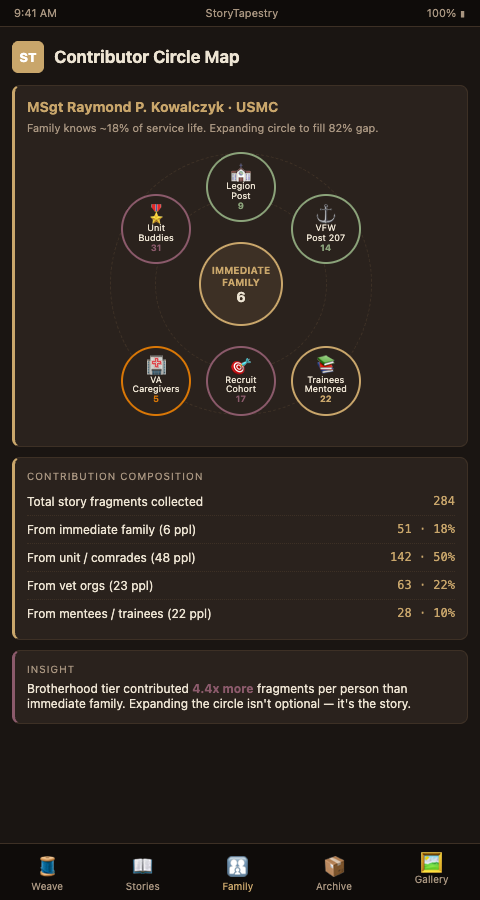
The weft threads come from five distinct non-family contributor categories. Battle buddies and fire-team partners share the tightest relational memories, often the stories of near-misses and daily routines that define deployment experience. Commanding officers and senior NCOs contribute the leadership lens, describing the veteran's professional reputation and growth arc. Junior Marines, sailors, soldiers, airmen, or guardians the veteran mentored carry the legacy forward. VSO comrades from post-service years bring the American Legion post, VFW hall, and unit-reunion dimensions. Civilian colleagues and neighbors who served alongside the veteran in volunteer roles anchor the tapestry in the post-service community.
Classified-Aware Story Frameworks govern the non-family contributor experience with particular care. A former commanding officer may want to contribute detail that remains restricted, and the framework provides prompts oriented toward character, mentorship style, and shared experience without requiring operational detail. This is the same instinct behind comrade story reconstruction workflows that respect operational boundaries while still producing deep memorial content.
Deployment Timeline Reconstruction anchors each non-family contribution to the exact tour, garrison assignment, or post-service year where the contributor knew the veteran. A battle buddy who served with him in 2006 contributes to that chapter; a VFW post commander who knew him from 2015 onward contributes to the post-service chapter. The tapestry shows the veteran's life populated by the right voices at the right times rather than a random scatter of tributes.
Dual-Life Narrative Integration binds the non-family contributions back to the family's warp threads. The widow's memory of her husband's difficult return from Afghanistan sits alongside his squad leader's memory of the mission that preceded that return. The daughter's memory of the Little League games he coached sits alongside the VFW post commander's memory of the fundraising he led for the post's youth program. Families exploring how post-service organizations might contribute find the outreach pathways already built.
Contributor permissions and attribution controls give the family the final say over how non-family voices appear on the memorial. A battle buddy may contribute under his full name and rank, or under first name and unit only, or anonymously with tour attribution preserved. The same Marine Sergeant Major who knew the veteran's full name for thirty years may prefer to appear on the public tapestry as "Former Senior NCO, 2nd Battalion 5th Marines" with details he shares privately to the family through a contributor note rather than the public panel. StoryTapestry separates these layers so the family controls what the public sees while the private contributions remain accessible to them in perpetuity.
Advanced Tactics for Expanding the Memorial Circle
Map contributor categories before outreach. List the deployments, duty stations, and post-service involvements where the veteran's weft threads might live. A 30-year career typically generates six to ten contributor categories, and most memorials never exceed two without a deliberate plan. Use the DD-214 and unit-reunion records to identify contributor pools per category before drafting a single outreach message.
Sequence outreach by emotional proximity. Begin with the battle buddy closest to the veteran's final deployment, because that relationship is often the most emotionally available for memorial work and tends to generate the longest first contributions. Commanding officers and senior NCOs typically take a second round of outreach because they are balancing multiple memorial requests across former subordinates. VSO contacts respond well to outreach routed through post adjutants who can vouch for the funeral home.
Draft category-specific prompts. A battle buddy responds best to "describe the time he had your back," a commanding officer to "describe his professional reputation in the unit," a mentee to "describe what he taught you that you still use today," and a VSO comrade to "describe his post contributions." Generic prompts produce generic contributions. Category-specific prompts produce memorial gold.
Handle declined invitations gracefully. Unit cohesion and grief research shows that some comrades cannot yet participate in memorials for veterans they served with (PMC). Respect the decline, note the date, and send a single follow-up at the one-year mark with the memorial tapestry already published. Many declined contributors rejoin in the second year, and the tapestry continues to thicken long past the funeral.
Attribute every contribution visibly. Unit cohesion depends on mutual recognition, and a memorial that credits the battle buddy by rank and tour honors the contributor as well as the veteran. This visible attribution also signals to other potential contributors that their voices will be held with care, which lifts response rates across the contributor pool.
Layer contributions around unit-specific language. A Marine memorial that surfaces "Oorah" and "Semper Fi" in the contribution prompts feels different from one that uses generic "in memoriam" language, and Marines responding to the prompts slip immediately into the register their unit used. An Army Airborne memorial that opens with "All the Way" pulls paratroopers into the contribution mode they inhabited at Fort Bragg, Fort Campbell, or Fort Richardson. A Navy memorial that uses "Shipmate" and "Fair Winds and Following Seas" signals to sailors that the tapestry knows its audience. This linguistic fluency comes from the funeral director's cultural training and from the platform's unit-specific prompt libraries, and it converts contributor hesitation into active engagement.
Protect the memorial against contributor conflict. Sometimes two former comrades remember the same event very differently, and sometimes a former commanding officer and a former subordinate hold genuinely incompatible views of the veteran's service. StoryTapestry's contributor moderation tools let the funeral director or family representative review contributions before publication, resolve conflicts through private outreach to the contributors involved, and preserve multiple perspectives when resolution is not possible. A memorial is not an arbitration forum, but it can honor diverse memories without forcing consensus where honest disagreement exists. Honoring the full narrative depth that shows veterans operated across parallel registers of connection requires exactly this discipline — preserving contradictions rather than flattening them into a single official account.
Widen the Weave of Your Next Veteran Memorial
Veteran Memorial Programs serving military families need platform tools designed for the distributed contributor structure of military lives. StoryTapestry organizes non-family contribution by category, by deployment, and by relationship type, with Unit Comrade Outreach Network, Deployment Timeline Reconstruction, Classified-Aware Story Frameworks, and Dual-Life Narrative Integration already mapped. Connect with our team to bring structured non-family contribution into your next veteran memorial, and give the widow a tapestry that honors both the forty percent she witnessed and the sixty percent his comrades carry.
The demo walks through a sample reconstruction across three hypothetical profiles: a Vietnam-era Army infantryman with scattered 1st Cavalry Division comrades, a Desert Storm-era Marine armor crewman with surviving tank crew across five states, and a post-9/11 Air Force pararescueman whose community spans active duty, reserve, and the tight community of special warfare airmen. Each profile demonstrates how the contributor categories, outreach templates, and attribution controls adapt to the veteran's specific service pattern. Your staff leaves the walkthrough with a concrete mental model for how the next veteran intake will unfold, from the first family meeting through the contribution windows that extend across the first year of the memorial's life. Veterans earn the depth of a full weft, and the widows who outlive them deserve to see their husbands' comrades woven into the memorial rather than left outside the family home where the service years happened outside their view.