How to Reconstruct Military Life Stories from Scattered Service Comrades
The Problem: A Life in Service Lives Outside the Family Home
A funeral director sits with a Gold Star widow whose husband served 22 years active duty Army before retiring to civilian work. She can describe his final decade clearly. The previous 22 years exist as a drawer of faded photos with unlabeled faces, a DD-214 with acronyms she cannot decode, and half-sentences he began over dinners but never finished. The people who witnessed those years are scattered from Fort Bragg to Okinawa to a nursing home in Wichita.
This gap is not unusual. The Library of Congress Veterans History Project has built its national collection precisely because veteran narratives live distributed across VSOs, universities, and personal archives rather than inside any one family home (Library of Congress). Oral history methodology from the U.S. Army assumes that reconstructing a service life requires active listeners chasing clues across multiple sources rather than relying on one informant (U.S. Army).
The problem compounds over time. PTSD research on veterans shows many service members deliberately compartmentalize combat experiences from family life for decades, meaning spouses may never have heard the stories a fire-team partner can recount in detail (NPHM). When the veteran dies, the family memorial captures one life. The unit memorial captures another. Without reconstruction, neither is complete, and the veteran's grandchildren inherit silence where a full narrative could have lived.
Solution Framework: Weaving Scattered Threads Into a Tapestry
Reconstructing a military life requires treating the biography as a tapestry in progress. Each comrade holds a length of thread dyed by a specific deployment, barracks assignment, or mission. StoryTapestry gives funeral directors and families a structured way to locate those thread-holders, gather their strands, and weave them into a permanent, interactive memorial that reflects the whole fabric of service rather than a single corner of it.
The reconstruction process moves in four stages. First, the DD-214 anchors the frame by identifying units, duty stations, campaign ribbons, and dates. Second, unit rosters and reunion networks like TogetherWeServed, which hosts more than 159,408 U.S. military unit pages with member histories, surface the comrades still reachable (TogetherWeServed). Third, trauma-informed interviews with those comrades, structured around the three-phase approach the National WWII Museum documents for veteran oral history, produce first-person fragments (National WWII Museum). Fourth, StoryTapestry stitches those fragments into the timeline alongside family contributions, keeping each contributor's voice distinct while showing how their threads connect.
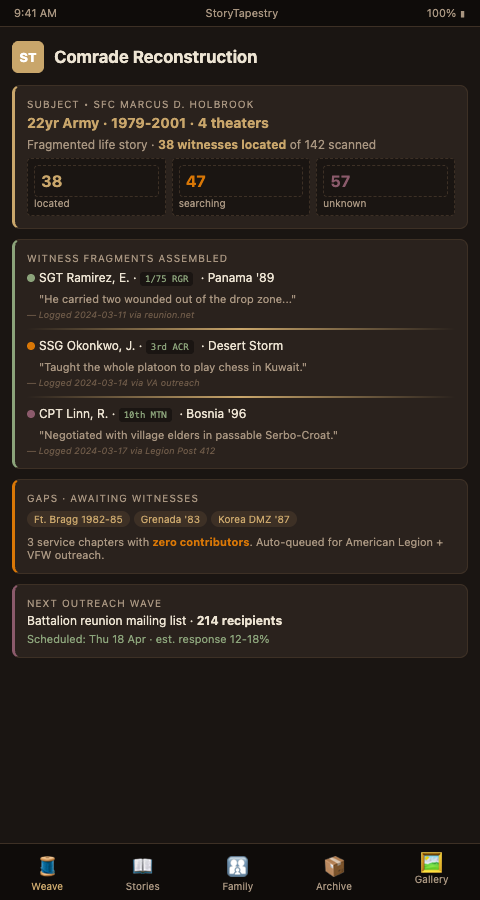
Unit Comrade Outreach Network is the muscle that makes stage two work. Rather than asking the widow to cold-call Army Veterans Locator services or learn SF-180 procedures, the platform maintains searchable pathways to unit reunion coordinators, VSO post adjutants, and veterans who have registered interest in contributing to former comrades' memorials. The funeral director can draft outreach messages from templates that university veteran oral history programs have refined over decades (Samuel Proctor).
Deployment Timeline Reconstruction handles stage three by organizing incoming contributions around the service record chronology. A comrade who served with the veteran at Firebase Tomahawk in 1969 contributes under that specific node. Another who trained with him at Fort Benning in 1967 contributes separately. Each thread is dated, attributed, and placed where it belongs in the weave, so the tapestry shows the arc of service rather than a pile of disconnected anecdotes.
Classified-Aware Story Frameworks prevent the most common pitfall in veteran memorial reconstruction: comrades self-censoring because they fear sharing classified detail. StoryTapestry provides prompts calibrated to different clearance levels and mission types, guiding contributors toward what they can share about atmosphere, relationships, and personal experience without requiring them to cross operational lines.
Dual-Life Narrative Integration closes the reconstruction by binding the service tapestry to the post-service life the family knows. The same platform that captures a platoon sergeant's memories of Mosul captures the veteran's grandchildren describing the way he taught them to tie a bowline knot. For deployment chapter piecing, this integration turns isolated chapters into a single coherent life, and unit member location workflows provide the practical roadmap for finding the people who hold those chapters.
The four stages run in parallel rather than strict sequence once the initial DD-214 frame is set. While the funeral director is chasing down a squad leader from the 1988 Fort Bragg years, the family can be dictating their Thanksgiving memories into the post-service chapter, and a former platoon medic halfway through the country can be submitting a written contribution about an ambulance run at JRTC Fort Polk that same afternoon. StoryTapestry holds each thread in draft form until the family approves it, so the reconstruction advances on multiple fronts without requiring anyone to wait on anyone else. A memorial that would otherwise take eight weeks compresses to three because the weave moves in every direction at once.
Contributor roles matter as much as contributor count. A fire-team partner from the veteran's first deployment holds different narrative weight than a battalion commander from a staff tour a decade later. StoryTapestry tags each contributor by relationship type so the finished tapestry shows the reader which voices are intimate peers, which are supervisors, which are subordinates the veteran mentored, and which are family members reflecting across the service years. The grandchildren inherit a memorial where they can trace who knew what kind of soldier their grandfather was, and the widow finally sees the specific fire-team partner her husband spoke about at 2 AM in 1984 named in the tapestry with his rank and tour attribution intact.
Advanced Tactics for Stitching the Full Service Record
Funeral directors running multiple veteran memorials benefit from a reusable reconstruction playbook. Begin every intake by copying the veteran's DD-214, circling each unit designation and deployment window, then searching the TogetherWeServed unit page and any published unit histories before the first family meeting. Arrive at intake with two or three candidate comrade contacts already identified, and the widow's initial reaction shifts from overwhelm to relief.
Structure the first round of comrade interviews around the three-phase National WWII Museum method: open-ended arrival questions, chronological deployment walk-through, and closing reflection (National WWII Museum). Record interviews with permission. Keep the narrator's final say over contents front and center, because trauma-informed oral history practice treats the contributor as the author of their own words (NPHM).
Cross-verify dates and locations across three or more sources before treating a fact as settled in the tapestry. If one comrade remembers a firefight in April and another remembers May, StoryTapestry records both attributions rather than collapsing them, so the memorial honors the way memory actually works across a unit. This matters not only for veterans but for scattered caregiver stories where distributed witnesses also hold fragments no single family member can assemble alone.
Build a reusable outreach letter that identifies you as a funeral director, names the specific veteran and unit, and gives the recipient three ways to contribute: a recorded call, a written memory, or a photograph with caption. Comrades who decline the first invitation sometimes accept a lighter ask six weeks later, so maintain a gentle follow-up cadence.
When the reconstruction is done, publish the tapestry with contributor attributions visible. Other comrades who discover it often add threads you never found, and the memorial continues to thicken across the first year.
Account for geographic dispersion when scheduling interviews. A cavalry scout who served with the veteran at Fort Hood in 1982 may now live in rural Montana with spotty cellular coverage, while a 1995 Bosnia peacekeeping peer could be stationed overseas as a defense contractor. StoryTapestry's interview scheduler handles time zone math and proposes written-contribution fallbacks for comrades the funeral director cannot reach by voice. Respect the fact that many older veterans prefer the phone to video calls, and that many post-9/11 veterans prefer asynchronous written contribution to either option.
Treat the published tapestry as a living archive rather than a static memorial card. Unit reunions happening a year after the funeral frequently generate the strongest additional threads, because former comrades sit in the same room with the photograph boards and begin remembering stories they had not thought of in decades. Attend one reunion per year with the tapestry ready to ingest new contributions, and the memorial thickens on the schedule the unit itself keeps.
Start Reconstructing the Full Service Life
Funeral directors honoring veterans deserve tools built for the distributed nature of military lives. StoryTapestry handles the comrade outreach, timeline reconstruction, and classified-aware prompting that turns scattered service fragments into a coherent memorial families can share. Schedule a walkthrough with our Veteran Memorial Programs team to see how the platform manages your next reconstruction intake from DD-214 to published tapestry. Every veteran's full service record deserves to reach the grandchildren who will inherit it.
The platform is engineered for firms handling 40 to 400 veteran services per year, with batch intake tooling, VSO referral templates, and the classified-aware prompt library already built. Your staff does not need to become oral historians overnight; they need to execute a documented workflow that the veterans' community recognizes as respectful of their culture. Bring your toughest pending reconstruction to the walkthrough, whether it is a Vietnam widow whose husband served with the 1st Cavalry Division in the Ia Drang Valley or a post-9/11 Gold Star family whose son served three OEF tours before separation. The Veteran Memorial Programs team will walk through the comrade outreach strategy, the deployment timeline build, and the publication path to a tapestry the family can share with extended relatives, unit reunion associations, and the grandchildren who will inherit the memorial in thirty years.
The scattered threads are out there, held by people ready to contribute when invited through the right channels. StoryTapestry turns that readiness into a finished weave.