Piecing Together Deployment Chapters for Veteran Memorial Storytelling
The Problem: Deployment Chapters Arrive in Fragments
A funeral director meets with the widow of a Marine who served from 2003 through 2014. She remembers the homecomings, the phone calls that stopped for weeks, and the last deployment that broke something in him. She does not know he ran convoys out of Al Asad in 2005, that his unit was among the first into Marjah in 2010, or that the decade of operations he lived inside carries a documented chronology in Navy and Army histories. The reference exists (NHHC). The family has no path to it.
Research on post-9/11 veterans documents 1.9 million service members moving through 3 million OEF and OIF tours since 2001, with deployment intensity producing measurable symptom trajectories that shaped how veterans spoke to their families (NCBI; PubMed). The result is a systemic pattern: spouses holding fragments of story per tour, with gaps between deployments filled by silence rather than narrative.
Army doctrine treats unit history as a continuous operational record, with combat historians tasked specifically to rebuild deployment narratives that would otherwise vanish (FAS; Army Historical Foundation). Families trying to honor a veteran at memorial time lack that institutional memory. Each deployment becomes a closed door rather than a chapter.
Solution Framework: Chapter-By-Chapter Tapestry Weaving
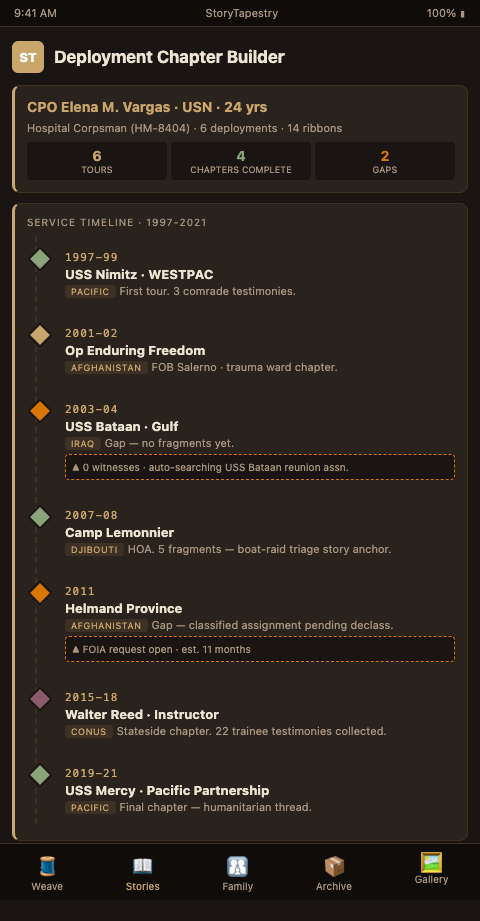
Piecing deployment chapters into a memorial works when the tapestry is structured around the operational boundaries veterans themselves recognize. Each tour is a distinct panel with its own characters, geography, duration, and tone. StoryTapestry organizes those panels chronologically while letting each one hold its full texture, so the resulting memorial reads the way veterans actually lived their service: as a sequence of chapters with their own arcs, not as a blur of "military years."
The Deployment Timeline Reconstruction feature anchors the tapestry in the veteran's specific tour sequence. Congress publishes official reference boundaries for U.S. periods of war, which StoryTapestry uses to label each chapter with the correct era designation and associated VA benefits context (Congress.gov). A 2003 Iraq tour appears under the Persian Gulf War era with associated campaign medals and unit activations surfaced automatically.
Each deployment chapter holds four structural elements. The pre-deployment buildup captures training, home-station assignments, and the farewell period the family actually witnessed. The in-theater arc captures location, mission type, unit composition, and key events. The homecoming phase captures return, decompression, and the family's experience of reintegration. The inter-deployment interval captures the space between tours where veterans lived in garrison or on leave. This four-part structure comes from the way combat historians actually organize unit narrative (Army Historical Foundation).
Unit Comrade Outreach Network populates each chapter with first-person voices from the tour in question. A Marine who served in Marjah in 2010 contributes to that chapter specifically rather than to an undifferentiated "service" bucket. StoryTapestry surfaces unit rosters for the exact tour dates, lets the funeral director reach out to verified former unit members, and keeps contributions tagged to the deployment where the contributor was present. This is the same work combat historians do institutionally, now available to the family tapestry through scattered comrade reconstruction workflows.
Classified-Aware Story Frameworks matter especially in deployment chapters. A SOF veteran's Iraq tour may hold stories that cannot be shared in detail but can be honored in atmosphere and relationship. StoryTapestry provides prompts that guide contributors toward personal experience, shared jokes, mess-hall moments, and unit character without crossing operational lines. The chapter feels populated even when specific missions remain out of frame.
Dual-Life Narrative Integration threads each deployment chapter back to the family's parallel experience. The widow's memory of Christmas 2005 without him sits alongside the comrade's memory of the convoy they ran that same week. The tapestry shows both sides of the tour, so the memorial honors the marriage as well as the mission. For funeral directors working with DD-214 service timelines, the chapter structure turns a discharge document into a narrative frame.
Chapter depth varies by tour, and the tapestry accommodates that variation rather than forcing uniform volume across deployments. A quiet 2008 stability rotation in Kosovo may hold fifteen personal memories and six photographs; a 2004 Fallujah tour may hold forty contributions across six squad members plus a company commander. StoryTapestry sizes each panel to the content available rather than padding thinner chapters to match denser ones. Readers grasp the emotional weight of each tour by the density of the thread, which is how veterans themselves remember their service arc.
Advanced Tactics for Chapter-Level Accuracy
Build each deployment chapter from the DD-214 outward. Circle the tour dates, the unit designation, the duty location, and any campaign ribbons associated with that specific tour. Those four data points let you pull the published chronology for the operation, the unit page on TogetherWeServed, and the VA campaign-medal rubric before the first comrade interview.
For post-9/11 deployments, reference the Navy OEF chronology and equivalent Army records to place the veteran's tour inside the broader operation (NHHC). Knowing that the veteran's unit deployed during a specific offensive lets you prompt comrades with accurate context rather than generic questions, and the resulting contributions carry operational specificity.
Treat deployment gaps as chapters in their own right. The six months at Camp Lejeune between tours often hold the stories of mentorship, training, and unit-cohesion that shaped how the veteran fought. Veterans who deployed together but separated afterward may hold garrison stories that no deployment roster surfaces. StoryTapestry's timeline shows those gaps as distinct panels so contributors see where they fit.
Respect the narrator's symptom trajectory. Research on decade-of-war PTSD shows many post-9/11 veterans develop grief and trauma responses that surface years after separation (PubMed). A comrade you approach about a 2007 tour may need the conversation paced over multiple sessions. Build follow-up into your outreach calendar rather than expecting one call to produce the full contribution. This pacing insight also guides cross-continent story collection when memorial contributors span time zones.
Publish chapter previews to the family before finalizing. Widows often recognize names or places in draft form that unlock additional memories, and the collaborative revision strengthens the tapestry.
Handle equipment and mission details with precision. A Marine who ran convoys out of Al Asad in 2005 drove 7-ton trucks, served in a specific motor transport company, and carried specific weapons systems. A Navy corpsman attached to a Marine infantry battalion in Helmand in 2010 operated under different rules of engagement than a Navy corpsman on a destroyer in the Persian Gulf during the same year. Get these specifics right in the chapter rendering, because veterans and their comrades notice when the tapestry demonstrates fluency with the actual texture of their tour versus a generic "deployment to Iraq" framing. Source these details from the DD-214, unit histories, and the first comrade interview rather than guessing.
For National Guard and Reserve deployments, mark the mobilization and demobilization dates separately from the in-theater dates. A 2005 Iraq mobilization often began with three months of pre-deployment training at Fort Dix or Fort Bliss before the unit deployed, and ended with demobilization and medical processing stretching weeks past the return date. Families sometimes conflate these phases into the deployment window, losing the texture of how the full mobilization affected the family. StoryTapestry separates these phases so the chapter captures the full mobilization arc rather than just the in-theater portion.
Coordinate with the battalion or squadron reunion coordinator for post-published edits to each deployment chapter. Unit reunions happening two or three years after the funeral often surface fresh deployment stories that contributors did not remember at the initial memorial build. A reunion attendee who encounters the tapestry during the gathering may contribute a specific patrol memory or training incident that fits directly into an existing chapter, and the chapter thickens organically across unit-reunion cycles.
Honor Every Tour in the Service Record
Veterans Memorial Programs need tools that respect how service actually unfolds: tour by tour, unit by unit, chapter by chapter. StoryTapestry structures each deployment as its own panel with its own comrade voices, family counterparts, and operational context. Reach out to our team to see how deployment-chapter reconstruction works for your next veteran intake, and bring the widow a memorial that shows the full arc of her husband's service rather than an undifferentiated blur of military years. Each tour earned its place in the tapestry.
The platform supports the full range of post-9/11 service patterns, from single four-year enlistments with one deployment to 20-plus-year careers spanning OEF, OIF, Operation Inherent Resolve, Operation Freedom's Sentinel, and the more recent operations across Africa and the Pacific. It also handles Vietnam, Korea, and earlier-era deployments where the tour structure differed: one-year Vietnam rotations versus two-to-three-year Germany assignments during the Cold War versus the 28-month Korean War tours that ended entire enlistments. The chapter architecture adapts to whichever operational reality the veteran lived. Schedule a walkthrough with the Veteran Memorial Programs team and bring the toughest deployment reconstruction in your pending queue, whether it is a retired Marine Master Sergeant with five OIF tours or a Vietnam-era Army helicopter crew chief whose crew scattered across the country after DEROS in 1971. The tapestry will hold every tour with the specificity each earned.