Creating Interactive Timelines from DD-214s and Service Records
The Problem: DD-214s Sit Flat When They Should Be Narrative Spines
A funeral director photocopies the veteran's DD-214 for the burial benefits file, notes the service dates on the obituary, and moves on. The document, issued by the National Archives as the core piece of the Official Military Personnel File, actually contains the structured backbone of the veteran's service life: entry and separation dates, training schools, duty stations, MOS codes, campaign participation, and decorations (National Archives - DD-214). Flat-filed, it helps with VA benefits. Structured into a timeline, it becomes the memorial spine.
Families rarely understand the information they hold. MOS codes like 11B or 88M translate to specific career jobs and day-to-day experiences the veteran lived for years (Wikipedia). Decorations listed as abbreviations map to specific acts of service with their own stories (National Archives - Medals). Without interpretation, the document communicates almost nothing to the grandchildren who inherit it in a shoebox.
The 1973 NPRC fire destroyed 16 to 18 million OMPFs, and the VA maintains active reconstruction guidance for families whose records were lost (National Archives - Fire; VA). For those veterans, the surviving DD-214 carries disproportionate weight, and treating it as a timeline input rather than a filing document honors what the fire could not destroy. Funeral directors have dedicated channels for obtaining DD-214s when families do not hold them, so the document is more accessible than many assume (NPRC).
Solution Framework: The DD-214 as Tapestry Spine
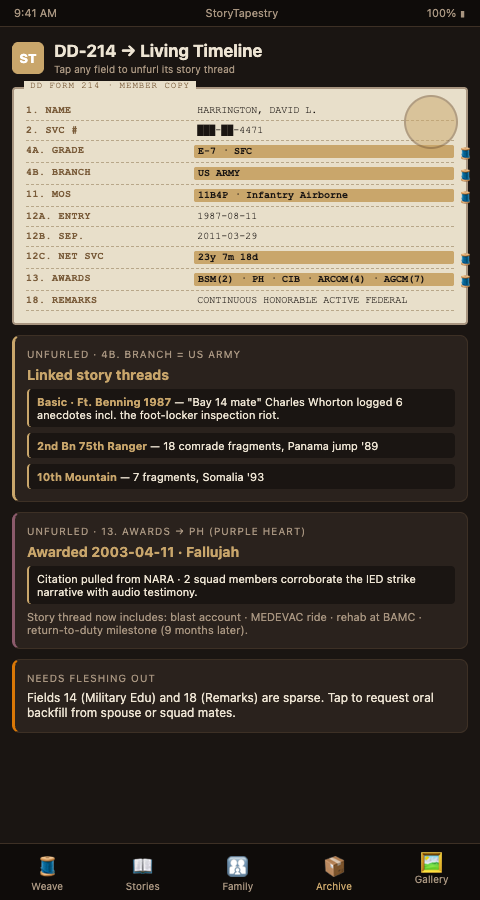
An interactive timeline built from the DD-214 turns fifteen fields of bureaucratic shorthand into the chronological skeleton of a life. StoryTapestry parses each field into a timeline node, glosses abbreviations inline, and surfaces context that turns the document into narrative. The tapestry runs from date of entry to date of separation with duty stations, schools, deployments, and decorations marking the weave. Every thread has a time and a place.
The Deployment Timeline Reconstruction feature takes the DD-214 as its primary input. Date of entry becomes the tapestry's left edge. Date of separation becomes the right edge. Service schools listed in Block 14 become nodes along the training phase. Foreign service and sea service totals become structured bands overlaid on the timeline. Campaign ribbons and medals become distinct markers attached to the tours they recognize. The result reads like a service biography with verifiable structure rather than a family narrative built on memory alone.
MOS code translation happens inline. The timeline renders "11B Infantryman" rather than the bare code, with a glossary pop-up explaining the daily duties, training pipeline, and typical deployment profile for that occupational specialty (Wikipedia). Secondary MOS codes and training qualifications appear as attached notes, so a grandchild reading the tapestry sees not just "Dad was in the Army" but "Dad was an 11B who cross-trained as a 68W combat medic before his second deployment." The deployment story chapters build directly on this MOS-anchored timeline.
Award and decoration translation carries equal weight. StoryTapestry maps each decoration abbreviation to its full name, issuing authority, and honor context, drawing on the National Archives medal reference and DoD award descriptions (National Archives - Medals). A Bronze Star appears on the timeline at the date of action, with the citation text where available and a descriptor of the decoration's meaning for readers unfamiliar with military honors. Campaign stars on service medals render as separate markers so each participation is visible.
Unit Comrade Outreach Network attaches to every duty station and deployment node. When the timeline shows a 1988 assignment to Fort Benning, the platform surfaces contact paths to the unit reunion network for that specific battalion and era. When the timeline shows a 2004 deployment to Camp Taji, the platform routes outreach to the confirmed unit-history page for that tour. Funeral directors run the timeline as both memorial artifact and contributor-discovery engine.
Classified-Aware Story Frameworks handle the sections of a service record that cannot appear in detail on public memorials. StoryTapestry provides prompts that honor redactions and clearance levels without leaving gaps visible as empty panels, drawing on declassified record integration practices refined for veteran memorial contexts. The timeline still reads as continuous even when specific missions cannot be named.
Dual-Life Narrative Integration extends the DD-214 spine beyond separation. The post-service years receive the same timeline treatment, with civilian career nodes, family milestones, VSO involvement, and community contributions placed alongside the service record. The whole life weaves together, and the memorial reads as one continuous tapestry rather than two disconnected biographies. This seamless integration also anchors adaptive memorial platforms for families whose veterans served from immigrant communities.
Block 24 and Block 25 of the DD-214 hold character of service and separation code information that shapes VA eligibility and memorial framing. An Honorable discharge enables the full suite of military honors and VA burial benefits the family may want to reference on the memorial, while other character designations call for careful, dignified framing that neither hides the detail nor foregrounds it in a way the veteran would have objected to. StoryTapestry handles these distinctions with template language refined through funeral director input, keeping the memorial accurate to the DD-214 without reducing the veteran's life to a discharge code. This is especially important for Vietnam-era veterans whose discharges carried complex political overlay and whose families may be navigating upgrade petitions years after the veteran's death.
Advanced Tactics for DD-214 Timeline Construction
Obtain the DD-214 early, even when the family does not hold a copy. The NPRC Funeral Home Director channel provides expedited access for funeral service professionals, and the VA supports eVetRecs, SF-180, and fax pathways for record retrieval (NPRC; VA). Knowing the channels by heart means the timeline construction can begin before the service, not after.
For veterans whose records were destroyed in the 1973 fire, follow the VA reconstruction guidance to assemble alternative records: morning reports, pay records, and unit rosters (VA). StoryTapestry accepts reconstructed source documents as timeline inputs with clear provenance labeling, so the tapestry reads as honestly reconstructed rather than falsely complete.
Cross-reference DD-214 decorations against citation archives. Bronze Stars, Distinguished Flying Crosses, and Silver Stars often have published citations that describe the specific action recognized. When a citation exists, the timeline node includes the citation text and transforms a decoration abbreviation into a documented moment of service. Families frequently did not know the citation existed and revisit this panel repeatedly after discovery.
Build the timeline collaboratively with the family. Walk through the DD-214 field by field at intake, asking the family what they recognize and what they do not. The conversation itself surfaces stories attached to duty stations and deployments, and those stories populate the timeline at the exact nodes where they belong. Intake time doubles in the first meeting and repays itself across the memorial.
Preserve the scan of the original document inside the tapestry. A link from the timeline to the DD-214 image, with redactions applied where appropriate, anchors the interactive version in primary source material. Future researchers in the family can trust the timeline precisely because the source is right there.
Layer supporting documents alongside the DD-214 spine when the family holds them. A retiree's military retirement order, a set of officer efficiency reports or enlisted evaluation reports, a selection for promotion list, or a citation packet for a specific award each add depth to the timeline. Scan these at intake, classify them into the right timeline nodes, and render them as supplementary documents on the memorial rather than leaving them in the shoebox. Many retirees accumulated decades of official documentation that the family has never organized; the tapestry offers a structured home for those papers that serves both the memorial and the family's personal records.
Handle multiple DD-214s for veterans with broken service. A veteran who served four years active duty, separated, spent eight years in civilian life, then enlisted again and served twelve more years before retiring will have two separate DD-214s covering distinct periods. StoryTapestry renders each period on the timeline with the gap between clearly marked, and surfaces the civilian-life chapter as a first-class panel rather than a footnote. Veterans whose service ran in two or three discrete chapters often lived the most interesting lives, and the tapestry honors that structure rather than collapsing the breaks into a single military period.
Give Your Next Veteran Memorial the DD-214 Spine
Veteran Memorial Programs benefit most when the service record becomes the tapestry's anchoring structure rather than an intake form. StoryTapestry parses DD-214 fields into interactive timeline nodes, glosses MOS codes and decorations inline, and routes comrade outreach to each duty station and deployment. Walk through a live DD-214 timeline build with our Veteran Memorial Programs team, and see how the document your firm already holds becomes the tapestry spine the family will revisit for generations.
The walkthrough uses a redacted sample DD-214 drawn from public records: a retired Army Command Sergeant Major's discharge with multiple duty stations, three deployment periods, a stack of ribbons including a Bronze Star with V device and two Purple Hearts, and the full range of training schools and assignment history that a 30-year career accumulates. The walkthrough demonstrates how each field renders as an interactive node, how the glossary pop-ups handle MOS and decoration abbreviations, and how comrade outreach routes from the timeline to the unit-reunion networks for each tour. Your staff sees the finished tapestry the way a family member would see it, then walks through the construction path in reverse so they understand the intake-to-publication workflow.
Bring a DD-214 from your own pending caseload if you want to see the build against real documentation; our team handles redactions and treats the sample with the same confidentiality you would expect for any client document. The goal is a tapestry spine your firm can construct inside one intake meeting, with the rest of the memorial building on that structure through the weeks that follow.