Why Diaspora Families Need Culturally Adaptive Memorial Platforms
Why Generic Memorial Sites Miss Immigrant Family Needs
The United States is home to a record 50.2 million immigrants, representing 14.8% of the population, according to Pew Research Center. Every one of those immigrants carries cultural practices around death that most memorial software was never designed to accommodate. Novena traditions, 40-day Orthodox Christian commemorations, Hindu shraddha rites, Jewish shloshim, Muslim thikr gatherings, Chinese Qingming observances, and hundreds more distinct customs each imply specific memorial structures, timelines, and participation patterns.
Research in the Wiley Family Process journal documents the tension immigrant families face between parents wanting burial "back home" and children whose lives are rooted in the adopted country. That tension extends into the memorial itself: a Vietnamese son in Boston and his grandmother in Ho Chi Minh City need the same memorial to honor both Catholic novena and Buddhist 49-day practices, not choose between them.
PMC research on grief in Latino/a communities describes how Latinx immigrants face ambiguous and disenfranchised grief when their cultural practices are not recognized in host-country institutions, and a Springer study on end-of-life care confirms that language barriers hinder trust-building throughout the bereavement journey. These are not nice-to-have features. They are the difference between a family feeling seen and feeling erased.
A Tapestry Framework for Cross-Cultural Tribute Customization
The tapestry metaphor fits diaspora memorials better than any other model. A tapestry is not monochrome, and it does not force every thread into the same pattern. Different sections of the same fabric can reflect different cultural motifs while the whole work remains unified by the person being remembered.
StoryTapestry structures cultural adaptation around four layers: visual system, ritual calendar, participation model, and language presentation. The visual system allows each memorial to select color palettes, iconography, and layout motifs appropriate to the family's heritage without forcing crude ethnic templating. A Mexican family might choose warm ochre and cempasuchil imagery drawn from Day of the Dead tradition, while a Korean family might prefer muted blues and calligraphy-inspired section breaks.
The ritual calendar embeds culturally specific observance dates into the memorial itself. A Hindu memorial surfaces the 13th-day shraddha and annual tithi reminders. A Catholic memorial includes Month's Mind at 30 days and anniversary Masses. A Buddhist memorial marks 49-day, 100-day, and first-year milestones. Rather than one generic "anniversary reminder," the calendar reflects the actual grief schedule the family already observes.
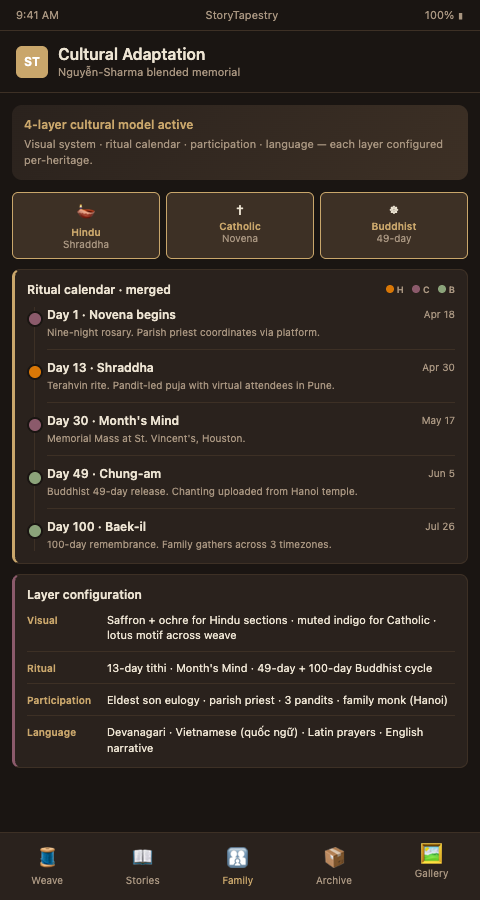
The participation model varies too. Some traditions expect the eldest son to deliver the primary eulogy. Others expect an uncle or priest. Some cultures value anonymous contributions from distant acquaintances, while others treat anonymity as disrespectful. The cultural storytelling traditions built into StoryTapestry let each family configure contributor permissions, ordering, and visibility without programming knowledge.
Language presentation is the fourth layer. Beyond simple translation, the platform accounts for script fidelity, right-to-left layout, and cultural notation conventions. Chinese memorials display names in traditional characters if preferred, Arabic memorials flow right-to-left without layout breakage, and Indian memorials handle Devanagari, Tamil, Telugu, and Gurmukhi scripts natively. A Pew Research study on the Hispanic digital divide found foreign-born Latino internet adoption at 54% compared to 81% among native-born, reinforcing why mobile-first, Spanish-native interfaces matter for accessibility.
Supporting cross-cultural funeral customs demands that a single platform handle blended families, interfaith marriages, and multi-generational cultural drift without forcing false unity. StoryTapestry's culturally sensitive memorial design assumes blending is the norm, not the exception.
Beyond these four layers, the platform supports the physical realities of diaspora mourning. A Filipino family in San Diego may hold a traditional nine-day pasiyam while relatives in Cebu hold their own parallel prayers, and the digital memorial becomes the thread that binds both observances. A Somali family in Minneapolis may face the Islamic requirement of burial within 24 hours while distant relatives in Dubai and Mogadishu cannot travel in time, and the tapestry lets those distant mourners contribute within the compressed window without needing to rush to a terminal. A Tibetan family in New York observing 49-day Bardo rituals can receive daily prayer contributions from monks in Dharamsala and Bylakuppe, each prayer marked with the specific day of the cycle it accompanies.
Advanced Tactics for Diaspora Digital Remembrance Tools
Funeral homes serving diaspora communities can layer additional practices on top of platform capabilities. First, maintain a cultural consultant network. A short list of clergy, community elders, and cultural association leaders from each heritage your funeral home serves means you can call a Vietnamese Buddhist monk, a Haitian Vodou elder, or an Ethiopian Orthodox priest for guidance within hours, not days. Families notice.
Second, offer a cultural intake assessment. During the first meeting with any new family, ask explicit questions about observance preferences: Will there be a novena, a shiva, a wake, a viewing, a vigil? What languages will be spoken at the service? What items should appear on the memorial ofrenda, altar, or shrine? Which anniversaries matter in this tradition? The answers drive platform configuration. Research in Frontiers in Psychiatry on migratory grief confirms that complicated grief tracks immigration duration, meaning newer immigrants often carry cultural expectations even more acutely than long-settled diaspora.
Third, build bilingual registration and intake forms. The family member organizing the memorial may be fully fluent in English, but elderly contributors often are not. Collaborative memorial tools like Kudoboard demonstrate the appetite for simple distant-family participation, but cultural adaptation is the frontier where generic tools fall short.
Fourth, support physical-digital bridging. Many diaspora memorials include a physical altar, ofrenda, or shrine where digital photos and written contributions get printed and placed alongside candles, food offerings, and family artifacts. StoryTapestry supports automatic print layouts that preserve the tapestry's visual system on paper, so the altar at home matches the website.
Fifth, acknowledge generational variation within one family. Grandparents often want traditional customs preserved exactly, while grandchildren want modern digital-native features like searchability, video integration, and social sharing. The same memorial can serve both by layering features rather than forcing a single aesthetic. This is analogous to how veteran grief culture accommodates both traditional military ritual and modern family preferences within one memorial.
Sixth, plan for the returning-home service. Many diaspora families hold two physical services, one in the host country and one in the country of origin. An Ethiopian family in Washington DC may hold a funeral at their local Ethiopian Orthodox church, then repatriate remains for a tezkar at the family village in Tigray weeks later. StoryTapestry treats these as chapters of one memorial rather than separate events. Relatives who attend only the DC service see the Tigray photos when they upload; cousins who attend only the village observance see the American tributes when they contribute. The unified tapestry prevents the common diaspora sensation that the memorial happened in two places and neither captured the whole family.
Seventh, document generational cultural drift explicitly rather than pretending it does not exist. A Korean-American grandmother may expect Confucian ancestral rites while her American-born grandchildren have never attended one. Rather than forcing every family member into the same cultural frame, the platform includes brief explainer panels that let the grandchildren understand what their grandmother is observing and why. These panels turn the memorial into a cultural learning moment, often producing exactly the multigenerational understanding that daily diaspora life rarely provides.
Eighth, equip staff with a short cultural sensitivity reference card for each family. Rather than expecting every staff member to memorize the customs of 15 or 20 cultural groups, StoryTapestry generates a case-specific briefing: the family's primary traditions, key ritual terms with pronunciation notes, taboo topics, expected observance timeline, and key contact points for cultural consultation. A funeral director meeting a Laotian Buddhist family for the first time can glance at the card and know to offer monks a dedicated meal space and to preserve the deceased's clothing until the ritual bathing is complete. These small signals of competence compound into the trust that determines whether the family feels seen.
Serve Every Culture You Already Serve
Your funeral home already meets families from dozens of heritage backgrounds. StoryTapestry gives you the platform to honor those backgrounds digitally without retraining your staff on every cultural tradition. Reach out for a consultation focused on the specific cultural communities you serve most often. Our team will walk through the platform configuration for your top three heritage groups and show you how existing families respond when the memorial actually reflects their traditions. Bring the demographic profile of your service area, including the heritage groups with the fastest-growing elder populations, and we will prioritize configuration work around the traditions most likely to affect your caseload in the next two years. The consultation includes a review of your current intake forms, physical facility accommodations, and staff cultural familiarity, with practical recommendations for each.
Funeral homes that adopt StoryTapestry typically see their referral rates from culturally specific communities climb within the first two or three served families, because cultural competence is one of the most heavily discussed topics within diaspora networks. Getting this right is not a nice addition to your operation; it is the difference between being the home that immigrant families recommend and the home they avoid.