7 Cultural Storytelling Traditions That Shape Digital Memorials
The Homogenization Problem in Online Memorials
The UNESCO Intangible Cultural Heritage program warns that migration and mass media actively threaten oral traditions, and digital memorial platforms built without cultural awareness accelerate that erosion rather than preserving it. When a Senegalese family's griot ancestry recitation becomes a 300-character "about" field, when a Mexican ofrenda becomes a clickable photo carousel, when a Jewish shiva becomes a single RSVP button, something essential is lost.
Seven distinct cultural storytelling traditions shape how families actually want to memorialize their dead, and each requires platform capabilities that most online memorial services lack. Griot recitation in West African cultures, as documented by Britannica, treats hereditary storytellers as living archives who recite ancestry at funerals. The Mexican ofrenda, inscribed by UNESCO in 2008, layers photographs, food, flowers, and handwritten messages into a physical and emotional tapestry. Jewish shiva, as Reform Judaism describes, structures seven days of mourning around Kaddish and collective storytelling.
These ethnic memorial customs online are not surface aesthetics. They are participation architectures, and they dictate who speaks, in what order, for how long, and under what conditions. A memorial platform that ignores architecture and offers only chronological comments is asking every culture to assimilate to a single Western model.
A Tapestry Framework for Heritage-Based Tribute Formats
The tapestry metaphor works because it assumes multiple patterns coexist within one fabric. A diaspora memorial can honor seven different traditions, or just one, by letting each tradition's architecture govern its section of the memorial.
StoryTapestry supports seven recurring tradition types, and each deserves examination. First, the West African griot format enables a designated family storyteller to record a multi-hour ancestry recitation, with the platform offering automatic chapter markers at each generational transition. Younger relatives contribute questions and annotations without interrupting the primary recitation.
Second, the Mexican ofrenda format lets families build a digital altar rather than a chronological feed. Contributors upload photos, favorite foods, handwritten letters scanned as images, and music recordings. The visual layout mirrors the physical ofrenda with layered tiers rather than a scrolling timeline. This is especially important for Latin American funeral traditions where the velorio involves 24 to 48 hours of continuous storytelling.
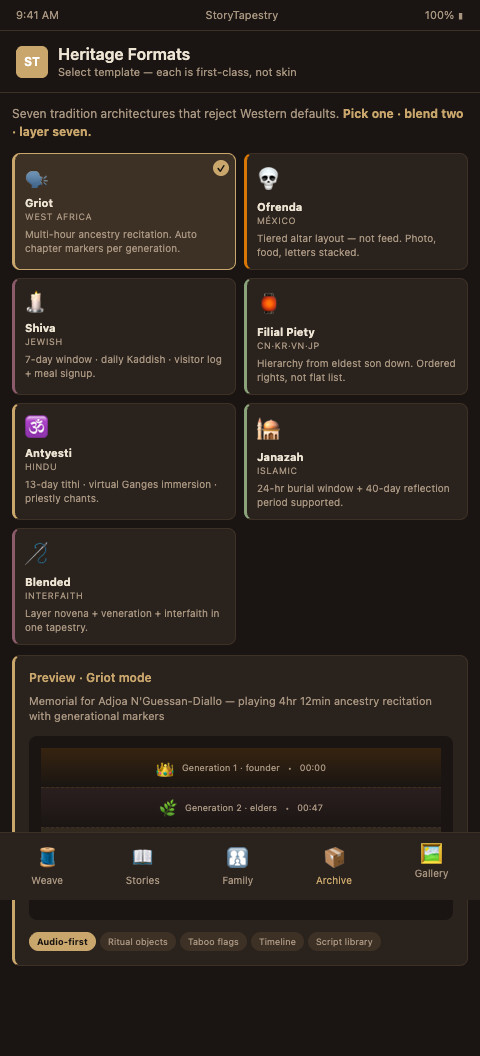
Third, the Jewish shiva format structures a seven-day memorial window with daily Kaddish reminders, visitor log-ins, and meal coordination for those sitting shiva in person. Story contributions happen in waves corresponding to the traditional daily gathering rhythm.
Fourth, the Confucian filial piety format, as described on Wikipedia, structures the memorial around hierarchical contributions from eldest son downward, with specific roles for daughters-in-law, grandchildren, and distant relatives. Chinese, Korean, Vietnamese, and Japanese diaspora families often find this architecture matches their expectations better than flat Western templates.
Fifth, the Hindu antyesti format, per Wikipedia, centers on cremation and the return of ashes to sacred waters. For diaspora Hindu families who cannot bring ashes to the Ganges, the digital memorial provides a spiritual analogue: virtual immersion ceremonies, recorded priestly chants, and multi-day mourning architecture. Building oral tradition honoring into every format respects the primacy of spoken memory in each heritage.
Sixth, the Islamic janazah format, which expects burial within 24 hours, creates a compressed intake window followed by a 40-day mourning reflection period. StoryTapestry accommodates both phases.
Seventh, the blended-heritage format accommodates families with multiple traditions in one household. An Irish-American father, Chinese-American mother, and mixed-heritage children might need a memorial that layers Catholic novena, Ancestor Veneration, and interfaith elements simultaneously. Integrating religious storytelling customs into a single coherent tapestry is the core design problem, not an edge case.
Each of these seven formats carries operational implications that generic platforms sidestep. A griot recitation requires storage, playback, and contributor-protection tools that most memorial software treats as afterthoughts. A Jewish shiva demands a seven-day window with specific permissions for mourners versus visitors. A Hindu antyesti expects integration with specific prayer audio at specific days after death. A Confucian filial piety structure requires ordered contribution rights that most platforms treat as a flat contributor list. StoryTapestry treats each format as a first-class mode rather than a skin applied to a Western default, and the design difference shows in the first five minutes of any family walkthrough.
A Ga-speaking family from Accra using the griot mode sees their ancestry recitation rendered with the chapter markers their tradition expects; a Mexican family using ofrenda mode sees layered tiers rather than a vertical feed; a Ukrainian family observing 40-day panakhyda sees the specific candle-lighting and prayer-reading cadence their tradition calls for.
Advanced Tactics for Traditional Eulogy Styles Across Cultures
Funeral homes serving diverse communities can layer additional sophistication on top of template selection. First, build a heritage-specific interview script library. When a griot recitation is planned, the family interviewer needs different prompts than when a Jewish shiva memorial is being built. Pre-loaded scripts for each of the seven formats save staff hours and avoid awkward cultural missteps.
Second, accommodate ritual objects as digital artifacts. A Mexican ofrenda needs photos of cempasuchil, pan de muerto, and sugar skulls, not generic memorial candle icons. A Jewish memorial might include a Yahrzeit candle image. A Hindu memorial needs images of diya lamps. StoryTapestry ships with culture-specific ritual object libraries that contributors can tag alongside stories.
Third, integrate audio recitation prominently. In griot, Hindu antyesti, Jewish Kaddish, and many other traditions, audio is primary and text is secondary. Most memorial platforms invert this hierarchy. Cultural competence means treating audio as a first-class contribution type, not an attachment.
Fourth, respect mourning timelines. A seven-day shiva, 49-day Buddhist remembrance, 40-day Orthodox commemoration, and one-year Confucian mourning period each imply different notification cadences, contribution windows, and memorial "close" behavior. Generic platforms often auto-archive memorials after 30 days, which can be deeply offensive in traditions with longer mourning arcs. Building in ongoing memorial rituals is a design principle that applies across life stages.
Fifth, document each tradition's taboos explicitly. Some Indigenous traditions restrict naming the deceased for a period. Some Orthodox Jewish traditions avoid photographic depictions of the deceased. Some Hindu traditions prefer not to display death dates until prescribed rituals are complete. Funeral staff using StoryTapestry receive pop-up guidance on taboos relevant to the selected tradition so they avoid accidental cultural harm.
Sixth, integrate ritual food and offerings as story threads. Many traditions treat food, not words, as the primary language of remembrance. A Puerto Rican family's memorial may include recipes for pasteles and arroz con gandules that the deceased cooked for every Navidad; an Italian family's tapestry may feature a grandmother's handwritten ragù recipe alongside photos of three generations cooking it; a Vietnamese family's Tết-adjacent remembrance may document the specific banh chung preparation the deceased insisted upon. Treating these as full contributions rather than decorative additions honors the truth that many diaspora elders expressed love primarily through food and that their recipes are their most enduring legacy.
Seventh, support multi-generational naming conventions within the platform. A Sikh grandmother may be listed in her birth village under her Punjabi given name, in her Canadian community under her married name, and in her grandchildren's memory under the affectionate name they called her. A Nigerian man may carry a baptismal Christian name, a Yoruba given name, a chieftaincy title, and an English business name, each valid for different relationships. StoryTapestry preserves all these identifiers rather than forcing the family to designate one as primary, which respects the full identity the person actually inhabited.
Eighth, collaborate with clergy, community elders, and traditional practitioners in intake rather than treating them as external factors. A Maronite priest, a Theravada monk, an Ifá babalawo, or an Orthodox deacon each bring knowledge about what their tradition permits and expects in digital memorialization. Inviting them into the intake conversation, sharing the platform configuration with them, and incorporating their feedback transforms the memorial from an outside service imposed on the family into a collaborative work the tradition's authorities bless. Most traditional practitioners welcome this collaboration and become advocates for your funeral home within their communities.
Honor Every Tradition You Serve
The seven traditions above barely scratch the cultural diversity of the families you serve. StoryTapestry was designed so funeral homes can honor each heritage with architectural fidelity rather than surface-level aesthetic adjustments. Contact our team to explore the heritage-based tribute formats most common in your service area, and we will walk through the specific template configurations with you. Your diverse client base deserves more than a one-size template with different stock photos. We begin every consultation by mapping your caseload against the seven core formats and identifying which traditions appear most frequently, which require the deepest platform configuration, and which overlap in blended families. The output is a practical rollout plan rather than a generic sales pitch: which formats to prioritize in your first quarter, which cultural consultants to partner with, and which training modules your staff should complete.
Funeral directors in regions with substantial Caribbean, South Asian, East African, Southeast Asian, or Latin American populations typically see immediate differentiation from competitors who still force every family into the same generic template. The families you already serve, and especially the younger generations who are evaluating where to take their parents' memorials, will notice the difference from the first intake meeting onward.