How to Honor Oral Traditions in a Digital Memorial Format
Why Text-First Memorials Erase Oral Heritage
The UNESCO Intangible Cultural Heritage program warns that migration and technology place oral traditions at risk, and memorial platforms that default to text contributions participate in that erosion whether they intend to or not. Oral cultures around the world, from West African griots to Indigenous American storytellers to Pacific Islander chanters, treat voice as primary and writing as derivative.
Britannica's overview of griots describes how West African hereditary storytellers recite ancestry at funerals for hours, with tonal variations, pauses, and repetitions that carry meaning no transcript captures. The Oral History Association best practices document the professional standards oral historians have developed over decades: preparation, skilled interviewing, preservation, and access. The Smithsonian's oral history guide emphasizes that voice itself is the primary source, not a less-convenient route to eventual text.
When a funeral home asks a Yoruba family to type their father's biography into a web form, the platform has already chosen text over voice. That choice affects which relatives participate, how emotional the contributions feel, and what gets preserved for future generations. The NEH's research on cultural resilience specifically identifies oral history as the medium through which communities preserve memory in their own voices.
A Tapestry Framework for Audio-Based Memorial Contributions
The tapestry metaphor accommodates oral tradition naturally. Audio threads, video threads, and text threads all weave into the same fabric, each contributing texture the others cannot. Voice is not a supplement to the memorial; for oral-tradition families, voice is the memorial.
StoryTapestry implements oral history integration in remembrance through four design principles. First, audio-first intake means the primary "add a story" button opens a recording interface rather than a text box. Contributors who prefer text can switch, but the default invitation is to speak. This small design choice dramatically changes participation demographics: elderly relatives, non-literate contributors, and those uncomfortable writing suddenly become primary contributors rather than people who "just couldn't help."
Second, high-fidelity audio capture preserves tonal, dialect, and pacing detail that oral traditions depend on. The platform records at 48 kHz / 24-bit rather than compressed phone-call quality, because a Somali ancestry recitation or Hawaiian chant carries information in the sonic texture itself. Compression strips that texture in service of smaller file sizes, an acceptable trade for some contexts but a betrayal for oral heritage.
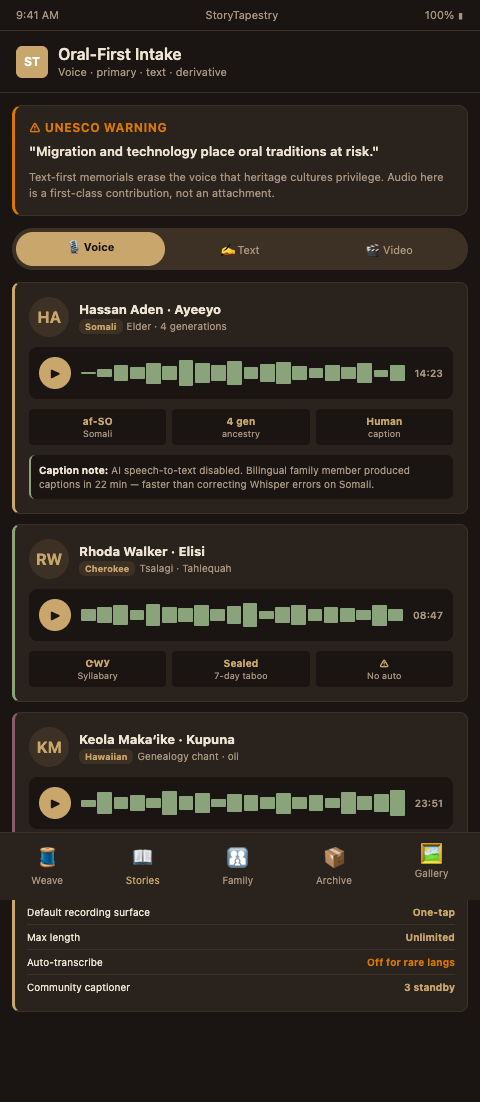
Third, chapter markers and searchable captions let visitors navigate long audio without sacrificing its integrity. A 47-minute griot recitation becomes accessible to a great-granddaughter who wants to hear the section about her own birth. She can find the moment, listen to the voice, and read captions for comprehension without reducing the recitation to a summary text.
Fourth, long-form audio is treated as first-class content. Many platforms cap uploads at 5 minutes or force compression that degrades quality. StoryTapestry accepts multi-hour recordings without degradation because oral traditions often exceed typical eulogy length. Honoring cultural storytelling formats means matching platform limits to cultural practice, not forcing culture into platform defaults.
Organizations like StoryCorps demonstrated the appetite for peer-led oral history at the Library of Congress scale, and the Library of Congress oral history archives confirm the long-term preservation value. Funeral homes can adopt the same principles at family scale.
Video testimonial integration adds a visual layer to oral contributions without displacing the audio. A griot's facial expressions, a storyteller's hand gestures, and a chanter's physical presence all reinforce meaning. StoryTapestry supports video, audio-only, and text with equal prominence, letting each contributor choose the medium that matches their tradition.
The platform also accommodates the physical realities of oral recording in diaspora settings. Most elders do not own studio equipment, but almost all have access to a smartphone, a community member with a decent microphone, or a church or community center with basic audio gear. StoryTapestry provides a pre-recording checklist for each cultural context that covers practical concerns: room acoustics, microphone placement for the storytelling style in question, appropriate dress if the recording will be preserved, and ritual preparations some traditions require before significant oral contribution. A Cambodian elder preparing a funeral chant may fast before recording; a Navajo elder may perform a prayer beforehand; a Vietnamese elder may burn incense. The checklist normalizes these preparations as part of serious oral recording rather than treating them as optional cultural decoration.
Advanced Tactics for Spoken Story Preservation for Tributes
Funeral directors serving oral-tradition communities layer several practices on top of audio-first platforms. First, commission trained oral historians for key recordings. The eldest ancestry-bearer in a family, the traditional storyteller, the community elder, all deserve a skilled interviewer who knows how to draw out depth without rushing. An hour with a trained interviewer produces material that later generations will treasure.
Second, record in culturally appropriate settings. An Indigenous elder's story deserves recording in their community, not in a funeral home office. A Latino family's velorio storytelling deserves on-site capture during the 24-to-48-hour traditional vigil, not a retrospective interview. Field-quality portable recording equipment and discreet operators make this possible.
Third, build family interviewer training into your intake process. Not every oral tradition belongs to a professional interviewer. Often a daughter interviewing her father produces deeper material than a stranger ever could. Drawing on family interview techniques developed for memory-care families, the platform provides 20-minute training videos and question prompts specific to each heritage tradition.
Fourth, preserve original-language audio even when translation is expensive. The spoken Yoruba, Navajo, Tagalog, or Amharic itself is the heritage artifact. Translation captions serve accessibility, but the original recording is the treasure. StoryTapestry stores both at full fidelity so future generations can return to the original voice.
Fifth, plan intergenerational listening sessions. The point of preservation is that grandchildren and great-grandchildren can hear the voice. Funeral homes can coordinate family gatherings at 1-year, 5-year, and 10-year anniversaries where the oral archive is played together, often triggering additional family members to add their own oral contributions. This converts a one-time memorial into a living oral heritage archive.
Sixth, partner with cultural heritage institutions for permanent preservation. Libraries, universities, and cultural associations often accept oral history donations from families willing to share beyond the private memorial. StoryTapestry supports controlled public-archive export for families who want their elder's voice preserved in institutional collections alongside the private family memorial.
Seventh, safeguard against equipment failure during elder recordings. Elderly contributors often have narrow windows of health and energy during which they can sustain a multi-hour recitation. Losing a recording to a dropped file, a dead battery, or a corrupted SD card is genuinely catastrophic because that exact recording cannot be recreated. StoryTapestry backs up recordings in real time to cloud storage with redundant encoding, and the platform surfaces backup confirmation to the interviewer as each segment completes. A family member running an interview sees a green confirmation after each 10-minute segment, providing psychological reassurance that the elder's words are safe.
Eighth, preserve storytelling environmental context beyond the voice itself. A Hmong family's oral history may be recorded in the elder's kitchen with grandchildren quietly listening; a Sudanese family's tribute may capture evening prayers from the mosque next door; a Maori family's kōrero may include the sound of the Pacific wind outside the wharenui. These environmental elements are part of the recording rather than noise to be filtered out. StoryTapestry's processing preserves ambient sound at the family's option, and many families choose to keep it because the context makes the voice feel present in a way a studio-clean recording never would.
Ninth, honor the traditional permissions frameworks that govern who may hear which recordings. Some Indigenous traditions restrict certain stories to initiated kin; some West African traditions assign specific narratives to specific lineages; some Pacific Islander traditions treat elder narratives as taonga that cannot be shared without chief approval. StoryTapestry supports tiered permissions at the recording level, letting families honor their tradition's sharing rules rather than forcing every recording into either fully public or fully private buckets. A griot recitation meant only for family lineage members can be restricted to exactly that audience, while a community history meant for broader sharing can be opened up.
Preserve the Voices You Cannot Replace
When an elder passes, their voice either gets preserved this week or lost forever. Funeral homes serving oral-tradition communities have a narrow window to capture what matters most. StoryTapestry was designed so voice is never a second-class contribution. Contact our diaspora services team to discuss your community's specific oral traditions, and we will configure audio capture, chapter marking, and caption workflows that match your heritage. Your next service can become the permanent archive of voices that would otherwise vanish. We recommend starting with an audit of your current service area's oral-tradition communities: West African griot-tradition families, Indigenous storyteller communities, Pacific Islander chanters, South Asian qawwali and folk traditions, Caribbean calypso and storytelling families, and countless others. Each carries distinct recording needs, permissions frameworks, and cultural expectations.
Our team has configured workflows for communities spanning six continents, and we can typically have your oral recording infrastructure production-ready within four to six weeks. The first few elder recordings your funeral home completes often become referrals back to multiple families in that community, because a respectful, high-fidelity oral capture is exactly the kind of work traditional elders tell their neighbors about. Start with one community, do it exceptionally well, and let the quality of that work open the next doors for you.