Integrating Video Testimonials from Global Contributors into One Tapestry
Why Scattered Video Tributes Break Traditional Memorial Formats
A Nigerian family in Houston asked cousins in Lagos, London, and Toronto to record phone videos of their aunt. Submissions arrived over 40 days in four languages, three aspect ratios, and wildly different audio levels. The funeral home's editing template, built for a single 8-minute tribute video, could not absorb this volume or variance.
The USC Shoah Foundation has been wrestling with the same mechanics at archival scale, holding 59,893 video testimonies in 44 languages across 70 countries. Their documentation shows that video memorial tapestry assembly breaks when contributors work outside professional studios: handheld phone clips, inconsistent framing, and untranscribed dialects compound into unusable footage within a single editing pass.
Museums studying this problem report urgency. NPR documented that institutions now race to capture elder testimony before memories are lost permanently, a pressure diaspora families feel acutely when relatives span four time zones and two dying dialects. Meanwhile, a scoping review of virtual funerals found that bereaved attendees of remote memorial services report lower acute distress when contributions feel integrated rather than tacked on, validating what funeral directors already sense: disconnected video clips feel worse than no video at all.
Integrating video testimonials into memorials without losing authenticity requires more than a faster editor. It requires a collection architecture.
A Tapestry Framework for Assembling Transnational Video Eulogies
Think of each submitted clip as a thread arriving from a different loom. Some are silk (studio-grade recordings from a cousin with AV equipment), some are rough linen (a 92-year-old uncle filmed on a borrowed phone), and some are mixed-fiber (a Zoom call screengrab from a time-shifted wake). A tapestry does not hide the threads. It pattern-matches them into a weave where each texture reinforces rather than disrupts the composite.
StoryTapestry structures this weave through four coordinated layers designed for transnational diaspora collection:
Layer 1: Multilingual intake with dialect tagging. Contributors upload from any device, select their native language variant (Yoruba-Ibadan vs. Yoruba-Lagos, Mandarin-Taiwan vs. Mandarin-Fujian), and self-describe their relationship. The Oral History Association's best practices manual emphasizes that audiovisual preservation must capture provenance metadata, not just footage — who spoke, in what context, to which interviewer.
Layer 2: Asynchronous prompt cascades. Rather than a single "record anything" call-out, StoryTapestry delivers 6–10 specific prompts staggered over the collection window. One prompt might ask about the deceased's first day at work; another about a specific recipe. This mirrors the web-based digital video oral history methodology documented in Oxford's Oral History Review, where targeted prompts generate richer testimony than open-ended asks.
Layer 3: Contributor networks that seed oral tradition preservation. Some video fragments only make sense alongside voice-only elder testimony that predates smartphones, which is why StoryTapestry links video clips to oral tradition preservation workflows. A grandson's polished video about a grandmother's apron pattern reads differently when bound to a 2004 cassette-tape interview of that same grandmother explaining where she first sewed it.
Layer 4: Temporal weaving. The collection window typically spans 14–45 days, which means contributors submit asynchronously across continents. Linking each clip to the broader asynchronous story collection pipeline ensures late submissions from Jakarta or São Paulo still land in the memorial surface without re-editing the entire project.
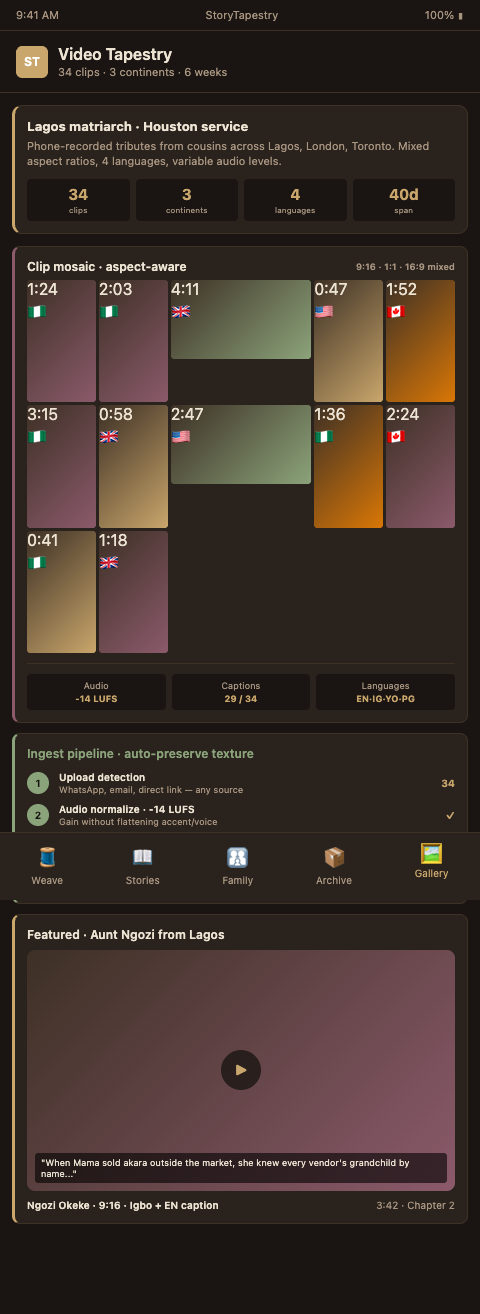
The weave does not sanitize variance. Phone-vertical clips, studio-horizontal clips, and audio-only cassette transfers coexist on one timeline, with the platform generating context cards that tell viewers which region, decade, and relationship each thread represents.
The tapestry also accommodates a particular asymmetry that other platforms struggle with: video tributes from contributors with vastly different equipment access. A nephew in Stockholm with a DSLR and ring light produces a visually polished clip; an aunt in rural Ghana records on a three-year-old phone in a kitchen with overhead fluorescent buzz; a cousin in a Colombian village records from a borrowed device with wind noise throughout. Rather than either rejecting low-quality submissions or normalizing them into a false uniformity, StoryTapestry renders each at its native quality with context cards acknowledging the production circumstances. The aesthetic variance becomes part of the story: viewers see the geographic range of the family in the visual texture itself, not only the verbal content. Families consistently tell us this honest rendering feels more like their actual family than the artificially smoothed versions other platforms produce.
Advanced Tactics for Higher-Fidelity Global Contributor Video Tributes
Match your collection protocol to how StoryCorps Connect runs remote interviews. StoryCorps pairs two contributors on a video call, records both sides, and produces a two-track asset. For diaspora families, pairing a New York niece with a Kuala Lumpur grandfather yields richer narrative than either would generate alone. Build the platform to record paired interviews natively, not as a Zoom afterthought.
Normalize audio without flattening accents. Loudness normalization to -16 LUFS is standard broadcast practice, but funeral services should avoid aggressive noise reduction that strips breath, room tone, or the soft consonants of a regional dialect. Commercial video-tribute products like Tribute Technology's Tribute Video tool handle the file pipeline, but over-processed audio erases the grain that makes a Kerala aunt sound like a Kerala aunt.
Capture metadata at intake, not post-production. Ask contributors up front: Where were you when you recorded? What room? Who else was present? This metadata becomes context cards inside StoryTapestry's video tribute assembly. Without it, a reviewer six months later cannot tell a Manila living room from a Montréal kitchen, and the memorial loses texture.
Build visual timelines alongside the video weave. When a video mentions a 1987 factory shift or a 1962 wedding, viewers benefit from the parallel context that photo archive timelines provide. Anchoring video testimony to image timelines converts talking-head clips into situated memory artifacts.
Protect the edit-forever option. Traditional tribute videos are frozen assets; StoryTapestry keeps the tapestry open for late contributions, corrections, and newly surfaced footage (a cousin finds an old VHS three years later). Diaspora memorial services need this because dispersed contributors rarely complete their grief work on the funeral home's initial timeline.
Build video submission guidance that respects device variance. Instead of demanding 1080p minimum resolution that excludes elder contributors with basic phones, provide guidance that produces the best possible capture on whatever equipment each contributor has access to. Tips for framing, lighting near a window, reducing background noise, and speaking into the device microphone work regardless of device quality. StoryTapestry's pre-recording checklist adjusts automatically based on the detected device, guiding a Pixel 8 user to different optimizations than a seven-year-old iPhone SE user.
Coordinate with family members who can record for others. A grandson in London who already plans to record his own tribute can visit his elderly aunt nearby and record hers as well. The coordinator should identify these helper relationships early in the outreach phase and formalize them. One helper can easily produce three to five additional elder recordings that would not otherwise have happened, and the quality is typically much better than the elder's solo attempt on an unfamiliar interface.
Plan for video length variance rather than fighting it. A 30-second clip from a busy cousin and a 45-minute oral history from an elder matriarch both have a legitimate place in the tapestry. Rather than forcing uniform lengths, StoryTapestry's timeline assembly handles the range gracefully, with automatic chapter markers for long-form submissions and curated visibility for shorter ones. Families appreciate the permission to contribute whatever length feels right for their relationship, and the resulting tapestry captures a broader range of voices than length-constrained platforms produce.
Weave Every Video Thread Into One Living Memorial
Diaspora funeral services lose the most when video testimony arrives too scattered to use. The family cannot assemble it; the funeral director cannot edit it in time; the clips sit on a hard drive until they are lost. StoryTapestry gives your service a framework where Houston cousins, Lagos nephews, and London grandchildren contribute on their own schedule and in their own language — and still end up inside one tapestry. Book a platform walkthrough to see how video intake, dialect tagging, and temporal weaving work for your next transnational memorial. Your families will recognize every voice on every thread. The walkthrough includes a live demo of the multilingual intake flow with dialect tagging, the asynchronous prompt cascade system, and the temporal weaving assembly that handles late submissions without disrupting the rest of the tapestry.
We also cover the back-end workflow for funeral staff: how video clips are automatically normalized for loudness while preserving accent fidelity, how context cards are generated from intake metadata, and how chapter markers are applied to long-form elder interviews. Funeral directors who adopt video-aware transnational workflows typically report their elder participation rate roughly doubling, because the pathway for contributing a phone-recorded tribute is finally easier than writing a formal eulogy. Your next transnational memorial can include every voice in the family, including the ones who have been staying quiet because the old process felt too demanding for their comfort level.