How to Use Military Photo Archives for Visual Memorial Timelines
The Problem: Public Photo Archives Memorial Programs Never Query
When Army infantryman Rex Delahunt died in 2023, his children gathered 11 family photographs from his Army years between 1968 and 1971. They assumed that was the extent of the photographic record. They were wrong by orders of magnitude. The Defense Visual Information Distribution Service (DVIDS) maintains a searchable DoD archive covering video, photo, and audio across decades of military operations. The National Archives Still Pictures Branch holds approximately 14 million analog photographs plus 3 million digital images organized into roughly 4,000 photographic series by branch and campaign, detailed in the archive's still pictures research guide and its dedicated military personnel photographs collection. The Archives maintains specific collections for WWII military unit photographs, and the Defense Media Activity distributes DVIDS content worldwide.
Memorial programs rarely query these archives. The reasons are practical: search interfaces differ across the National Archives online catalog, the DVIDS website, and individual service branch heritage commands; image licensing varies from fully public domain to requiring specific attribution; and the sheer volume of records (14 million images across 4,000 series) makes ad-hoc searching difficult. The result is that memorial programs use only the family cache, which represents a tiny fraction of the photographic record for most veterans who served in photographed operations.
Rex Delahunt's family, when finally shown how to query DVIDS and the Still Pictures Branch, found his unit's base-life photographs from Vietnam in an Army photographic series he had never mentioned. The images were not of him personally but of his unit in his time period, and several captured scenes he had described in family stories that nobody had visual context for. The memorial his children built with these images was materially richer than the one they would have built from the 11 family photographs alone.
The StoryTapestry Framework: Weaving the Public Photo Archive Into the Family Tapestry
StoryTapestry's photo archive integration treats the Still Pictures Branch, DVIDS, and branch heritage command photo archives as first-class inputs to the memorial tapestry, alongside family photographs and comrade contributions. The framework rests on four components: archive querying, unit-photo identification, rights and attribution management, and visual timeline weaving.
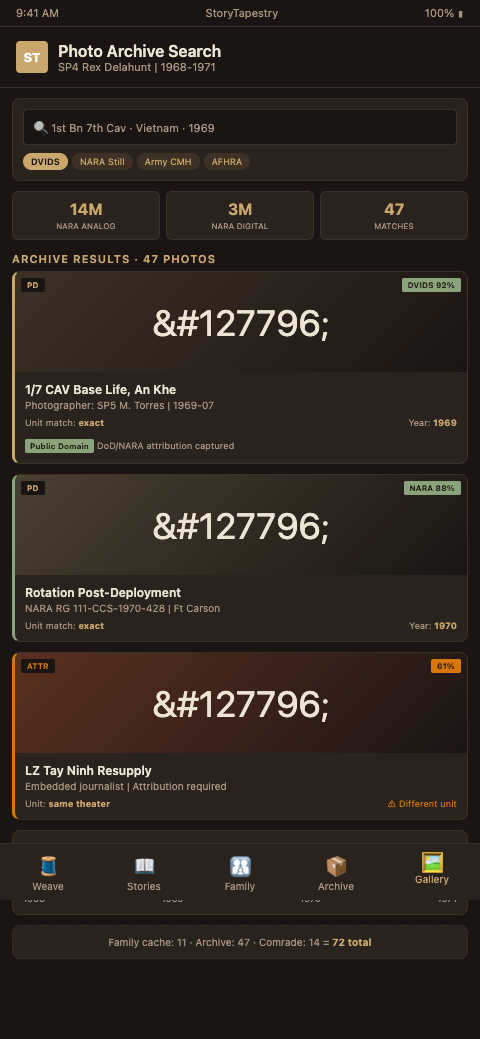
The first component is archive querying. The platform's coordinator dashboard translates a veteran's DD-214 into structured queries against the DVIDS search API, the National Archives online catalog, and service branch heritage command archives. Query fields include service branch, unit designation, base of assignment, deployment theater, and year range. The automated query returns candidate images ranked by metadata confidence, and the coordinator can expand or narrow the search without needing to learn each archive's native interface. This pairs with declassified records journals for coordinated archive research, since declassified records journal integration often surfaces captioned photographs tied to the same operations.
The second component is unit-photo identification. Veterans rarely appear personally in archive photographs, but unit photographs from their time period provide visual context the family cache almost never covers. The Still Pictures Branch holds unit photographs across Army, Navy, Marines, and Air Force organized by campaign and theater, and many WWII and Vietnam-era series are fully digitized. StoryTapestry's identification workflow helps coordinators distinguish between "photograph showing the veteran's unit in his time period" (valuable context) and "photograph from the same theater but a different unit or year" (misleading context). The distinction matters because memorial programs that conflate the two end up with visually rich tapestries built on false specificity.
The third component is rights and attribution management. Photographs produced by DoD personnel in the course of official duties are generally in the public domain, but this is not universally true and the distinction matters for memorial publishing. Photographs produced by contractors, allied service members, or embedded journalists may have different rights. Reproduced images from older formats (scanned glass negatives, microfilm) often carry archival attribution requirements even when the underlying content is public domain. The platform captures rights metadata alongside each image and generates appropriate attribution for use in memorial publications, preventing the common mistake of treating all archive material as free for any use.
The fourth component is visual timeline weaving. Archive photographs anchor specific points in the veteran's timeline: the base where they trained in 1968, the unit deployment in 1969, the post-deployment rotation in 1970. StoryTapestry's timeline interface places archive photographs as contextual anchors alongside family photographs of the same period, so a viewer sees both the official record and the family memory. The approach pairs with traditional vs digital memorials practices that weave multiple memorial modalities together, incorporating traditional and digital veteran memorial ceremony capture so archive photos stand beside honor guard footage, and with physical artifact documentation workflows for digitizing physical items that sit alongside archive photographs.
Advanced Tactics: Physical Item Digitization, Branch-Specific Archives, and Comrade Photo Crowdsourcing
Memorial programs handling significant photographic content need three tactics beyond the baseline framework.
The first is physical item digitization. Families often hold non-photograph visual material that belongs in the tapestry: unit yearbooks (common in Navy and Air Force), cruise books, patch collections, uniform insignia, embroidered unit flags, and framed certificates. StoryTapestry offers a physical item digitization workflow with guidelines for home scanning (yearbooks and flat items), professional digitization (three-dimensional items like patches and insignia), and metadata capture. The workflow typically adds 20 to 60 visual items to a tapestry that would otherwise rely only on loose photographs, and yields a visually richer timeline, adapting physical artifact documentation protocols originally built for small-object memorials.
The second tactic is branch-specific archive access. Beyond DVIDS and the Still Pictures Branch, each service maintains its own heritage command archives: the Army Center of Military History, Naval History and Heritage Command, Marine Corps History Division, and Air Force Historical Research Agency. These archives often hold unit-specific material that does not appear in the broader DVIDS catalog, including command histories with embedded photographs, deployment-specific photo collections, and retiree-donated albums. Coordinators working memorials for long-service veterans benefit from querying the appropriate branch heritage command alongside DVIDS and the Archives.
The third tactic is comrade photo crowdsourcing. Archive photographs rarely show the veteran personally; comrade photographs often do. The tapestry's comrade outreach workflow explicitly requests photographs of the veteran from the comrade's personal collection, with structured upload (consent, date range, context note). Comrades sometimes hold photographs the family never had, especially for periods when the veteran was overseas and family cameras did not reach. The crowdsourcing, combined with archive querying and family cache digitization, yields tapestries with three to five times the visual density of family-cache-only memorials.
Coordinate Visual Veteran Memorials with StoryTapestry
Veteran memorial programs serving families who want visually rich timelines beyond the family photograph cache use StoryTapestry's photo archive integration to surface DVIDS, Still Pictures Branch, and branch heritage command material alongside family and comrade contributions. Schedule a coordinator consultation to review a memorial where the visual record feels thin, and bring the veteran's DD-214 so we can demo a live archive query. Programs completing the photo archive integration setup typically see memorial visual density increase substantially while rights and attribution complexity stays managed. Reach out through the StoryTapestry program coordinator portal to begin photo archive integration.
The consultation covers the DVIDS query workflow, the Still Pictures Branch request protocol, the branch heritage command outreach sequence for Air Force, Navy, Marine Corps, and Army heritage offices, the physical item digitization pathway for unit guidons and patches families bring in, and the comrade photo crowdsourcing process that surfaces images from former unit members. Pilot engagements include photo-archive onboarding for your two lead coordinators, a supervised first-memorial deployment with a named archive specialist on the call, and a 60-day audit of visual density metrics and rights-clearance timeliness against the baseline. Most programs begin running archive-integrated intake on their next veteran memorial within 14 days of the consultation.
Bring your lead coordinator, one family-services director, and one archivist volunteer or rights specialist — the consultation produces an archive query checklist the three of them can run on the next DD-214 intake.