The Weight of Small Objects: Physical Artifacts in Digital Baby Memorials
The Problem: Small Objects That Carry Too Much to Store
Research on textile objects in stillbirth memorials from the Taylor & Francis design-research literature describes how a single knit blanket or tiny hat becomes the object through which a bereaved parent "senses" their baby over years — the fabric encoding presence that no other artifact carries. A parallel study, Outside the Memory Box, tracks how memory-box objects construct the "realness" of babies whose lives were too brief to produce a conventional record. These are not collectibles. They are the material record.
The PMC analysis of humanized care protocols lists memory boxes, CuddleCot time, and professional photography as standard components of modern perinatal bereavement care. Programs like Now I Lay Me Down to Sleep have photographed more than 50,000 babies with 2,200 volunteer photographers in 40+ countries, establishing photography as a near-universal practice in the space. The PMC best-practice bereavement photography analysis of 104 bereaved parents found that the photographs of the baby alongside physical objects — the hat, the blanket, the parent's wedding ring on the baby's hand — consistently ranked as the most meaningful images.
But physical objects decay, get lost in moves, fade in sunlight, disintegrate after water damage, or get accidentally discarded by well-meaning relatives. Research on bereavement in the digital age describes digital mementos as more portable and more preservable, but also more emotionally distant when they are not connected to the physical objects they derive from. The gap between the object's weight and the digital memorial's permanence is the design problem.
Solution Framework: Weaving the Physical Object Into the Digital Weave
StoryTapestry treats small artifacts as threads that must be captured from multiple angles so their full weight transfers into the tapestry. A single phone photo is rarely enough. The protocol below replicates what bereavement photographers and archivists know intuitively.
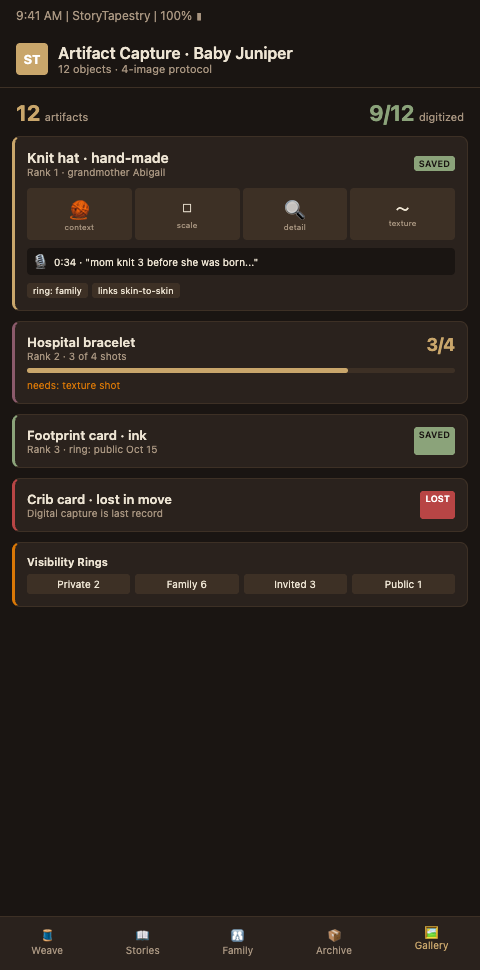
Capture protocol first. Each artifact gets four images, not one. A context shot shows the object in the parent's hand or next to a familiar reference for scale. A top-down shot on a neutral background captures dimensions. A detail shot focuses on the specific feature that carries meaning — the stitch pattern, the hospital bracelet's writing, the smudge that means someone held it. A touch shot captures texture (a macro close-up of fabric fibers, metal polish, paper grain). Together these four images provide the visual record the ResearchGate digital-age paper concludes is required for emotional fidelity.
Material memory next. StoryTapestry invites parents to record a short voice note about each artifact: where it came from, who gave it, what it was used for, what it weighs in the parent's hand. This transcribes the tacit knowledge the object carries — knowledge that nobody else has and that disappears with the parent if it is not captured. A 30-second audio clip per object yields an archival record disproportionate to the effort. This parallels how ultrasound image tapestry programs treat ultrasound images: the image alone is incomplete without the parent's annotation.
Object ordering matters. Parents often have 5-15 significant artifacts: hospital bracelet, footprint card, hand mold, knit hat, blanket, name card, certificate, candle, crib card, photograph print, letter, small toy, heart-shaped stone, engraved jewelry, lock of hair. StoryTapestry asks parents to rank their artifacts by weight, not alphabetically — the first artifact is the one they would reach for first if they could save only one. This ranking drives the tapestry's visual hierarchy: heaviest objects appear largest, first, and with the richest supporting material.
Preservation status next. StoryTapestry tracks whether the physical object still exists, is in storage, was lost, or was damaged. Loss is a common experience — relatives clean out a bedside drawer, a move misplaces a box, a fire destroys storage. The digital capture becomes the last record when the physical object is gone, and families report that knowing "we have this digitally" lowers the anxiety of long-term physical-object preservation. The tapestry becomes the insurance policy for the objects.
Curatorial layer. Some objects are for the family only. Some are for a broader circle. Some are for the public observance at October 15. StoryTapestry assigns each artifact a visibility ring: private, close family, invited community, public. A hat the family wraps around a teddy bear at every anniversary may be private. A hospital bracelet photograph may be family-visible. A candle photograph from Wave of Light may be public. The tapestry's visibility architecture keeps these rings coherent across hundreds of artifacts and contributors, including when a program extends across static vs digital keepsakes choices the family makes over time.
Advanced Tactics for High-Fidelity Artifact Capture
Four practices separate programs that document artifacts well from programs that photograph them adequately.
First, provide a capture kit. A $40 lightbox, a color reference card, and a macro-clip phone lens produce capture quality that matches professional archival standards. Hospital bereavement programs can loan kits to families during discharge, or include a discount code for families who want to buy one. The difference between good and poor capture is measurable: a well-lit, neutrally-backed artifact image ages into a usable archival record, while an under-lit phone photo ages into a grainy memory.
Second, train a volunteer photography corps. Some families cannot face photographing their artifacts themselves in the first months. Programs like Now I Lay Me Down to Sleep demonstrate that trained volunteer photographers can deliver exceptional results, and the same model applies to artifact photography. A small volunteer team, trained on the four-image protocol, can serve families who request it and deliver within two weeks.
Third, design for adding objects over years. Parents often find additional artifacts long after the initial capture — a letter from a grandmother who saved it, a photograph a friend took, a note the hospital chaplain left. The tapestry has to accept these additions without requiring a rebuild. Each new object slots into the existing ranking and visibility structure with a single guided flow.
Fourth, cross-reference objects with narrative threads. The hospital bracelet artifact links to the admission thread. The hat links to the skin-to-skin thread. The footprint card links to the delivery thread. These cross-references turn the tapestry from a gallery into a weave where each object connects to moments and moments connect to objects. The unspoken service chapters architecture developed for veteran memorials uses the same thread-crossing pattern and translates directly to infant loss.
Finally, budget for long-term preservation. Image files degrade on consumer cloud services, get lost in account transfers, and become inaccessible when proprietary formats are deprecated. StoryTapestry maintains artifact images in archival-grade formats with redundant storage and documented migration paths, so the family's digital archive ages as well as their physical objects.
CTA: For Hospital Bereavement Programs Capturing Physical Artifacts
Your bereavement coordinators already hand families memory boxes and photography session results, but the capture of those objects into a long-term digital archive rarely happens at hospital-grade quality. StoryTapestry gives your program a four-image capture protocol, voice-note material memory, and visibility rings that let families control who sees what. Invite your bereavement photographer and lead coordinator to a 45-minute session. We'll photograph a sample memory box through the protocol and show the resulting tapestry with material memory, visibility rings, and object ranking in place. The session covers the full four-image capture specification — context, scale, detail, and material — along with the voice-note prompt library for material memory, the visibility ring configuration families use to gate access by relationship tier, and the object ranking workflow that surfaces the family's most important artifacts first.
Pilot engagements include platform access for your bereavement coordinator, your hospital photographer, and one Now I Lay Me Down to Sleep volunteer photographer, plus a named implementation lead who runs the first 10 artifact captures alongside your team. Most programs onboard their first family inside three weeks of contract signing and reach full artifact-capture protocol adoption across shifts by month three. Bring your bereavement coordinator, photographer, and one volunteer photographer lead — the session produces an artifact capture manual the three of them can distribute across your photography network before the pilot begins.