Static Keepsakes vs Interactive Digital Infant Memorials
The Problem: A False Binary Between Physical and Digital
Bereaved parents often feel pressured to pick a side. The printed photograph is described by a Taylor & Francis paper on professional bereavement photography as creating a tangible, valued legacy — an object the parent can hold, that a grandparent can put on a mantle, that a surviving sibling can take to college. The interactive digital memorial is described in PMC's research on grieving in virtual worlds and in the Oxford JCMC study on Facebook memorial pages as accumulating emotional support, fostering ongoing connection, and enabling engagement that static objects cannot.
A Dundee DHI paper on the internet changing how we die documents that internet memorials express continuing bonds across distance, and a PMC scoping review on social media mourning finds that digital platforms foster ritualization and reduce isolation. Research on bereavement in the digital age identifies digital mementos as often more emotive than physical photographs because they carry voice, motion, and the baby's full sensory context. And a PMC review of online bereavement interventions concludes that online bereavement support improves access for families who cannot reach in-person services.
Neither format replaces the other. A printed photo is reached for in moments of acute presence-seeking. An interactive memorial is reached for in moments of ongoing meaning-making. Programs that offer only one — or that frame the two as a choice — leave families short of the tools they need.
Solution Framework: A Tapestry That Generates Both
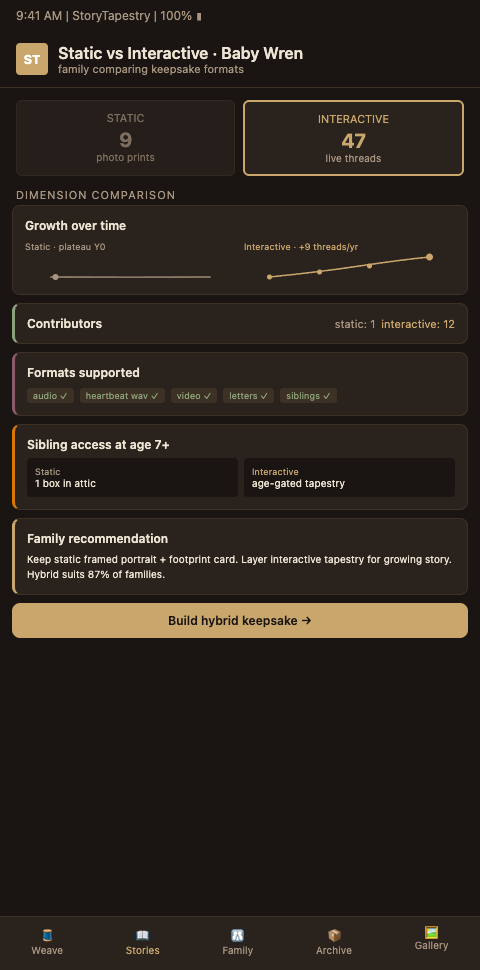
StoryTapestry is built for both timescales. The tapestry's primary form is interactive — visitable, contributable, permissioned — and the same tapestry produces static outputs designed to live on walls, in frames, and on mantles. The family does not choose between formats; they choose which moments get which treatment.
The interactive layer is the core. An interactive memorial holds the full weave: medical timeline, ultrasound heartbeat memorials, photographs, audio recordings, sibling contributions, grandparent letters, anniversary updates. It grows. It accommodates new contributors. It preserves version history. It handles permission scopes. This is what a static format cannot do — a printed photograph album published in year two cannot absorb the photograph taken at year ten's anniversary, nor can it include the voice memo a sibling records at age twelve.
The static outputs solve different problems. StoryTapestry generates high-quality printed books from the tapestry state, custom-laid-out spreads combining photographs and narrative, individual prints suitable for framing, and small cards for grandparents to carry. The key is that the static outputs are not second-class — they are produced at archival print quality with professional layout, not as an afterthought. Families report that the printed book sits next to the bed and the interactive memorial lives on the phone, each serving moments the other cannot.
Format switching at the moment of need. A parent on the anniversary morning may want to hold the printed album. The same parent at 2am on a bad night may want to scroll through the voice memos in the interactive tapestry. Both experiences derive from the same underlying weave. StoryTapestry maintains a 1:1 correspondence between the interactive tapestry and the static outputs, so a thread added to the interactive memorial can be incorporated into the next printed edition without manual reassembly. Physical artifact keepsakes — the memory box hat, the bracelet, the footprint card — sit alongside both formats as the third pillar of the family's memorial inventory.
Timescale allocation. The interactive memorial serves the long horizon: decades of anniversary updates, sibling contributions, community engagement. The static outputs serve specific moments: the first-anniversary print-edition book, the fifth-anniversary framed photograph, the funeral service's memorial card, the grandparent's carry-card. StoryTapestry lets families schedule static outputs in advance — a book produced each year on the anniversary, or on milestone anniversaries (one, five, ten) — so the physical output matches the emotional calendar.
Accessibility and inheritance. A parent who wants the surviving sibling to have something tangible at age eighteen can schedule a commemorative book to be produced at that moment. A tapestry that handles remote vs in-person gathering for diaspora families applies the same pattern — the interactive format bridges geography, the static format travels to the relative who cannot reach a screen. Both matter.
Community overlay for static outputs. For families who participate in October 15 Wave of Light or Baby Loss Awareness Week, StoryTapestry can produce a community-layer book that compiles the family's observance threads across years — a bound artifact of their participation in global remembrance. This is not a marketing book; it is a personal archive of the family's connection to the wider bereaved community, produced only if the family requests it.
Advanced Tactics for Offering Both Formats Well
Four tactics help programs avoid the common failure modes of dual-format memorials.
First, default to both, not either. When a family enters a memorial program, the assumption should be that they will eventually want both formats — not that they will pick one. Introduce the interactive tapestry first (since the static outputs depend on its content), but mention the static outputs within the first two conversations. Families who are told "you can choose digital or printed" often choose one and later regret not having the other. Families who are told "we build both, you choose timing" have the full toolkit available.
Second, produce the first static output at the right moment. Not too early (the tapestry has too little content), not too late (the family has grieved past the moment the first book would have helped). Research on online bereavement interventions suggests the 6-12 month window is optimal for the first consolidation artifact. The tapestry system can recommend a production window based on the tapestry's content density and the family's engagement pattern, without forcing.
Third, make the static outputs museum-quality. A printed book that feels like a throwaway photo book degrades the emotional weight the family has put into the tapestry. Archival-grade paper, professional binding, thoughtful typography, and layout that treats the content as sacred all signal that the family's investment was taken seriously. Cheap printing is worse than no printed output — it creates an artifact the family feels uncomfortable displaying.
Fourth, handle the format update problem. When a parent adds a thread at year three, the existing year-two printed book is now out of date. StoryTapestry offers reprint options: an updated edition that includes the new thread, a supplementary volume, or a small card insert. The family chooses how to handle the update. Programs that ignore this question leave families with increasingly stale static artifacts alongside an evolving interactive memorial.
Fifth, coordinate static production with anniversaries and holidays. A printed book arriving in the mail on the first anniversary — not a week before, not a month after — is an intentional act of care. Schedule production backward from the anniversary date, build in shipping time, and confirm delivery windows with the family. The Oxford JCMC research on interactive memorials emphasizes that accumulated emotional support compounds over time; pairing interactive accumulation with timed static delivery amplifies the effect.
CTA: For Hospital Bereavement Programs Bridging Physical and Digital
Your program probably offers one format cleanly and the other as an afterthought, and the families you serve feel the gap. StoryTapestry gives your bereavement program a single weave that generates both an interactive memorial and archival-quality static outputs on a shared schedule. Bring your bereavement coordinator, a bereavement photographer, and a family advocate to a 60-minute session. We'll produce a sample tapestry page, the corresponding printed spread, and a carry-card from the same underlying content — so your team can see how the two formats stay in sync across a 20-year program horizon. The session covers the interactive-to-static generation pipeline, the archival paper and binding specifications, the carry-card production workflow, and the anniversary-timed production schedule that delivers printed spreads to families on meaningful dates rather than arbitrary vendor schedules.
Pilot engagements include platform access for your bereavement coordinator and hospital photographer, a print production partnership with your affiliated funeral home's fulfillment vendor, and a named implementation lead who manages the first 15 dual-format deliverables. Most programs complete the dual-format configuration within eight weeks of contract signing and ship their first printed spread to a family on a scheduled anniversary date inside 12 weeks. Bring your bereavement coordinator, hospital photographer, and one family advocate from your alumni parent council — the session produces a dual-format production plan the three of them can present to hospital leadership and your print vendor before the pilot launches.