In-Person vs Remote Memorial Story Gathering for Diaspora Services
Why the Travel-or-Video Question Is Usually Decided Wrong
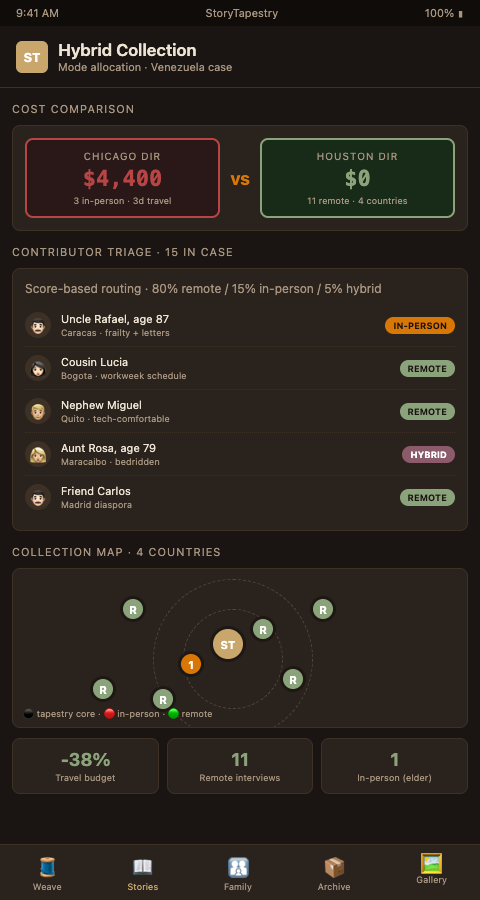
A Chicago funeral director flew to Caracas, Bogotá, and Quito to conduct in-person interviews for a single memorial, spending $4,400 plus three days of staff time. A Houston funeral director running a comparable diaspora case chose remote video interviews on Zoom and WhatsApp video, conducted eleven interviews across four countries in two weeks, and produced what the family judged to be equally moving tributes. The Houston cost: negligible travel, modest platform fees.
Published research supports that this outcome is typical, not lucky. SAGE's comparison of in-person versus video interviewing found in-person interviews marginally superior on some dimensions but with video-mediated differences characterized as modest. BMC's methodological comparison of Skype and in-person qualitative interviews reached similar conclusions: video interviews produce data of comparable quality for most purposes.
Memorial-specific research agrees. PubMed's guidance on when face-to-face is not possible validates video, telephone, and email as legitimate qualitative alternatives. PMC's scoping review of virtual funerals found virtual memorial attendees reported lower acute distress than expected. Taylor & Francis's study of virtual funeral attendance nuances this: virtual attendees valued accessibility but also identified shortcomings in non-verbal presence — meaning the remote format has real limitations, not that it is categorically inferior.
Harvard Library's methodology guide on remote qualitative research and PMC's documentation of remote fieldwork in homes during the pandemic both provide concrete methodology for video-based story collection. The evidence consistently suggests that diaspora service delivery methods should be chosen based on specific case characteristics, not a blanket preference for either mode.
A Tapestry Framework for Hybrid Memorial Collection Approaches
A tapestry benefits from both coarse and fine threads, and a diaspora memorial benefits from both in-person and remote collection. The question is which thread goes where. StoryTapestry's framework routes collection modes based on case-specific signals rather than default preference.
The framework operates through six allocation principles:
1. Default to remote; escalate to in-person with justification. Remote is the starting mode for diaspora collection, which matches how video testimonial collection already operates at transnational scale. In-person is escalated deliberately for cases where remote demonstrably underperforms — never as the reflexive default for important contributors.
2. In-person triggers: frailty, document-handling, technology barriers. Elderly relatives with hearing impairment, memory concerns, or unfamiliarity with video conferencing often produce richer material in person. Contributors with physical artifacts (letters, photographs, objects) that need in-person review benefit from face-to-face. Contributors who explicitly request in-person and have the physical access to make it feasible should receive it.
3. Remote triggers: distance, scheduling, contributor comfort. Contributors across multiple time zones, contributors with restrictive work schedules, and contributors who prefer the informality of video in their own home often produce better material remotely. Diaspora contributors in particular often feel more at ease speaking from their own kitchen than from a formal interview setting.
4. Hybrid sequencing for deep-narrative families. For families with unusually rich material, a sequenced approach works well: initial remote interview establishes rapport and surfaces topics; follow-up in-person interview (if geography allows) goes deeper on key topics. Final document review returns remote. This matches the async story workflows pattern of layered contribution over time.
5. Platform-enabled coordination. StoryTapestry schedules, records, transcribes, and integrates both in-person and remote interviews into a single tapestry. The memorial surface does not distinguish which mode produced which content — the family sees one woven memorial, regardless of collection mode.
6. Budget-aware mode allocation. Funeral services operate under real constraints. StoryTapestry's mode-allocation recommendations include estimated cost, staff time, and expected-yield differences so directors make mode decisions deliberately, not by habit. A $4,400 in-person trip should be chosen only when the specific case analysis predicts it will produce materially better outcomes than the remote alternative.
The tapestry doesn't penalize a contributor for being interviewed on Zoom instead of in a living room. What matters is whether the collection mode elicits the story the contributor actually has to give.
The mode-agnostic architecture also handles an important practical reality: contributor preference often shifts during a memorial collection as relationships build. A reluctant elderly uncle who initially requested in-person because he distrusted technology may discover during a warm-up phone conversation that video works fine for him, and prefer the convenience of not hosting a stranger at his home. A family coordinator who started with remote-only plans may realize during outreach that a specific bedridden relative absolutely requires an in-person visit. StoryTapestry supports mode switching mid-collection without disrupting the overall project, treating mode as a property of each contributor's situation rather than a blanket decision applied uniformly. Coordinators find this flexibility particularly valuable when working with elderly contributors whose comfort level evolves over the collection window.
Advanced Tactics for Face-to-Face Versus Digital Tribute Interviews
Run a case triage before mode selection. For each planned contributor, capture: age, technology comfort, geographic location, physical artifacts, and expressed preference. A simple scoring rubric routes roughly 80% of contributors to remote, 15% to in-person, and 5% to hybrid — proportions that vary by community but rarely flip to an in-person majority.
Invest in remote interview infrastructure. Good remote interviews require good equipment: decent microphones, stable video, transcription tooling, and interviewer training. Funeral services that treat remote as "we'll just use Zoom" produce worse remote output than the research suggests is achievable. Spend the equipment budget once; recoup across many memorials.
Match interviewer language to contributor language. Remote interviews with native-language interviewers outperform in-person interviews with non-native-language interviewers. This is often decisive: a Tagalog-speaking interviewer on Zoom beats an English-speaking interviewer in a Manila living room. Staff your interviewer bench accordingly.
Record with contributor consent and file management in mind. Every interview generates a recording that becomes part of the memorial archive. Capture consent at the outset, store the file in the case management system, and tag it for future retrieval. The archive compounds in value across families over time.
Handle "I'd rather do this in person" requests thoughtfully. When a contributor explicitly requests in-person, honor the request when feasible. Forcing remote on someone who resents the mode degrades their contribution more than the mode choice itself would have. The preference is itself information.
Compare to adjacent memorial formats. The tradeoff between live and digital applies beyond interviews — families face similar decisions about static versus digital memorials for the finished product. Consistent decision frameworks across collection and presentation help families understand the tradeoffs in both.
Debrief after each case. Which mode produced the best material? Which contributors over- or under-performed expectations? What would you change next time? Document these debriefs and adjust the triage rubric quarterly.
Plan for in-person resource scarcity. In-person is a scarce resource. Allocate it to the two or three contributors per case who most need it, not to whoever asked first. Over-allocating in-person drains budget that could extend remote reach to additional contributors.
Coordinate in-person interviews with multiple nearby contributors when travel is required. If staff time and budget allow an in-person trip to Caracas, plan to interview three or four contributors in the same city rather than one. Cluster scheduling amortizes travel cost across multiple pieces of material and often produces richer results than a single longer interview with one person. The logistics are straightforward: reserve a local venue (a hotel meeting room, a rented office, or a relative's home) for an afternoon, and schedule contributors in two-hour blocks.
Invest in contributor-side support for the remote mode. A surprising fraction of contributors fail at remote interviews not because remote is the wrong mode for them but because they lack basic setup: the phone is propped against a water glass at a bad angle, ambient noise overwhelms the voice, the connection cuts out in the middle of a story. A 15-minute pre-interview setup call, where an interviewer helps the contributor stabilize their device, find a quiet corner, and test audio levels, dramatically improves output quality. StoryTapestry's workflow includes a standardized pre-interview setup checklist that coordinators can run through with each contributor.
Run Diaspora Memorial Collection That Matches Each Contributor, Not a Template
Most funeral services choose interview mode by default rather than by analysis, and they overspend on in-person while undersupporting remote. StoryTapestry gives your service a case-triage system, remote interview infrastructure, and integrated tapestry assembly so every contributor gets the mode that actually fits them. Contact our team to configure your triage rubric and remote interview tooling. Your diaspora memorial collection will reach more contributors, spend budget more effectively, and produce material that families recognize as authentic regardless of whether the interview happened across a kitchen table or across a screen. The configuration includes triage rubric customization for your typical contributor demographics, remote interview equipment recommendations and procurement guidance, interviewer training protocols for both modes, and integrated case management that tracks which mode produced which content across your caseload.
We also help you calculate the break-even point between in-person and remote for your specific cost structure, so you make mode decisions based on actual economics rather than industry assumptions. Funeral homes that adopt hybrid mode allocation typically report 30 to 50 percent reduction in travel budget on transnational cases while producing equivalent or better memorial content, because the dollars previously spent on a single in-person trip now support five to eight remote interviews with the contributors who actually benefit most from them. Your budget, your staff time, and your family coordinator's patience are all served by an intentional mode allocation rather than reflexive default.