Best Practices for Asynchronous Story Collection Across Time Zones
Why Synchronous Memorials Fail Transnational Diaspora Families
A Toronto funeral home tried to gather tributes for a Filipino matriarch through a single Zoom call. At 8 PM Eastern, it was 8 AM in Manila (next day), 1 AM in London, and 5 AM in Jeddah. Fifteen people joined; six stayed; four said anything; one recording was usable. The director rebuilt the workflow with async memorial contribution workflows and re-ran the collection. Twenty-eight people contributed from 14 countries over 11 days. Every testimony was usable.
This pattern matches what research on distributed work has documented for years. Harvard Business Review argued that async should be the default for globally distributed teams, not the fallback when scheduling fails. Harvard Business School working knowledge reports that a one-hour time delay reduces synchronous interaction by 11%, and effects compound exponentially across multiple zones. Rice Business Wisdom adds that the burden of time-shifted work falls unevenly — female employees in particular engage less when meetings force unsociable hours, and the same dynamic penalizes elder diaspora contributors who cannot reasonably stay up past midnight for a synchronous wake.
For memorial services, these findings translate directly: if you demand a shared real-time moment, you will lose the people you most need to include. Non-simultaneous tribute gathering methods are not a weaker substitute — they are the only ethical collection model for a diaspora family scattered across 6+ time zones.
A Tapestry Framework for Time-Independent Memorial Story Uploads
A tapestry does not require all weavers to sit at the loom simultaneously. Each thread arrives when its maker can bring it. The finished textile reveals no gap between the thread woven at midnight Tokyo and the thread woven at dawn Accra. StoryTapestry's async workflow is structured around this premise.
The framework rests on five coordinated components:
1. Contributor invitations with open submission windows. Instead of "join us Friday at 7 PM," invitations read: "Submit your story anytime between April 20 and May 10 — we'll stitch everything into one memorial on May 15." Contributors choose their own time, device, and length. This mirrors how GitLab runs a 2,000+ person organization across 65 countries async, with documented handbook practices that memorial platforms can adopt wholesale.
2. Prompt sequences delivered on local time. StoryTapestry schedules prompts based on contributor local time, not the funeral home's zone. A Manila contributor receives a morning prompt at 8 AM Manila time; a São Paulo contributor receives it at 8 AM São Paulo time. This removes the hidden burden documented in HBR's piece on mastering asynchronous communication, where off-hours messages erode contributor engagement over time.
3. Multi-format intake. Contributors upload written narratives, voice memos, video clips, or scanned handwritten letters. The async platform does not privilege one format over another, which matters because a 78-year-old uncle in Dhaka will handwrite while his 24-year-old niece in Berlin will video. StoryTapestry normalizes these into a common timeline without forcing contributors into formats they cannot produce.
4. Collaborative weaving visibility. As submissions arrive, contributors see the growing tapestry without waiting for a final reveal. This visibility reduces the isolation INFORMS research on working around the clock documented in time-shifted teams — the feeling that you are contributing to a void. Diaspora families in particular need reassurance that their midnight-written tribute from Nairobi is being integrated, not parked.
5. Structured sync checkpoints where genuinely necessary. Some moments demand real-time presence (final family gathering, ritual blessing). StoryTapestry isolates these to 1–2 synchronous touchpoints while keeping 95% of collection async. This mirrors the ACM CHI finding in their large-scale characterization of synchronous patterns across time zones: sync works when rare and ritualized; it fails when it's the default collection mode.
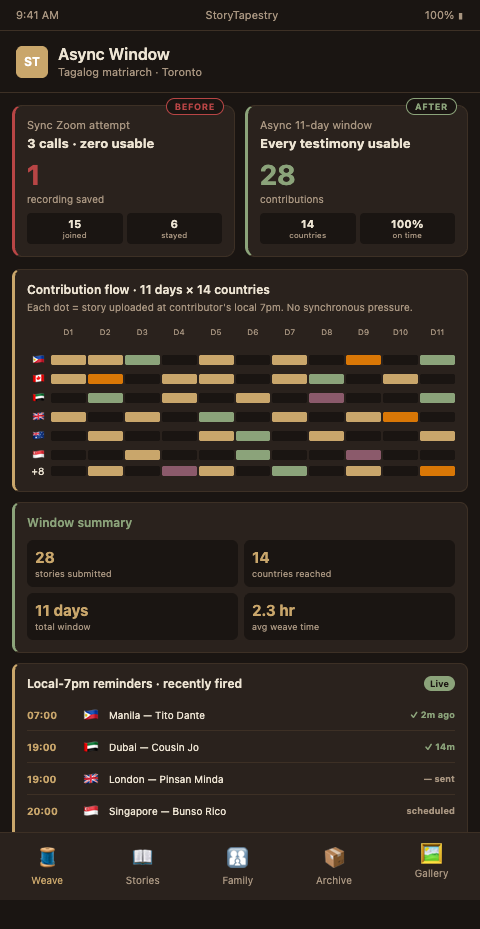
The result is a tapestry where the Mumbai cousin's 2 AM handwritten letter sits beside the Vancouver nephew's sunset voice memo, and neither required the other to stay awake.
The async approach also addresses a quieter problem that transnational memorials routinely produce: the guilt distant relatives feel when they cannot attend synchronously. A Nairobi uncle who cannot join a Los Angeles Zoom at 3 AM his time may already feel distant from the grief; forcing him to miss the synchronous event and then watch a recording later compounds that distance. When the workflow is async by default, no relative is positioned as the one who "missed" the memorial. Every contribution has the same standing regardless of when it arrived, and the Nairobi uncle's written tribute sits with the same visual weight as the Los Angeles daughter's in-person eulogy. Funeral directors who switch to async-first architecture consistently hear family coordinators describe the change as the difference between a memorial that excluded people and a memorial that included everyone.
Advanced Tactics for Cross-Timezone Memorial Collection
Anchor the collection window to the ritual, not the time zone. If the funeral is May 15, open the window April 20 regardless of where family members live. Do not set the window relative to the funeral home's headquarters. This small framing change removes a subtle bias that penalizes distant contributors.
Delegate time zone coordination to the platform, not the grieving family. Asking a bereaved spouse to track cousins across eight zones is cruel. The platform should send local-time nudges, manage translation queues asynchronously, and surface only exception cases that need human judgment.
Plan hybrid workflows that combine async with targeted remote story gathering. Some contributors lack the self-direction to produce a written or recorded tribute without an interviewer. For them, schedule a single 1:1 remote interview (video call) on their local clock, record it, and feed that recording back into the async tapestry alongside self-submitted entries. The interview is sync; the broader collection remains async.
Coordinate with facility-level submissions when they are in the mix. If a nursing home in Boise contributes alongside cousins in Cairo, the async infrastructure already handles cross-site logistics — funeral directors should reuse that pipeline rather than build a parallel one.
Set explicit decay rules for stale submissions. Async windows stay open too long sometimes, and late submissions that arrive after the memorial goes live need clear handling rules. StoryTapestry lets funeral directors choose: lock the tapestry, allow continuous additions, or create a "second volume" for post-memorial submissions. Each choice has consequences; pick deliberately.
Batch reviewer work at reviewer-friendly hours. Dialect reviewers and translators should work when they're sharp, not when the funeral director happens to be in the office. Async removes the need for reviewer-director temporal overlap, which widens your reviewer pool and improves quality.
Test intake flows on an elder's phone before rollout. A contribution flow that works smoothly on a funeral director's laptop may be unusable on a seven-year-old Android phone in a village with intermittent 3G connectivity. A Surinamese grandmother using a basic device at a community center should be able to complete a contribution within five minutes without fighting the interface. StoryTapestry's elder-friendly intake mode strips decorative elements, enlarges tap targets, and reduces bandwidth demands so the flow works on devices and connections that premium platforms ignore. Test with representative devices from each diaspora cluster before every major memorial rollout.
Respect spiritual practice in scheduling cadence. Async does not mean random. Contributors observing Ramadan should not receive contribution reminders during fasting hours; contributors observing Shabbat should not receive them from Friday sundown to Saturday sundown; contributors observing Pesach, Diwali, Eid, or other major observances should see their cadence adjusted automatically. StoryTapestry's cadence engine respects major religious calendars and pauses reminders during culturally specific windows, which prevents the tone-deaf message that arrives at exactly the wrong moment.
Track which prompt variants drive contributions from which clusters. A prompt that works well for a North American audience may land flat for a South Asian audience, and vice versa. StoryTapestry reports per-cluster contribution rates so coordinators can identify which prompts are activating which groups and iterate accordingly. This data, accumulated across many cases, becomes institutional knowledge about how specific communities prefer to be invited, which improves every subsequent transnational service your funeral home handles.
Build Memorials Your Scattered Families Can Actually Contribute To
Synchronous memorial collection privileges whoever lives closest to the funeral home and whoever can afford to lose sleep. Async collection privileges the story. StoryTapestry gives your diaspora funeral service a time-independent memorial story uploads infrastructure that treats a Manila grandmother's 9 AM local submission as equal to a Toronto niece's 8 PM local submission. Reach out for a configuration session tailored to your typical contributor geography. Your families will finally be able to show up — in their time, their format, their voice. The configuration session covers prompt-cadence design for your typical contributor distribution, elder-friendly intake customization for your specific device mix, reviewer routing for your typical translation needs, and integration with your existing case management systems, including multi-site story coordination where cross-facility submissions flow through the same async pipeline.
We typically complete configuration within three to four weeks, meaning your next transnational case can run on async architecture before the end of the quarter. Funeral homes that adopt async-first workflows consistently report reduced family coordinator burnout, higher contribution rates from distant relatives, and improved completeness of the final memorial. The overhead of running a synchronous-first memorial for a scattered family is genuinely exhausting for both staff and family; removing that overhead lets your team spend their attention on craft rather than on calendars, and lets your families spend their energy on grief rather than on logistics.