The Unspoken Chapters: Honoring Service Gaps in Veteran Memorials
The Problem: Gaps That Memorials Pretend Aren't There
When Staff Sergeant Miriam Tafoya's family requested her Army personnel file in 2021, the National Personnel Records Center responded with a reconstructed summary and a note that most of her 1950s-era service record had burned in the 1973 fire. Her family had assumed that requesting the file 60 years later would surface at least a unit history, a training record, and a list of assignments. Instead, they received a one-page reconstruction built from auxiliary records and a letter explaining that the original file had been among the 16 to 18 million Official Military Personnel Files destroyed when the NPRC building in St. Louis burned for 22 hours, a catastrophe the National WWII Museum documents as the St. Louis national records fire of July 12, 1973.
Miriam's case is not rare. The NPRC has reconstructed service information roughly 5.5 million times since the fire, and the auxiliary-records reconstruction approach produces a partial picture rather than a complete one. The VA currently tracks more than 18 million living veterans, and the population served by these partial records stretches across multiple generations. The National WWII Museum documents the scale of the 1973 fire as fundamentally reshaping what can be known about a whole cohort of veterans. Even for veterans whose files survived, the DD-214 captures discharge-point information but not the textured service history that families want for memorials.
Memorial programs often paper over these gaps. They reconstruct a timeline from family stories, fill the fire-destroyed years with guesses, and publish a program that reads as if the record is whole. Veterans whose service involved classified assignments, personal silence, or incomplete records end up memorialized with a fictional completeness that hides the actual shape of their lives. This is not honoring the veteran; it is erasing the truth of what can and cannot be known.
The StoryTapestry Framework: Weaving Gaps as Visible Chapters
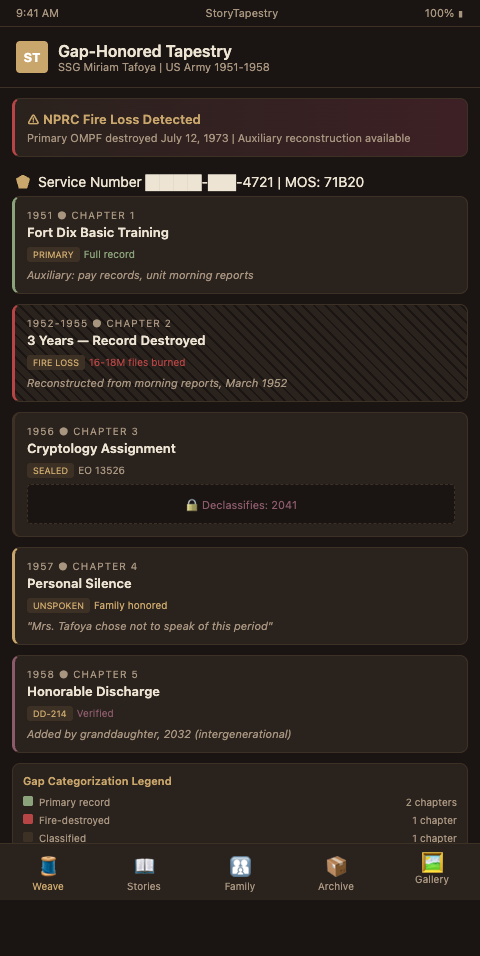
StoryTapestry treats gaps in the veteran record as chapters in their own right, not as defects to be hidden. The framework rests on a simple principle: a memorial that honestly marks what is unknown is more truthful than one that forges a complete narrative. This mirrors the private storytelling norms approach used in other memorial contexts, where the shape of what cannot be shared is itself meaningful, and many coordinators pair it with public-versus-private storytelling norms mapping before any outreach starts.
The first framework element is gap categorization. The platform distinguishes five kinds of gaps: administratively destroyed records (1973 fire and similar losses), sealed classified chapters, personally silent chapters (where the veteran chose never to discuss a period), family-unknown chapters (where the veteran died before sharing), and conflict-era gaps (where the veteran was in active combat or captivity and no contemporaneous record exists). Each category gets a distinct visual treatment on the tapestry, so viewers can see why the chapter is missing rather than assuming it simply was not documented.
The second element is the auxiliary-records surfacing workflow. The VA and NPRC support reconstruction from pay records, hospital admissions, unit morning reports, and insurance rolls when primary records are destroyed. StoryTapestry's coordinator dashboard walks families through the VA's reconstruction request process, which typically returns partial records within 60 to 120 days. The partial records populate the tapestry with explicit provenance notes ("reconstructed from morning reports, March 1952"), so viewers know which chapters rest on primary records versus auxiliary ones.
The third element is the sealed-chapter annotation, which overlaps with classified memory sharing practices and adjacent classified memory sharing protocols for cleared comrades. Chapters sealed by ongoing classification receive a specific visual marker (a dark rectangle with a small lock icon) and a tooltip explaining that the chapter exists but cannot currently be shared. The annotation includes the earliest date the chapter could potentially declassify under Executive Order 13526, so families know whether to expect a release in five years or fifty.
The fourth element is the personal-silence marker. When families know that a veteran never discussed a specific period (a deployment they returned from changed, a training accident they witnessed, a loss they carried) the tapestry preserves that silence as part of the memorial rather than forcing a narrative. The marker reads "Mr. Tafoya chose not to speak of this period" or similar language agreed with the family. This preserves the integrity of the veteran's choice while acknowledging that the chapter shaped who they became. The approach draws on authentic veteran narratives principles that resist fabricating content to fill silences.
The fifth element is the family-unknown workflow. When families learn of a chapter only after the veteran's death (a mentioned-once deployment, a boot camp friendship, a brief assignment nobody in the family remembered), the tapestry invites extended family, unit comrades, and archive researchers to contribute what they can. The chapter may remain partial, and that partiality is marked with provenance ("added by cousin Delia from a 1971 letter, unverified by other sources"). Partial knowledge presented honestly is better than fabricated completeness.
Advanced Tactics: Fire-Affected Cohort Coordination, Narrative Rhythm, and Intergenerational Gap-Filling
Memorial programs working extensively with veterans from the 1912-1964 Army records cohort (the primary group affected by the 1973 fire) need three tactics beyond the baseline framework.
The first is fire-affected cohort coordination. Families of veterans from the affected cohort benefit from a shared workflow that surfaces the same auxiliary record sources across memorials: VA compensation files, state veteran bonus records, draft registration cards, unit morning reports surviving at regional archives, and Red Cross casualty records. StoryTapestry's coordinator dashboard lets a program serve multiple fire-affected families simultaneously with shared research workflows, which substantially reduces the per-memorial research cost while improving the completeness of each reconstruction.
The second tactic is narrative rhythm. A tapestry with visible gaps reads differently from one that appears complete, and coordinators need to think about how gaps affect the rhythm of the memorial program. Five distinct sealed chapters clustered in a three-year deployment period tell a different story than the same five sealed chapters spread across a 25-year career. The platform offers rhythm visualization tools that show coordinators how gaps distribute across the life, and family coordinators often use this to decide whether to group gaps thematically or to leave them in chronological place.
The third tactic is intergenerational gap-filling. Veterans' grandchildren sometimes develop interest in service chapters their parents never pursued, and the tapestry's gap structure supports delayed contribution. A grandson who becomes a military historian in 2032 can research his grandmother's 1963 cryptology assignment and add documented context to a memorial her children built in 2018. The platform treats the tapestry as a document that grows across generations, so the gaps the first generation left open become the chapters the second generation fills in, and each addition holds to authentic veteran narrative standards rather than patching gaps with imagined heroism. Some chapters will stay open. That is part of the tapestry, too.
Coordinate Gap-Honoring Veteran Memorials with StoryTapestry
Veteran memorial programs serving families of 1973-fire-affected cohorts, classified-community veterans, and veterans who maintained personal silence about parts of their service use StoryTapestry's gap-honoring framework to build memorials that tell the whole truth, including the parts that cannot be told. Schedule a coordinator consultation to review a recent memorial where gaps posed a documentation challenge, and bring the family's NPRC response letter so we can demo auxiliary record workflows on real material. Programs completing the framework setup typically see family satisfaction rise materially because the tapestry reflects what the family knows and does not know rather than papering over uncertainty. Reach out through the StoryTapestry program coordinator portal to begin a gap-honoring framework setup.
The consultation covers the NPRC auxiliary records request workflow for 1973-fire-affected cohorts, the visible-chapter narrative rhythm used when a record-gap cannot be closed, the fire-affected cohort coordination protocol that batches multiple families facing the same documentation loss, and the intergenerational gap-filling framework that invites grandchildren to contribute context when the veteran maintained personal silence. Pilot engagements include gap-honoring onboarding for your two lead coordinators, a supervised first-memorial deployment with a named implementation specialist on the call, and a 60-day review of family satisfaction scores against pre-framework baseline. Most programs begin running gap-honoring intake on their next fire-affected cohort memorial within 21 days of the consultation. Bring your lead coordinator, one family-services director, and one archivist or volunteer records researcher — the consultation produces an auxiliary-records workflow the three of them can run on the next NPRC-affected memorial.