Balancing Heroism Narratives with Authentic Veteran Personal Stories
The Problem: Heroism Templates That Erase the Actual Veteran
Journalist Sebastian Junger spent five months in 2007 embedded with a platoon in the Korengal Valley, Afghanistan, and his reporting (including the film "Restrepo" and the book "War") pushed directly against the heroism framing that dominates American veteran media, as captured in his JFK Library forum on "War" and a Modern War Institute podcast on the veteran experience afterwards. His later book "Tribe" argued that the transition from platoon cohesion back to individualist American society drives more post-service distress than the combat exposure itself, a claim covered by NPR's reporting on veteran life after leaving "tribe" and reinforced by the Military Times on why it's hard for troops to come home. The Medal of Honor database at Hall of Valor and the VA's own Medal of Honor history archive make clear that actual valor-citation-worthy heroism is vanishingly rare relative to the broader veteran population.
Memorial programs default to heroism templates anyway. The program cover gets the uniformed photograph. The opening narrative references duty, sacrifice, and valor. The biographical middle section catalogs decorations, and the stories collected from comrades emphasize moments of courage even when the comrade is describing a logistics sergeant whose service was characterized by reliability rather than any singular valorous act. Families who pushed back on the heroism template often report feeling the memorial was not about the person they knew, which is a specific form of grief that memorial programs can avoid producing.
The problem compounds when heroism-framed memorials serve veterans whose service actually involved morally complex circumstances. Veterans who witnessed acts that haunted them, veterans whose unit experienced friendly-fire incidents, veterans who participated in operations later controversial, and veterans whose strongest service contribution was staying alive and bringing their platoon home all get flattened into the same valor-template shape. Authenticity is not the opposite of heroism; it is the broader frame within which legitimate heroism can sit alongside ordinary competent service, moral complexity, and daily humanity.
The StoryTapestry Framework: Weaving Valor Into a Broader Authenticity
StoryTapestry's framework treats legitimate heroism as one thread among many rather than the dominant thread that other threads must match. The tapestry accommodates Medal of Honor recipients, Silver Star winners, Purple Heart recipients, and the vastly larger population of veterans whose service involved no decorations beyond the standard good conduct and theater ribbons. The goal is a memorial that matches the veteran rather than matching a template.
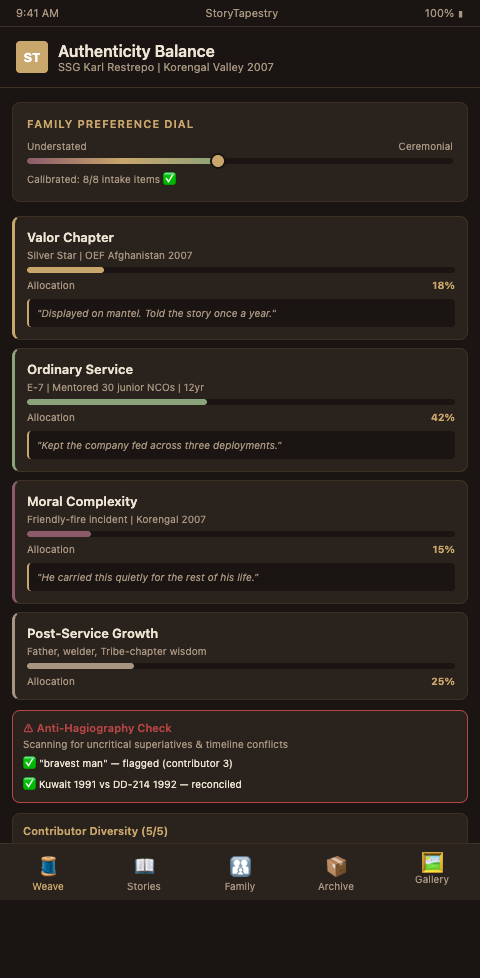
The first framework element is the decoration-proportional content allocation. When a veteran has received decorations for valor, the tapestry includes citation text and context in proportion to how the veteran themselves treated those decorations. A veteran who displayed their Silver Star on the mantelpiece and told the story often gets a prominent Silver Star chapter; a veteran who kept the citation folded in a drawer and changed the subject when asked gets a small, respectful acknowledgment. The family determines which mode fits their veteran, and the tapestry adapts accordingly. Heroism-first templates remove this calibration and treat every decoration as requiring the same treatment.
The second element is the ordinary-service emphasis. For the 99 percent of veterans whose service did not involve valor decorations, the tapestry actively prioritizes ordinary service content: the logistics job done well for 12 years, the E-7 who mentored 30 junior NCOs, the supply sergeant whose requisitions kept a company fed across three deployments. The platform prompts contributors specifically for ordinary-competence stories rather than only combat moments, because that is what most veteran service actually looked like. This pairs with civilian military weaving to capture the full life rather than only the uniformed fraction, and extending into civilian military chapter weaving ensures post-service decades carry equal timeline weight.
The third element is the moral-complexity chapter. Veterans whose service involved witnessing or participating in acts that sit in moral gray territory (acts that were legal but haunting, acts that were ordered but later contested, acts that the veteran carried complex feelings about) benefit from dedicated chapter structure rather than having those experiences flattened into a combat-heroism narrative. The chapter structure allows family and comrade contributors to approach the complexity honestly without turning the memorial into a confession or a defense. Junger's Korengal reporting demonstrates this kind of framing is achievable without dishonoring the veteran.
The fourth element is the anti-hagiography check. Before publication, the platform runs a review that flags common hagiographic patterns: uncritical superlatives ("the bravest man I ever knew"), unsupported combat claims, timeline inconsistencies with public records, and contributor statements that conflict with the veteran's own stated self-assessment. The flags are advisory; the family decides what to keep. But the check prevents inadvertent hagiography that the family would not have chosen if it had been pointed out. The check complements military photo archives workflows that anchor claims in documented evidence, and draws on military photo archive timelines to corroborate dates and units referenced in contributor stories.
The fifth element is the contributor-diversity prompt. Heroism-dominated memorials often emerge from interviewing only combat comrades; authenticity-weighted memorials interview spouses, children, civilian colleagues, post-service friends, and the veteran's own recorded reflections alongside combat comrades. The tapestry's contributor portal explicitly asks coordinators whether all five contributor categories are represented, and flags memorials that rely on a single category. Photo archives and ethical memorial storytelling practices inform the diverse-contributor approach.
Advanced Tactics: Family Preference Calibration, Junior-Service Attention, and Post-Service Growth Emphasis
Memorial programs balancing heroism and authenticity need three tactics beyond the baseline framework.
The first is family preference calibration. Different families want different balances, and the coordinator's job is to surface the preference rather than impose a template. Some families want the heroism-forward program because the veteran themselves valued that framing; others explicitly reject it because the veteran spent post-service years distancing from the valor-citation image. StoryTapestry's coordinator intake includes a preference questionnaire with eight items covering decoration prominence, combat-story emphasis, civilian-life weight, and the veteran's own preferred self-presentation. The calibration happens before content collection begins so contributors can be briefed accordingly.
The second tactic is junior-service attention. Veterans who served brief enlistments (two to six years as a junior enlisted service member) sometimes feel their service does not warrant a memorial tapestry because they did not "do enough." The framework explicitly supports junior-service memorials with structures that honor the formative experience without inflating it. A 22-year-old soldier who served three years in an Army support role, then lived 62 civilian years, gets a tapestry that honors the three years authentically rather than either omitting them or heroically reframing them. The tapestry often surfaces how the brief service shaped the long civilian life.
The third tactic is post-service growth emphasis. For veterans whose most meaningful personal growth occurred after discharge (recovery from combat exposure, family formation, professional reinvention, late-life reflection), the tapestry weights post-service chapters accordingly. This is not a reduction of military service but a recognition that the whole life is the memorial subject. Junger's "Tribe" argument (that transition itself is where the hardest work often happens) supports the weighting. Veterans who emerged from post-service decades with hard-won wisdom deserve a memorial that reflects the earning of that wisdom rather than collapsing back to the uniform photograph, and the ethical memorial storytelling standards used in cognitive-decline contexts translate directly to veterans whose late-life reflection shaped their final self-portrait.
Coordinate Authentic Veteran Memorials with StoryTapestry
Veteran memorial programs working with families who want memorials that match the actual veteran rather than a heroism template use StoryTapestry's authenticity framework to calibrate content to the veteran's own stance on their service. Schedule a coordinator consultation to review a recent memorial where the heroism template felt off, and bring the family preference intake we use to align tone before content collection. Programs adopting the framework report meaningfully higher family satisfaction because the memorial sounds like the person they knew rather than a generic valor script. Reach out through the StoryTapestry program coordinator portal to begin authenticity framework calibration.
The consultation covers the family-preference intake tool, the tone calibration workflow, the junior-service attention protocol that protects E-3 and E-4 narratives from being overshadowed by officer or senior-NCO stories, the post-service growth emphasis framework, and a review of three sample memorials running across the authenticity spectrum from understated to ceremonial. Pilot engagements include authenticity-framework onboarding for your two lead coordinators, a supervised first-memorial deployment with a named implementation specialist on the call, and a 60-day family satisfaction audit against the pre-framework baseline. Most programs begin running authenticity-calibrated intake on their next memorial within 14 days of the consultation. Bring your lead coordinator, one family-services director, and one recently bereaved family who would benefit from the framework if it had been available — the consultation produces a family-preference intake template the three of them can use on the next memorial.