How to Weave Civilian and Military Life Chapters into One Memorial
The Problem: Civilian Chapters Treated as the Footnote
When Colonel Bernard Okafor's memorial program went to print, the cover featured his 1991 Desert Storm unit photograph and the interior devoted nine pages to his 35-year Air Force career and two pages to his 22 years as a public school band director. His widow looked at the draft and said, "He spent more time teaching band than he did in uniform." The coordinator revised the program, but the default template had quietly treated the military identity as primary and the civilian identity as its appendage.
This pattern is structural. Research on veteran identity shows that most veterans seek a blended military-civilian identity rather than a replacement of one with the other, and that identity integration persists long after discharge rather than resolving in the first post-service year, a finding reinforced by recent sociological research on veteran reintegration. The Institute for Veterans and Military Families at Syracuse describes veteran identity as involving multiple simultaneous role identities rather than a single primary one. Studies in the Journal of Veterans Studies frame the self as existing across dual domains that continue interacting throughout life, echoed by additional veteran identity scholarship on how military and civilian selves coexist.
Memorial programs that default to military primacy do not reflect how veterans lived. They reflect how memorial templates were built: often in partnership with VSOs whose expertise sits on the uniform side of the life, or with funeral directors whose imagery stock leans toward flags and uniforms. The civilian chapters get the fill pages at the end, not the spine of the program. A memorial built this way tells half a life, and often not the half the veteran most identified with in their last decades.
The StoryTapestry Framework: One Tapestry, Two Equal Warp Threads
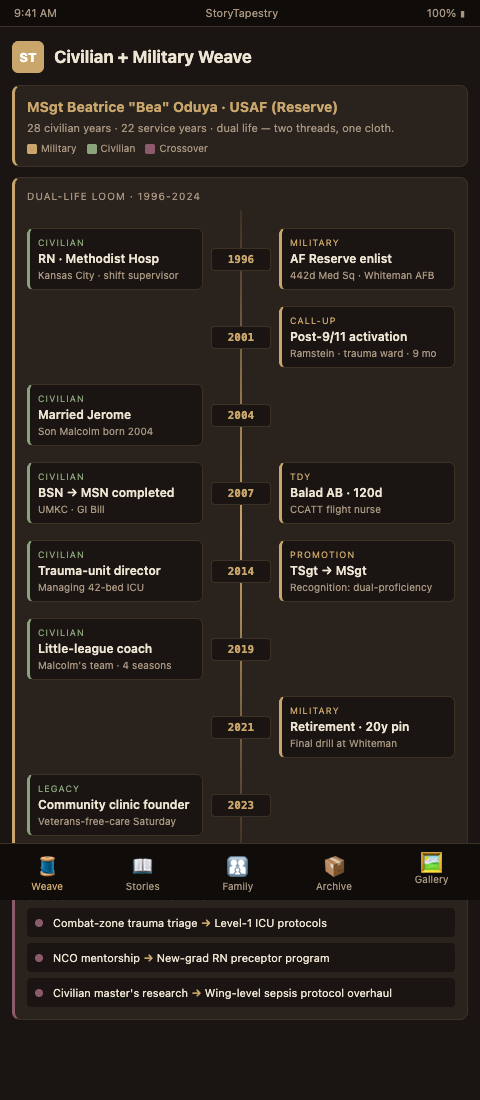
StoryTapestry's Dual-Life Narrative Integration treats military and civilian chapters as two warp threads running the full length of a veteran's adult life, with the weft (relationships, values, habits, skills transferred across both) binding them together. The tapestry does not segregate the chapters into "Part One: Military" and "Part Two: Civilian"; it runs them side by side so a viewer sees what the veteran was doing in uniform in 1994 alongside what the veteran was doing in civilian work in 2004, with the continuities visible across the gap.
The first framework element is the parallel timeline. Every veteran memorial in StoryTapestry defaults to two stacked horizontal timelines: military service on top, civilian work and family milestones below, with a shared year axis. When Colonel Okafor's widow built his tapestry this way, the timeline showed his 1991 Desert Storm tour above his first year of school band teaching in 1994 (he retired that year), and the students who contributed stories could see exactly where their chapters fit in his life. The deployment chapter assembly informs the top thread while civilian milestones populate the bottom, and the underlying deployment chapter assembly mechanics keep the military half coherent across reassignments.
The second element is cross-thread annotation. The tapestry invites contributors to mark where the two threads connected. A master sergeant who became a firefighter can point to where his military logistics training showed up on a 2011 department restructuring. A Navy nurse who became a hospice director can annotate how her ship's triage experience shaped her approach to end-of-life care. Cross-thread annotation lets the tapestry show not two lives but one continuous life that moved between two domains, which is how most veterans experience it.
The third element is the civilian-first intake path. For families whose veteran's primary later identity was civilian (a teacher, a pastor, a small business owner, a grandfather), the intake begins with civilian contributors and invites military comrades in as a second wave. This inverts the default and often doubles the contributor pool, because civilian contacts (students, parishioners, customers, neighbors) are often larger in number than the shrinking comrade cohort by the time the veteran dies. The platform supports authentic personal stories that resist the default heroism-narrative template and make space for the quieter civilian memories.
The fourth element is skill-transfer mapping. The platform prompts contributors to name specific skills the veteran brought from military service into civilian work, and vice versa. Colonel Okafor's band students did not know he had been a wing maintenance officer, but when they described his pre-concert rehearsal discipline, the tapestry could annotate the likely military origin of his approach. The mapping builds what the framework calls transferred identity, visible to viewers as a distinct layer of the tapestry separate from the biographical timeline.
The fifth element handles later-life civilian caregiving. Veterans whose final chapters involved caregiving for a spouse with dementia, a disabled child, or a sibling's estate often leave less documented civilian memory than their military chapters. The framework supports pre-diagnosis memory preservation approaches adapted for veteran caregivers, so the civilian caregiving years are not reduced to a single paragraph about decline, and the same pre-diagnosis memory preservation workflow captures the years before the spouse's cognition shifted.
Advanced Tactics: Civilian Employer Outreach, Volunteer Organization Threads, and Post-Retirement Reinvention
Memorial programs working with veterans who had substantial civilian second acts need three tactics beyond the baseline framework.
The first is civilian employer outreach. When a veteran spent 20 or 30 years with a post-service employer, the employer's HR records, retirement speech archives, and colleague networks often hold material the family has never seen. StoryTapestry's coordinator dashboard generates employer outreach templates that request (with family consent) retirement ceremony recordings, colleague memorial contributions, and archived newsletter mentions. Large employers often respond with material the family did not know existed, including internal award citations and project team photos.
The second tactic is volunteer organization threading. Veterans often become heavily involved in civilian volunteer organizations (Rotary, Masonic lodges, church leadership, Little League coaching, Habitat for Humanity chapters) after retirement. Each organization tends to have its own story cache, and the tapestry supports parallel outreach to every organization the veteran was involved with. A veteran who volunteered with six organizations over two decades often yields six distinct civilian story clusters, each with its own contributors and artifacts.
The third tactic is retirement-to-death chronology. Veterans whose retirement from the military came 20 or more years before death often had a civilian chapter longer than their military one, but memorial programs frequently compress the civilian years into a single paragraph. StoryTapestry's tapestry explicitly allocates timeline space proportional to years lived in each domain, not to the cultural weight typically assigned to uniform versus civilian identity. A veteran who served four years and then lived 55 civilian years gets a timeline that looks the way that life actually looked, not the way a flag-backed memorial template would draw it, a principle reinforced by authentic personal storytelling over heroism-template shortcuts.
Coordinate Dual-Life Veteran Memorials with StoryTapestry
Veteran memorial programs serving families of career-transition veterans, retirees with long civilian second acts, and veterans whose primary later identity was civilian use StoryTapestry's Dual-Life Narrative Integration to build tapestries that reflect the full life rather than the uniformed fraction. Schedule a coordinator consultation to review a recent memorial program draft, and bring one civilian contributor contact so we can demo the parallel timeline with real material. Programs that adopt the dual-life default within their intake see civilian contributor participation rise substantially in the first month. Reach out through the StoryTapestry program coordinator portal to start a dual-life integration setup. The consultation covers your current intake script, the parallel timeline architecture, the civilian employer outreach workflow, the volunteer organization contribution channels, and the post-retirement reinvention prompt library used with spouses and adult children.
Pilot engagements include dual-life onboarding for your two lead coordinators, a supervised first-memorial deployment with a named implementation specialist on the call, and a 60-day audit of civilian-to-military contributor ratios against your pre-framework baseline. Most programs begin running dual-life intake on their next retiree-cohort memorial within 14 days of the consultation. Bring your lead coordinator, one family-services director, and one civilian community liaison — perhaps a volunteer-organization president or a human resources contact from an employer that has hired veterans — the consultation produces a civilian-contributor outreach list the three of them can activate before the next intake.