Balancing Public Memorial Culture vs Private Storytelling Norms
Why One Visibility Setting Cannot Serve Transnational Families
A Korean-American family in Los Angeles planned a public memorial page for their matriarch. The California grandchildren expected an open social-media-style tribute where friends and acquaintances could post. The Seoul-based siblings of the deceased objected: in their cultural frame, family grief should not be displayed beyond immediate kin. The platform had no way to satisfy both sides. The family compromised with a small public page that stripped out the detailed memories that would have mattered most.
This split traces cleanly to documented cross-cultural privacy research. Springer's analysis of cross-cultural privacy differences shows that individualistic cultures (US, Canada, Northern Europe) and collectivistic cultures (much of East Asia, Latin America, parts of the Middle East) differ systematically in what personal content they consider appropriate to share. SAGE's cross-cultural privacy calculus research and Wikipedia's summary of Hofstede's cultural dimensions theory document how individualism-collectivism scores predict national-level privacy norm variation. Hofstede Insights' country comparison tool makes this interactive.
Grief-specific research sharpens the picture. Death with Dignity documented that Western mourning shifted from public to private since WWI, while Taylor & Francis's ethnographic work on public mourning shows that cultures maintain distinctive public-grief conventions even in the digital era. IAPP's paradigms-of-privacy analysis extends this to regulatory divergence: GDPR, PIPL, and US state privacy laws encode different cultural defaults.
For transnational diaspora funeral services, this means memorial visibility is not a single toggle. It is a distributed set of decisions that different family branches will answer differently.
A Tapestry Framework for Cultural Privacy Norms in Digital Tributes
A tapestry can have some panels facing outward to a public gallery while other panels remain rolled inward for family-only viewing. StoryTapestry's visibility architecture builds this flexibility into every memorial, recognizing that a single family may need both orientations simultaneously.
The framework rests on six structural commitments:
1. Section-level visibility, not page-level. StoryTapestry's memorial pages divide into named sections (e.g., "public tributes," "family reflections," "spouse's private letters," "professional colleagues"). Each section has independent visibility settings: public, invited only, family-only, or a custom access list. One memorial can host all four simultaneously.
2. Cultural default presets. When a family specifies the deceased's cultural background, StoryTapestry suggests sensible default visibility patterns: Korean families see a closed-family default; American families see an open-public default. Families override as needed, but the defaults reflect documented norms from Hofstede's country data rather than platform assumptions.
3. Contributor-side visibility preferences. Each contributor can flag their own submission as "family only," "extended kin only," or "public." A Seoul aunt who submits a private reminiscence controls its exposure regardless of the overall page settings. This aligns with religious story customs documentation that treats sacred or intimate content as contributor-controlled.
4. Negotiated cross-branch permissions. When family branches disagree about visibility (the LA side wants public; the Seoul side wants private), StoryTapestry surfaces a structured decision-capture flow: which family members are authorized to set page-level defaults, how disputes are documented, and what fallback settings apply when consensus is unreached.
5. Story accuracy and verification boundaries. Verification of sensitive content depends on visibility context. A public story is fact-checked against a wider corpus; a private family story is fact-checked only against family memory. Linking to story accuracy verification workflows preserves verification without forcing public exposure.
6. Medical and end-of-life content protection. Some stories touch medical details, end-of-life decisions, or infant-loss circumstances that deserve elevated protection regardless of broader visibility. The framework integrates memorial privacy consent workflows so sensitive medical content never defaults to public exposure.
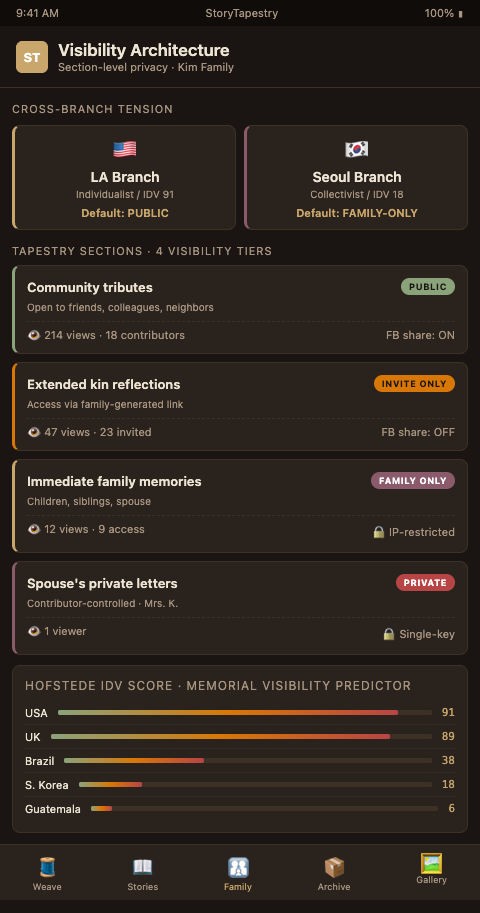
The effect is that one tapestry can simultaneously honor a family's public-facing grief and its private mourning — without forcing all contributors into the same visibility model.
The platform also handles a situation that generic memorial tools consistently mishandle: the posthumous shift in privacy preferences that families sometimes experience. A week after the service, a cousin may reconsider a contribution that felt appropriate in the acute grief moment but now feels overexposed. A widow may want to tighten restrictions on medical details she shared early in the process. A teenage grandchild may realize his emotional video is being shared at school and want it pulled from public view. StoryTapestry's retroactive privacy controls let families make these adjustments without destroying the underlying contribution or the tapestry's structural coherence. The content remains in the archive; its visibility simply narrows to the family-only tier. This respect for evolving preferences matters enormously in the months following a service, when grief shifts and contributors' needs shift with it.
Advanced Tactics for Public Grief Versus Private Mourning Customs
Ask the visibility question early, before stories arrive. Visibility is harder to change after submissions accumulate. During initial family onboarding, walk through the section plan and capture visibility preferences for each. Late changes risk alienating contributors whose privacy expectations shift retroactively.
Document visibility decisions in the memorial case file. Record who approved public visibility for each section and what cultural or family considerations shaped that decision. When questions arise later (a contributor requests takedown; a family member objects to a specific story appearing publicly), the documented decision chain resolves disputes faster than reconstructed recollections.
Treat different diaspora generations differently. First-generation diaspora members often maintain origin-country privacy norms; second and third generations often adopt host-country norms. Memorial visibility for a family spanning these generations needs explicit negotiation, not assumption.
Respect religious-tradition privacy conventions. Some Islamic families prefer limited female-presence in public content; some Hasidic families require rabbinic consultation before public exposure of ritual imagery; some Buddhist traditions treat the 49-day post-death period as particularly sensitive. Section-level visibility supports tradition-specific conventions without forcing compromise.
Build review workflows for public-facing sections. Any content that appears publicly should have a lightweight review step: family sign-off, funeral-director check, and optional cultural-advisor review. This is not censorship — it is protection from accidental public exposure of content a contributor assumed was private.
Handle social-media cross-posting carefully. Public memorial content sometimes gets shared to Facebook, Instagram, or WhatsApp. Publish with explicit sharing permissions (allow/disallow specific platforms), and surface these controls to contributors during submission.
Plan for post-publication visibility changes. Families sometimes request visibility downgrades later (a cousin reconsiders their public contribution). The platform should support retroactive section-level re-privatization without destroying the underlying content, preserving the tapestry while respecting the updated preference.
Audit your own defaults. US-based funeral services often assume public defaults without examining the cultural assumption behind that choice. Running a quarterly audit of your visibility defaults against your diaspora caseload surfaces where your defaults serve which demographics — and whether your service is implicitly favoring one cultural frame.
Handle surveillance-adjacent privacy concerns deliberately. Some diaspora contributors may face real surveillance concerns from the home-country government, particularly members of political dissident communities, religious minorities from certain regions, or ethnic groups subject to state monitoring. A memorial for a Tibetan, Uyghur, Kurdish, or Rohingya family may require visibility settings that account for the possibility that the home-country government is watching. StoryTapestry's privacy tools support IP-level access restrictions, pseudonymous contribution, and selective visibility to protect contributors whose safety might otherwise be at risk. Funeral homes serving these communities should explicitly ask about surveillance concerns during intake rather than waiting for families to volunteer them.
Coordinate privacy with GDPR, PIPL, and regional regulatory regimes. A memorial with contributors in the EU, UK, California, China, or other regulated jurisdictions must handle personal data within each jurisdiction's legal framework. StoryTapestry's privacy architecture is built to support these regulatory requirements by default, but funeral directors should still verify during intake that the family's intended visibility model complies with the legal framework each contributor is subject to. This is particularly important when contributors include EU residents, because GDPR's requirements around consent and data retention differ from US defaults.
Give Each Family the Memorial Visibility Their Culture Expects
The Seoul branch and the LA branch should both see a memorial that feels culturally appropriate to them — without forcing either to accept the other's norms. StoryTapestry's section-level visibility, cultural presets, and contributor-controlled settings make this possible. Schedule a consultation to review your service's visibility defaults and map them against your diaspora caseload. Your families will find a memorial architecture that respects their grief's natural orientation, whether that orientation points inward or outward. The consultation includes a review of your current platform defaults, a mapping of those defaults against Hofstede-documented cultural privacy norms, identification of the communities most likely to be underserved by your current configuration, and a remediation plan with specific platform changes and staff training adjustments.
We also cover the regulatory landscape for contributors in major jurisdictions, the protocols for surveillance-sensitive communities, and the retroactive privacy workflow for contributors who need to adjust visibility after publication. Funeral homes that align their visibility architecture with their actual caseload typically see measurable improvement in family satisfaction among collectivist-culture families within the first quarter, because those families finally feel their privacy norms are being respected rather than overridden. The Seoul branch of any given family is watching how the LA branch's funeral home handled visibility, and that observation shapes whether future family memorials come your way.