How to Verify Story Accuracy from Contributors Spanning Decades and Continents
Why Decades-Old Diaspora Memories Contradict Each Other
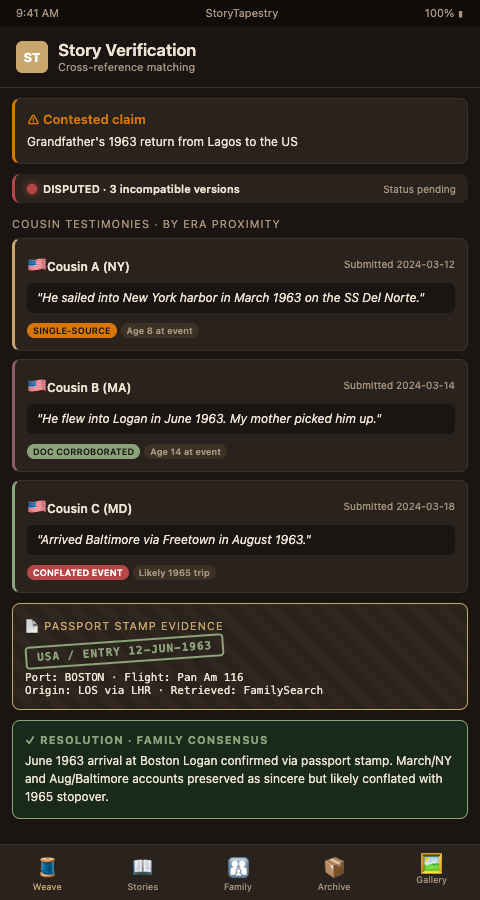
A New Jersey family collected grandfather stories for a 2024 memorial. Three cousins independently described his 1963 return from Lagos to the US. One said he sailed into New York in March; one said he flew into Boston in June; one said he arrived in Baltimore via Freetown in August. The trip genuinely happened, but decades of separate retellings had produced three incompatible reconstructions. All three cousins were sincere. All three were partly wrong.
Memory research predicts exactly this. PNAS's study of false memories in HSAM individuals showed that even people with highly superior autobiographical memory are susceptible to false memories. PMC's research on eyewitness accuracy, time, and repetition documents that memory accuracy decreases over time while repetition increases confidence in incorrect details. Wiley's review of autobiographical memory accuracy summarizes decades of research showing autobiographical memories are reconstructive, not stored as fixed recordings.
The Noba Project's overview of eyewitness memory biases adds that memory reconstruction fills gaps with details borrowed from other memories, creating vivid but inaccurate composites. For diaspora memorial services, this compounds across continents: the Lagos cousin's memory has drifted one way; the New York cousin's has drifted another; neither has a shared corrective environment to check against.
Fact-checking tribute narratives from decades is therefore not about catching liars. It is about structured reconciliation across sincere but incompatible recollections.
A Tapestry Framework for Authenticating Diaspora Family Recollections
A tapestry that records contradictions honestly is stronger than one that picks one version and discards the rest. StoryTapestry's verification methodology captures multiple accounts and surfaces the verification status alongside each, rather than silently adopting the first or loudest version.
The framework operates through six verification layers:
1. Source attribution at intake. Every story captures who submitted it, when, and what relationship they had to the deceased during the described era. A story about 1963 events carries heavier weight from the grandfather's brother than from the grandfather's grandchild, and StoryTapestry attaches this provenance permanently.
2. Corroboration fields for each claim. When a contributor makes a specific factual claim (place, date, action, person), the platform prompts for corroborating sources: "Is this based on direct conversation, family letters, photos, documents, or inference?" This aligns with University of Victoria's guidance on reliability and validity in oral history, which emphasizes corroborating oral testimony through multiple independent sources.
3. Cross-reference matching. StoryTapestry surfaces when two submissions make overlapping claims, flagging agreements and contradictions for family review. The 1963 return example would surface three competing versions side-by-side rather than publishing the first arrival.
4. Document integration. Letters, passport stamps, photographs, immigration records, and professional documents anchor memories to verifiable artifacts. The FamilySearch Genealogical Proof Standard requires widest search, proper citation, and correlation of evidence — principles StoryTapestry applies to memorial content specifically.
5. Published verification status. Each story displays its verification state: corroborated by documents, corroborated by multiple contributors, sole-source but plausible, or disputed. Readers see this status alongside the story, so they know when they are reading family consensus versus a single unverified recollection.
6. Integration with dialect narrative challenges and public private story norms frameworks. Verification decisions interact with dialect translation (a misheard date in translation); with visibility (some disputed content should stay private during verification); and with conflicting memory management workflows for families where a contributor has dementia-adjacent memory drift.
The Oral History Association's core principles state that narrators shape interviews based on their knowledge. StoryTapestry's framework respects narrator autonomy while making the knowledge-shape visible, so readers and future generations can see why two sincere versions differ.
The verification architecture also handles a particular pathology common in diaspora families: the emergence of family myths that have been told so many times they feel absolutely true but are verifiable only through documents nobody has examined. A family story about a grandfather escaping political imprisonment through a risky border crossing may have been repeated at every reunion for 40 years, and a document check might reveal it actually happened but in a less dramatic form, or occurred to a cousin and got transferred to grandfather over time. StoryTapestry's verification surface does not debunk family myths; it annotates them with what is documented and what remains oral tradition, letting the family decide how to present each. For many families, the documented and oral versions together reveal a richer picture than either alone, and the memorial becomes a place where tradition and record finally coexist rather than compete.
Advanced Tactics for Cross-Referencing Global Contributor Memories
Build a verification timeline before stories arrive. Before outreach begins, assemble known facts about the deceased: documented employment history, immigration records, major life events with date stamps. This timeline becomes the corroboration backbone against which submissions get checked.
Prioritize document-anchored memories in early outreach. Ask contributors early for letters, photographs with writing on the back, newspaper clippings, and memorabilia. These anchor later oral submissions. A photo dated "March 1963, Brooklyn" resolves the 1963 return debate faster than any interview.
Treat disagreements as information, not errors. When three cousins disagree about a 1963 trip, the disagreement itself is a data point about family communication and memory. StoryTapestry preserves all three accounts with a note explaining the divergence. Readers learn something about the family they would not learn from a single sanitized version.
Interview oldest living family members first. Memory decay is time-dependent; elder relatives closest to the events have the most valuable testimony and the least time remaining. The Oral History Association archives best practices emphasize urgency for eldest-first collection — a principle that applies doubly in diaspora contexts.
Use multi-contributor confirmation for sensitive claims. Before publishing a claim that might affect family reputation (e.g., "he served as a local official during a politically sensitive era"), require corroboration from at least two independent contributors. Sole-source claims on sensitive topics stay in draft until verified.
Document the verification reasoning. When the family accepts "the 1963 return was in June by air into Boston" as the verified version, capture why: the Boston cousin produced a flight record; two other cousins confirmed once prompted; the March-New York version appears to have been a conflation with a 1965 trip. This reasoning becomes part of the permanent record.
Respect unverifiable memories with appropriate labels. Some claims cannot be verified — a private conversation, an unrecorded feeling, a moment with no witnesses. These should be published with clear "single-source recollection" labels rather than suppressed. Memorial completeness requires space for unverifiable-but-meaningful content.
Audit the verification status regularly. Over time, new documents surface. A great-aunt dies and her papers reveal the March/June dispute was actually a Freetown stopover in April. StoryTapestry's verification status should be re-reviewed annually or when new source material enters the archive.
Coordinate verification with genealogical and archival resources. Some claims that are hard to verify through family memory become easy to verify through census records, ship manifests, naturalization papers, military service records, church baptismal registers, or immigration files. StoryTapestry's workflow includes optional integration with major genealogical databases so that family claims about dates, places, and relationships can be cross-checked against documentary records. A disputed 1963 return from Lagos may be resolved in minutes by consulting airline passenger manifests from that era, if the family knows to look.
Handle verification of sensitive historical periods with care. Family stories about escapes from conflict, refugee experiences, or politically charged historical moments often carry emotional weight that goes far beyond factual accuracy. A Hmong family's story about the 1975 exodus from Laos, a Vietnamese family's story about reeducation camps, a Bosnian family's story about Srebrenica, a Rwandan family's story about 1994 all carry profound emotional meaning regardless of precise documentary verification. The verification architecture should treat these stories with appropriate gravity, documenting what is confirmed without forcing families to litigate painful memories against documentary evidence.
Publish Memorial Stories Your Family Can Trust for Generations
A memorial that enshrines the first version contributed is a memorial that enshrines inaccuracies permanently. StoryTapestry's verification architecture gives your funeral service a documented, auditable methodology for handling contradictions across decades and continents — without forcing families to pick winners among sincere disagreeing relatives. Contact our team to configure verification workflows for your typical diaspora caseload. Your families will have a memorial that documents what is known, what is disputed, and what remains unverifiable, so every future reader understands the testimony they are reading. The configuration includes source attribution templates, corroboration field design for your typical case types, cross-reference matching logic, document integration with genealogical resources, and published verification status frameworks. We also cover the sensitive verification workflows for historical periods involving conflict, displacement, or political trauma, where families need documentation without adversarial fact-checking.
Funeral homes that adopt verification-aware workflows consistently report that the resulting memorials become more durable family artifacts, because future generations can rely on the memorial as a researched record rather than a collection of untraceable claims. The great-grandchild looking at the memorial in 2070 needs to know whether the grandfather's 1963 return happened the way the story says, and the verification architecture gives them exactly that answer.