Managing Classified Memories: What Comrades Can and Cannot Share
The Problem: Comrades Who Don't Know What They're Allowed to Say
Master Sergeant Eileen Park's memorial drew 80 comrades from three deployments, and the program coordinator asked each to share a two-minute story. By the fourth speaker, a retired intelligence analyst stopped mid-sentence and apologized: he had almost named an operation he wasn't sure had been publicly acknowledged. The family watched him sit down in silence, a story they wanted to hear locked behind uncertainty neither he nor they could resolve.
This scene plays out at veteran memorials constantly, because the boundary between what cleared comrades can and cannot share is genuinely hard to locate. The Defense Counterintelligence and Security Agency's OPSEC training emphasizes that protection extends to unclassified information whose aggregation could reveal critical capabilities, a principle reinforced by CDSE's GS130 OPSEC awareness coursework. DoD Manual 5200.01 governs classified information handling and its dissemination restrictions survive the service member's death and the comrade's separation. The National Archives maintains a Controlled Unclassified Information registry that includes an OPSEC category covering memorial-adjacent content.
Executive Order 13526 keeps some records classified for 25 years and others for 50 or indefinitely where human sources remain exposed. Veteran.com's OPSEC primer stresses that training covers non-classified information whose release could still endanger personnel or families. Comrades who deployed together internalize that aggregation rule and often err toward silence when they cannot parse which fragment is safe. The memorial loses stories that, parsed correctly, would have been shareable.
The StoryTapestry Framework: Weaving Safe Threads While Sealing the Rest
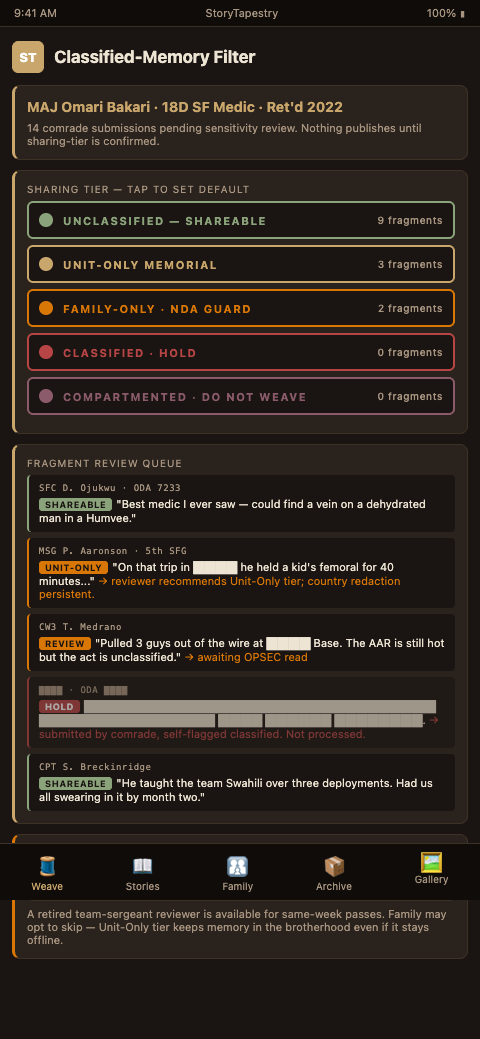
StoryTapestry's Classified-Aware Story Framework treats each comrade contribution as a bundle of threads that pass through a structured intake rather than a single unfiltered narrative. The goal is not to enforce classification review (only the cognizant original classification authority can do that) but to give contributors a clear lane so they stop at a reasonable boundary instead of going silent at the podium.
The framework's first layer is the intake questionnaire. Before a comrade records or writes a story, the platform asks five questions: the operation's publicly acknowledged name if any, the year and theater, whether the contributor held a clearance tied to the event, whether the veteran's family has requested a particular focus, and whether the contributor is aware of any non-disclosure agreement still in force. A contributor who answers "yes" to the NDA question is routed to a templated contribution focused on the veteran's character, daily habits, and shared non-classified moments, with a note explaining why operational details were not collected.
The second layer is the aggregation check. DCSA OPSEC training warns that individually unclassified details can become sensitive when combined, and StoryTapestry runs a simple rule set flagging combinations of unit, location, date, and mission type that together cross into OPSEC-relevant territory. When the rule set fires, the tapestry defaults to showing the veteran-facing fragment (unit, date, location) while holding the operational detail for family review with a note explaining the aggregation concern.
The third layer is the five categories of shareable material. The framework explicitly lists categories comrades can draw from without clearance concerns: personal character and habits, humor and off-duty moments, non-operational training scenarios, publicly acknowledged operations covered in DoD press releases, and post-service activities. Contributors who feel uncertain about a memory can usually find an adjacent category that captures the same meaning. A story about a team sergeant's leadership during a classified cross-border mission rarely needs the mission to carry its weight; the same leadership showed up during the pre-deployment workup that is entirely unclassified.
The fourth layer is the sealed-chapter annotation. When a contributor has a story they cannot share, the tapestry still records the fact that the story exists. A placeholder reads "this chapter remains classified, shared among comrades in person only" and lists the year and theater. Families who visit the tapestry see the shape of the service even where the content stays sealed, and the platform supports declassified record integration that can backfill the placeholder if and when the record is released, tying into the broader declassified records workflow for personal journals. The placeholder also pairs with unspoken service chapters to acknowledge gaps without pretending they do not exist.
The fifth layer handles conflicting memory. When two comrades give contradictory accounts of the same classified-adjacent operation, the platform records both and flags them for family review rather than auto-resolving. Contradiction in cleared testimony is often a sign that one or both comrades are working around boundaries differently, not that one is wrong.
Advanced Tactics: Clearance Reviewers, Unit-Level Norms, and Family Negotiation
Memorial program coordinators handling comrades from intelligence, special operations, cryptology, or nuclear weapons communities need three additional tactics beyond the framework baseline.
The first is the volunteer clearance reviewer pool. Some veteran service organizations maintain rosters of retired cleared personnel willing to offer informal OPSEC review on memorial contributions. This is not formal classification review (again, only the cognizant original classification authority can do that), but a senior retired chief or colonel with recent clearance history can often spot aggregation issues a family coordinator would miss. StoryTapestry's admin console lets coordinators route flagged contributions to a named reviewer with a 72-hour SLA, and the reviewer's initials appear on the tapestry as provenance.
The second tactic is unit-level norm documentation. Different units handle post-service sharing differently. Some MARSOC teams maintain that team composition remains off-record even decades later; some cryptologic teams from the Cold War maintain unit cover stories that override what records later reveal. StoryTapestry lets coordinators capture unit-specific norms as part of the memorial's metadata, so contributors from that unit see the norms before they begin contributing rather than hitting them mid-draft, which complements unspoken service gap acknowledgment for periods that remain permanently sealed.
The third tactic is explicit family negotiation. Families sometimes want operational detail that comrades feel they cannot provide. The framework supports a three-way conversation, mediated by the coordinator, where comrades explain the OPSEC reasoning, families explain what they are looking for, and both parties agree on what a shareable adjacent story might look like. Daughters who began asking for "what operation he was on in 1991" often end up with a richer portrait of how their father trained his team, why comrades trusted him, and what post-deployment recovery looked like, none of which required operational disclosure. The negotiation mirrors conflicting memory management in dementia bereavement, where coordinators broker reconciliation between family members holding incompatible accounts without forcing one version to win, and the same protocols transfer cleanly to cleared-community memorial work.
Coordinate Cleared-Comrade Memorials with StoryTapestry
Veteran memorial programs working with families whose veterans served in special operations, intelligence, cryptology, or other cleared communities use StoryTapestry's Classified-Aware Story Framework to collect comrade stories without putting contributors in the position that Eileen Park's memorial speaker faced. Book a coordinator consultation to review your current intake process, map the cleared-community units you commonly serve, and set up unit-specific norm documentation before your next memorial. Most programs complete framework setup in under two weeks and see comrade contribution rates rise sharply once intake reduces the ambiguity that was driving silence. Reach out through the StoryTapestry program coordinator portal to start a Classified-Aware Framework review.
The consultation covers your current intake script, the cleared-community unit directory you commonly serve, a draft of unit-level norm documentation for three to five reference units, and a review of your clearance reviewer network including retired OPSEC officers and former unit adjutants willing to act as volunteer reviewers. Pilot engagements include framework onboarding for your two lead coordinators, a supervised first-memorial deployment with a named implementation specialist on the call, and a 90-day check-in where we audit comrade contribution rates against the baseline. Most programs begin using the framework on their next cleared-community memorial within 14 days of the consultation. Bring your lead coordinator, one family-services director, and one trusted cleared-community veteran liaison — the consultation produces a unit-norm documentation starter the three of them can expand before the next memorial intake.