Integrating Declassified Records and Personal Journals into Vet Memorials
The Problem: Records and Journals That Never Meet
When Sergeant Delmar Mills died in 2019, his three daughters believed they knew his Special Forces tour from the stories he told. Three years later, a batch of Military Assistance Command Vietnam records cleared automatic declassification and a cousin emailed a scanned after-action report naming Mills as operations sergeant on a cross-border mission the family had never heard about. The family's memorial program, printed and distributed in 2019, already sat in archive boxes.
This gap between personal testimony and the archival record is structural, not rare. Executive Order 13526 sets a 25-year default for automatic declassification, which means Gulf War records are entering public access only now, and the National Declassification Center has processed hundreds of millions of pages since 2010 under the National Archives' records declassification mandate. Meanwhile, the Library of Congress Veterans History Project holds more than 121,000 collections, including roughly 150 original diaries donated by veterans or surviving kin.
The records and the journals almost never meet. Families build memorial programs from what Dad told them at Thanksgiving; the archives sit in College Park and St. Louis; the diaries sit in LOC reading rooms; the classification clock turns over every 25 years under EO 13526 and releases land with no notification to kin. A Civil War historian at the New Georgia Encyclopedia noted that personal journals convey warfare far better than the formal reports filed after engagements. A memorial built from one side alone is missing the other half of the cloth.
The StoryTapestry Framework: Weaving Archive and Diary into One Cloth
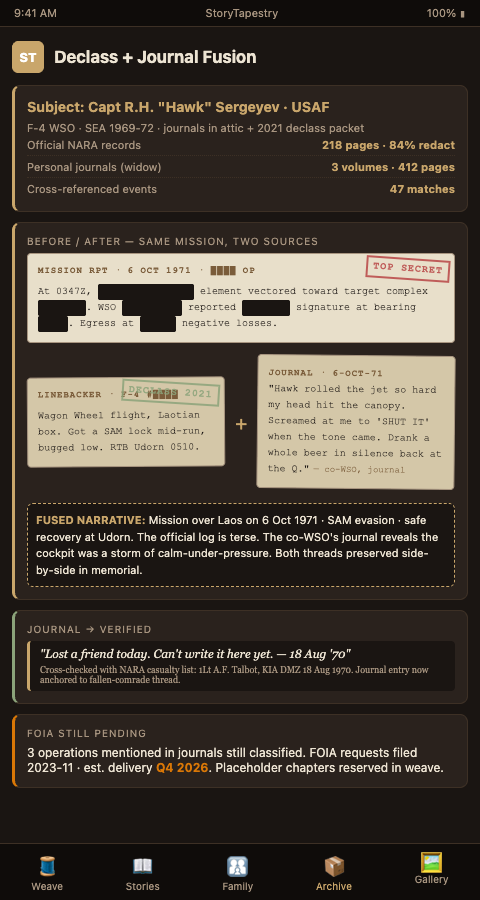
StoryTapestry treats declassified records and personal journals as two warp threads that run the full length of a veteran's life, with family stories forming the weft that binds them. Instead of asking families to choose between the sanitized official record and the raw personal diary, the platform lets both sit side by side on the same timeline, each annotated and cross-referenced so the memorial becomes a living document that grows as more records clear declassification review.
The first thread is the Deployment Timeline Reconstruction feature. Families upload a DD-214 and the system queries publicly released unit histories, after-action summaries, and declassified batch releases from the National Archives. When Mills' daughters ran his DD-214 through the timeline, the platform surfaced the 2022 batch release naming his unit in Operation Daniel Boone and auto-populated a timeline segment his family could annotate. The DD-214 service records anchor becomes the spine around which archival fragments hang, and coordinators often cross-reference these interactive DD-214 timelines during initial intake.
The second thread is journal ingestion. StoryTapestry accepts handwritten diary scans, typed transcripts, letter collections, and audio recordings of veterans reading their own journals aloud. Optical character recognition handles legible scans, and the platform lets volunteer transcribers work through harder pages while preserving the original image. Journal entries dated October 1967 sit alongside the declassified operation summary from October 1967, so a grandchild reading the tapestry sees both the official terrain description and the grandfather's note about the smell of rotting mangroves.
The third thread is what the framework calls lantern annotation, which marks places where the diary and the record diverge. Mills' diary said the mission lasted six days; the after-action report said nine. Both entries appear; the tapestry flags the discrepancy and invites family members to note which version Dad told them later. This is not about resolving contradictions but preserving them as part of the veteran's experience. Memory and memorandum often disagree, and a tapestry that flattens the disagreement loses something real.
The fourth thread handles future releases. Because EO 13526 triggers automatic declassification at 25 years, and the National Declassification Center releases batches quarterly, StoryTapestry lets families subscribe to release notifications keyed to a veteran's units, deployments, and date ranges. When a 2024 batch release names the veteran's battalion in a previously classified 1999 mission, the tapestry notifies the memorial administrator and drafts a timeline addition for family review. The memorial stops being frozen in the year of death and starts reflecting what the archive itself is still revealing. Because some records will never declassify, families can flag classified memory limits and mark those chapters as sealed rather than missing, an approach that aligns with broader classified story limits guidance for cleared comrades.
Advanced Tactics: FOIA Requests, Privacy Balance, and Multi-Generational Contributions
Beyond the baseline weaving, memorial program coordinators working at scale need tactics for the harder cases. The first is structured FOIA routing. The National Archives operates FOIA for personnel records through the National Personnel Records Center, and requests for specific deceased veterans' files often return usable material within 30 to 90 days, though balanced against Privacy Act protections for any still-living persons named. StoryTapestry's coordinator dashboard generates pre-filled FOIA templates tied to the veteran's service number, rank, dates, and units, reducing request preparation from an afternoon of research to about ten minutes.
The second tactic is multi-generational journal sourcing. Grandchildren often hold journals that children never saw. When a grandmother passes, a grandfather's shoebox of letters from Korea may surface for the first time. The platform sends a memorial-wide invitation to relatives on the maternal and paternal sides asking specifically for letters, diaries, service photos, and recorded phone calls where the veteran discussed service. Including a low-commitment path ("upload one photo, we'll tag it") raises response rates materially above a blanket "share your stories" ask, and pairs well with global testimonial integration for veterans with overseas relatives, supported by video testimonial collection workflows across continents.
The third tactic is coordinated transcription. Handwritten diaries from WWII and Korea often fail automated OCR. StoryTapestry offers a volunteer transcription workflow modeled on the National Archives Citizen Archivist program, letting extended family, unit association members, and interested strangers transcribe pages in small shifts. A 200-page diary typically completes in two to three weeks when four transcribers participate. The platform tracks transcription provenance, so the memorial shows not only the veteran's original words but also who helped surface them.
The fourth tactic is deliberate silence. Some diary entries reference operations that remain classified, describe illegal acts witnessed, or name sources who may still be alive and at risk. A memorial that posts everything is not automatically better than one that posts carefully. The platform supports family-marked redaction with a visible placeholder reading "this chapter remains closed by family choice," which preserves the shape of the story without compromising the content. Families report that visible sealing often feels more honest than either full disclosure or silent omission.
Coordinate Your Veteran Memorial Program with StoryTapestry
Veteran memorial programs serving families through American Legion posts, VFW districts, funeral homes with military specialization, or regional veteran cemeteries use StoryTapestry to handle declassification monitoring, diary ingestion, and multi-source timeline weaving without training staff to become FOIA specialists. Schedule a 30-minute walkthrough with a coordinator who has handled Vietnam, Gulf War, and Iraq-era tapestries, and bring a single DD-214 for a live timeline reconstruction demo. Memorial programs can onboard a backlog of 50 to 200 existing families in the first quarter, and most coordinators report the first declassified addition to an active memorial within six weeks of launch. Reach out through the StoryTapestry program coordinator portal to reserve a demo.
The walkthrough covers the DD-214 intake workflow, the declassification release subscription for the veteran's unit and date ranges, the diary ingestion pipeline for handwritten scans and audio recordings, the lantern annotation layer that marks archive-versus-diary divergence, and the FOIA template generator keyed to the veteran's service number and rank. Pilot engagements include coordinator onboarding for your two leads, a supervised first-memorial reconstruction with a named implementation specialist on the call, and a 90-day audit of how many declassified additions reached live memorials during the pilot window. Most programs begin running declassification-aware intake on their next Vietnam or Gulf War memorial within 21 days of the walkthrough. Bring your lead coordinator, one family-services director, and one VSO post adjutant or regional archivist — the walkthrough produces an auxiliary-records playbook the three of them can run on the next veteran intake.