Traditional Military Honors vs Interactive Digital Veteran Memorials
The Problem: Ceremony Does One Thing; A Life Needs More
When retired Navy Corpsman Simon Voorhees received full military honors at Arlington National Cemetery, the ceremony followed protocols set by DoD Instruction 1300.15: flag folding, Taps played by a live bugler, and for an officer of his rank a gun salute scaled per Arlington's military honors protocols and its 21-gun salute ceremony guidance. The Taps tradition composed by Butterfield in 1862 still anchors the ceremony, and the 13-fold flag protocol carries symbolic meaning attached to each fold. Military OneSource documents that DoD-mandated military funeral honors have been available for every eligible veteran since 2000, and organizations like Honor Flight Network have served 244,000 veterans across 128 hubs with commemorative experiences.
The ceremony does what a ceremony can do. It marks the moment. It honors the service. It gives the family a focal point for grief. What it cannot do is hold the 40 years of service, the 22 years of marriage, the three children raised, the civilian career, the unit friendships across six decades, the quirks and habits that made Simon recognizable to the people who knew him. The ceremony lasts 22 minutes. The life lasted 79 years. Something has to hold the rest, and the reception hall afterward is not enough.
Historically, the "something" was oral tradition, funeral memory books, and the gradual distribution of photographs and stories across family gatherings for a generation. That distribution model is failing now for reasons that have nothing to do with digital competition: families are geographically dispersed, memorial gatherings are shorter, and younger family members who would have absorbed oral tradition across decades of Thanksgivings are no longer in the room long enough. The gap between what ceremonies can hold and what a life contains is growing, and memorial programs need infrastructure to close it.
The StoryTapestry Framework: Ceremony Plus Tapestry as Complementary Memorial
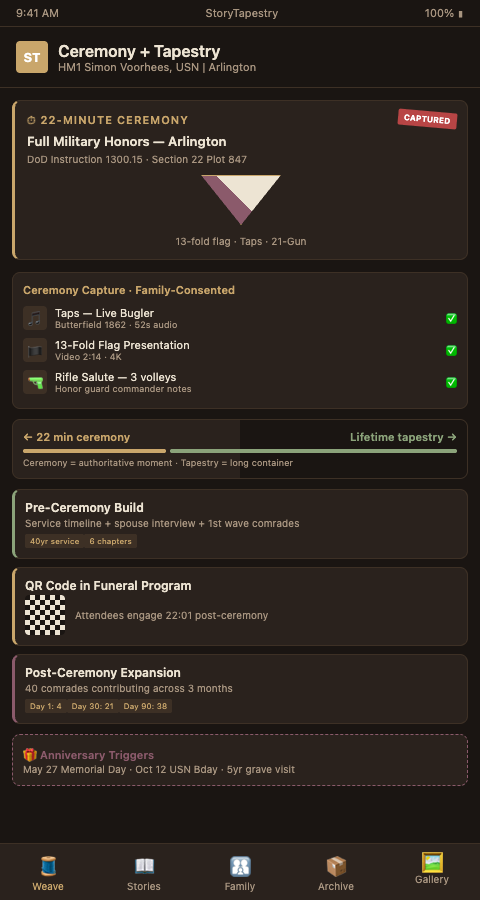
StoryTapestry treats traditional military honors as the authoritative ceremonial moment and the digital memorial tapestry as the long-form companion. The platform does not replace the flag folding, the Taps, the gun salute, or the presentation of the folded flag. It provides the long container that holds everything the 22-minute ceremony cannot, and the two together form the complete memorial.
The first framework element is ceremony capture. With family consent, the platform records the military honors ceremony (audio of Taps, video of flag folding and presentation, the honor guard's movements) and stores the capture as a permanent chapter of the tapestry. Ten or twenty years later, grandchildren who were three years old at the graveside can see exactly what the ceremony looked like, not reconstruct it from family memory. Arlington and most VA national cemeteries permit family recording with standard restrictions, and the platform handles the metadata and rights capture automatically.
The second element is pre-ceremony tapestry building. In the days and weeks between death and funeral, the family and coordinator build out the tapestry's initial chapters: service timeline, family photographs, a first wave of comrade contributions, and structured interviews with the surviving spouse or closest family member. The tapestry provides a QR code linkable from the funeral program, so attendees at the graveside and reception can engage with the longer story immediately after the ceremony. The pre-ceremony build pairs with interactive service timelines workflows that surface DD-214-based chapters quickly, leaning on the interactive service timeline engine to populate chapters from a single DD-214 upload.
The third element is post-ceremony expansion. The tapestry explicitly grows after the funeral. The 40 comrades who couldn't travel to the graveside contribute stories remotely over the following three months. The civilian colleagues who didn't attend the military-honors ceremony add post-service chapters. The children go through the attic and scan the photographs and letters they didn't know existed. The military photo timelines workflows surface archive photographs that complement the family cache. The tapestry becomes a living document that grows throughout the first year and persists across decades.
The fourth element is anniversary and reunion integration. Traditional military memorials sometimes include annual commemorations: Memorial Day ceremonies at the grave, wreath-laying, and unit-specific anniversary events. The tapestry supports anniversary-specific additions (a photo from this year's Memorial Day ceremony, a story from a unit reunion that the family attended in the veteran's honor). The memorial does not freeze in the year of death. It continues to gather material as long as family members and comrades want to contribute.
The fifth element is the static-versus-living comparison. Families sometimes ask whether a traditional printed memorial book is enough or whether they need a digital tapestry. The honest answer is that both serve functions the other cannot: a printed book is tactile, unchangeable, and survives power outages; a living tapestry grows, accommodates newly surfaced material, and reaches family members who cannot physically hold the book. The framework supports families who want both, with the printed book drawing on the tapestry's content at a specific snapshot moment. This parallels static vs digital memorials considerations in other memorial contexts where tactile and digital modes each carry distinct value.
Advanced Tactics: Funeral Director Coordination, Chaplain Integration, and Long-Arc Anniversary Planning
Memorial programs balancing traditional military honors with digital tapestries need three tactics beyond the baseline framework.
The first is funeral director coordination. Funeral directors handling veteran services typically coordinate the military honors request through the appropriate service branch casualty assistance office, handle cemetery logistics, and publish the formal obituary and funeral program. Memorial program coordinators adding tapestry infrastructure should partner with the funeral director rather than running parallel workflows. StoryTapestry offers a funeral director partnership module that handles QR code placement in the funeral program, tapestry staging before the service, and reception hall tapestry display without burdening the funeral director with additional operational tasks. Funeral directors who pilot the partnership typically integrate it as standard for subsequent veteran clients.
The second tactic is chaplain and honor guard integration. Honor guards rotate in and out of ceremonies, and the chaplain who officiates may not be the one who handled pre-funeral pastoral care. The tapestry supports contributions from chaplains and honor guard commanders who want to add the ceremonial context to the memorial: notes on why specific honors were rendered, reflections from the chaplain's homily, and context on the honor guard's own connection to the unit where applicable. The integration turns the 22-minute ceremony into a chapter with context rather than a single recorded clip.
The third tactic is long-arc anniversary planning. Families often struggle with anniversaries: the first Memorial Day after death, the first unit reunion where the veteran is commemorated, the five-year anniversary of burial. The tapestry supports anniversary planning with a reminder system that drafts commemoration suggestions (visit the grave, contribute a story from this year, participate in a specific unit event), and a contribution workflow that captures the commemorative moment for the tapestry. Long-arc planning reduces the common pattern where the tapestry gets intense attention in the first three months and then goes dormant for years.
Coordinate Ceremony-Plus-Tapestry Veteran Memorials with StoryTapestry
Veteran memorial programs partnering with funeral homes, VA national cemeteries, and military honors coordinators use StoryTapestry to complement traditional military honors with digital tapestries that hold what the 22-minute ceremony cannot. Schedule a coordinator consultation to review your current funeral integration and bring a recent memorial where the gap between ceremony and life-story was visible. Programs adopting the complementary framework typically see family satisfaction rise because the ceremony feels sufficient to its purpose rather than inadequate to the whole task. Reach out through the StoryTapestry program coordinator portal to begin ceremony-plus-tapestry integration for your next veteran memorial.
The consultation covers the funeral director coordination workflow, the chaplain integration protocol that weaves the chaplain's remarks into the tapestry, the long-arc anniversary planning framework that extends the ceremony's meaning into five-year and ten-year observances, and a review of three sample memorials showing how the 22-minute ceremony and the digital tapestry reinforce each other. Pilot engagements include ceremony-plus-tapestry onboarding for your two lead coordinators and one funeral director partner, a supervised first-memorial deployment with a named implementation specialist present at the service, and a 60-day family satisfaction audit against the baseline. Most programs begin running ceremony-integrated intake on their next veteran memorial within 14 days of the consultation.
Bring your lead coordinator, one family-services director, and one funeral director or VA cemetery director — the consultation produces a shared ceremony-and-tapestry runbook the three of them can execute at the next service.